
Written by Iryna Ilyuchyk & Tanjid Hossain
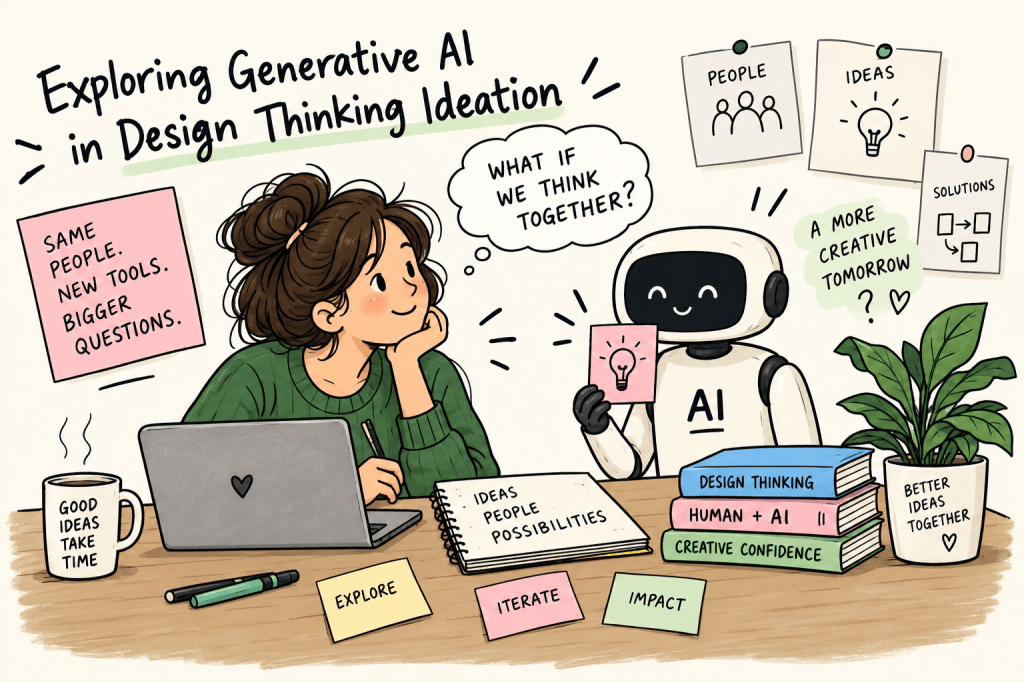
During our Design Thinking workshop, Katja Tschimmel introduced the idea of Design Thinking 4.0, where humans and AI work together in the creative process. We agreed not to use AI during ideation. We first explored the problem and generated ideas ourselves, while AI was allowed later, during prototyping.
One idea that stayed with us was that the first ideas are often the most obvious ones. Katja Tschimmel encouraged us to keep exploring and generate many alternatives before choosing a direction. This connects closely with Kelley and Kelley’s (2013) Creative Confidence, where creativity is presented not as a special talent, but as something we can develop through practice, experimentation and action.
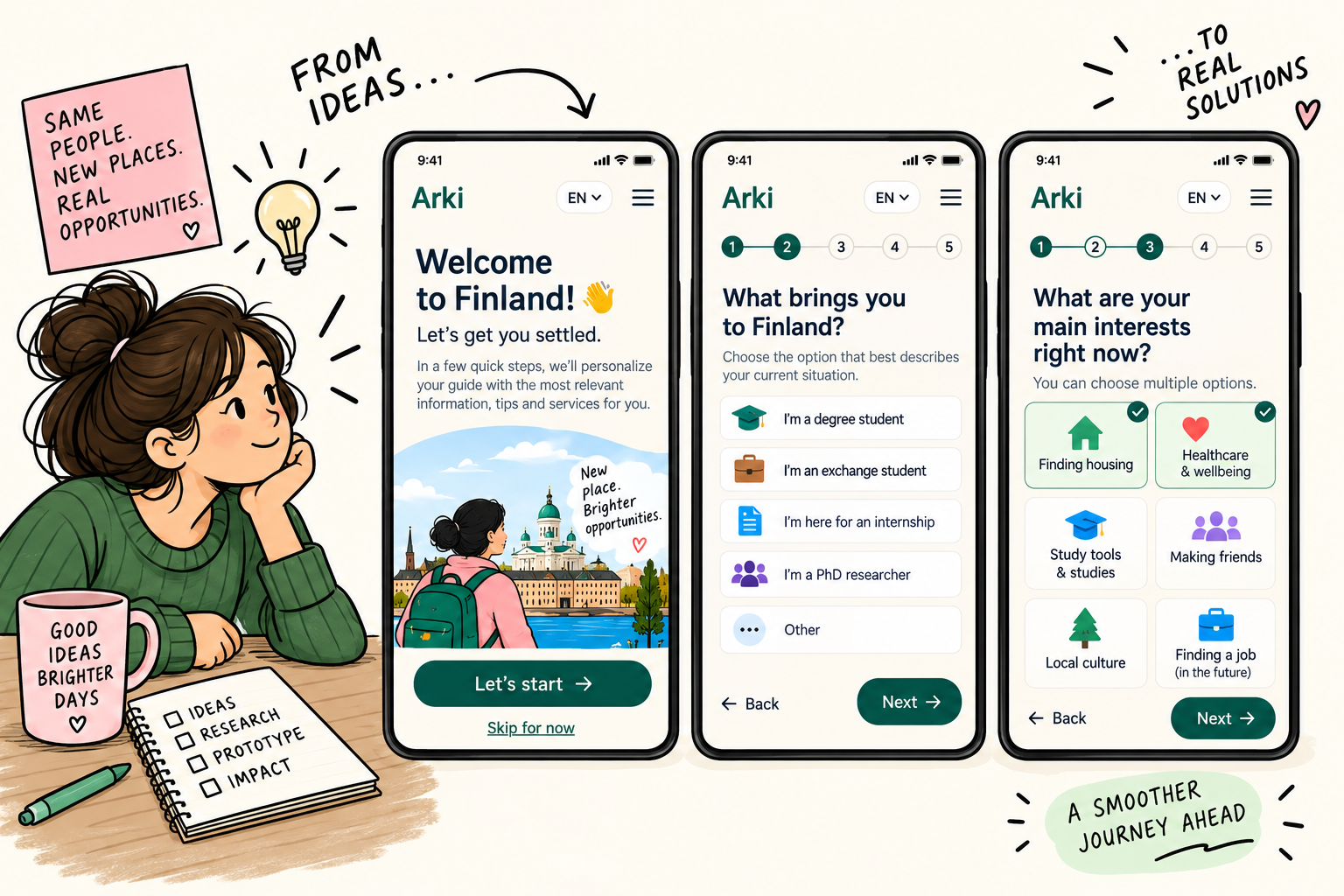
When we finally used AI for prototyping, its advantage was obvious: speed. It helped us work faster and turn our ideas into something tangible in a short time. But this made us wonder: what would happen if we brought AI into the process earlier, during ideation? Could it help us discover possibilities we would otherwise miss, or would it simply make the process faster? And could it even narrow our thinking?
More Ideas, Wider Thinking?
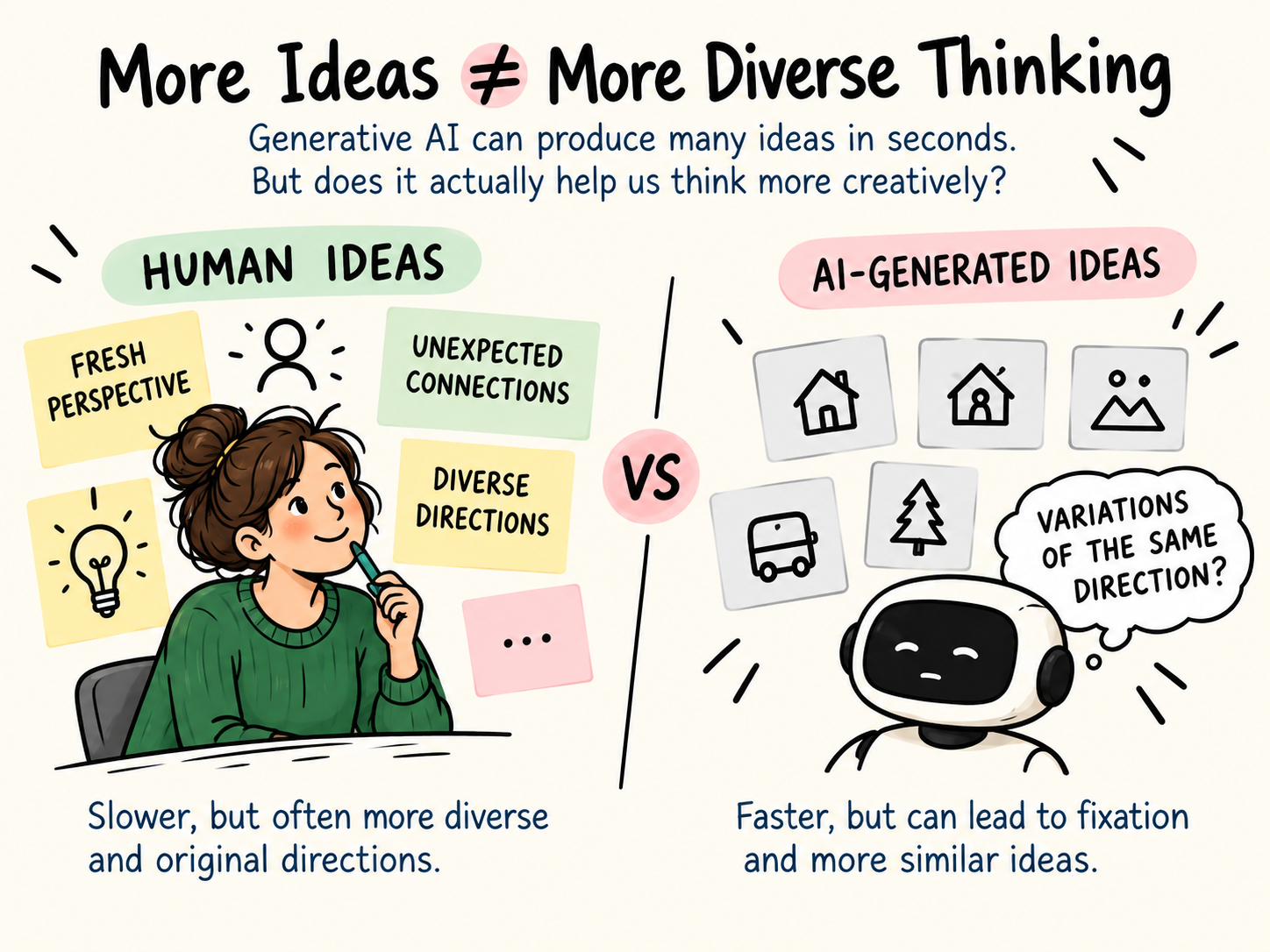
At first, Generative AI seems like a perfect ideation partner. It can produce dozens of ideas in seconds. However, more ideas do not necessarily mean more diverse thinking.
Wadinambiarachchi et al. (2024) found that exposure to AI-generated images could increase design fixation. Participants exposed to AI produced fewer ideas, with less variety and originality. Instead of expanding the solution space, AI could pull their thinking towards the examples it had already provided.
Baltà-Salvador et al. (2026), however, paint a more nuanced picture. Their study found no overall reduction in fluency, flexibility or originality when students used AI. Yet AI-assisted ideas showed lower semantic divergence and tended to resemble existing products more closely. Interestingly, early experience with AI could also support originality and diversity in later human-only ideation. Together, these studies show that the effects of AI on ideation are not straightforward. Generating ideas quickly does not necessarily mean exploring a wider range of possibilities. How we interact with AI may be just as important as whether we use it.
The risk of fixation is not limited to AI. Our teacher Virpi Kaartti also mentioned a similar concern about presenting high-fidelity prototypes too early. A polished prototype can make an idea feel more final than it really is, making it harder for the team and stakeholders to question it. Perhaps AI does not create the tension between speed and depth, it simply makes that tension more visible.
Mixed Findings. What Should We Do Differently?
The studies do not give us a simple yes-or-no answer. Instead, they suggest that the way we introduce and interact with AI deserves careful attention.
The findings leave us with practical choices about how to organise our work.
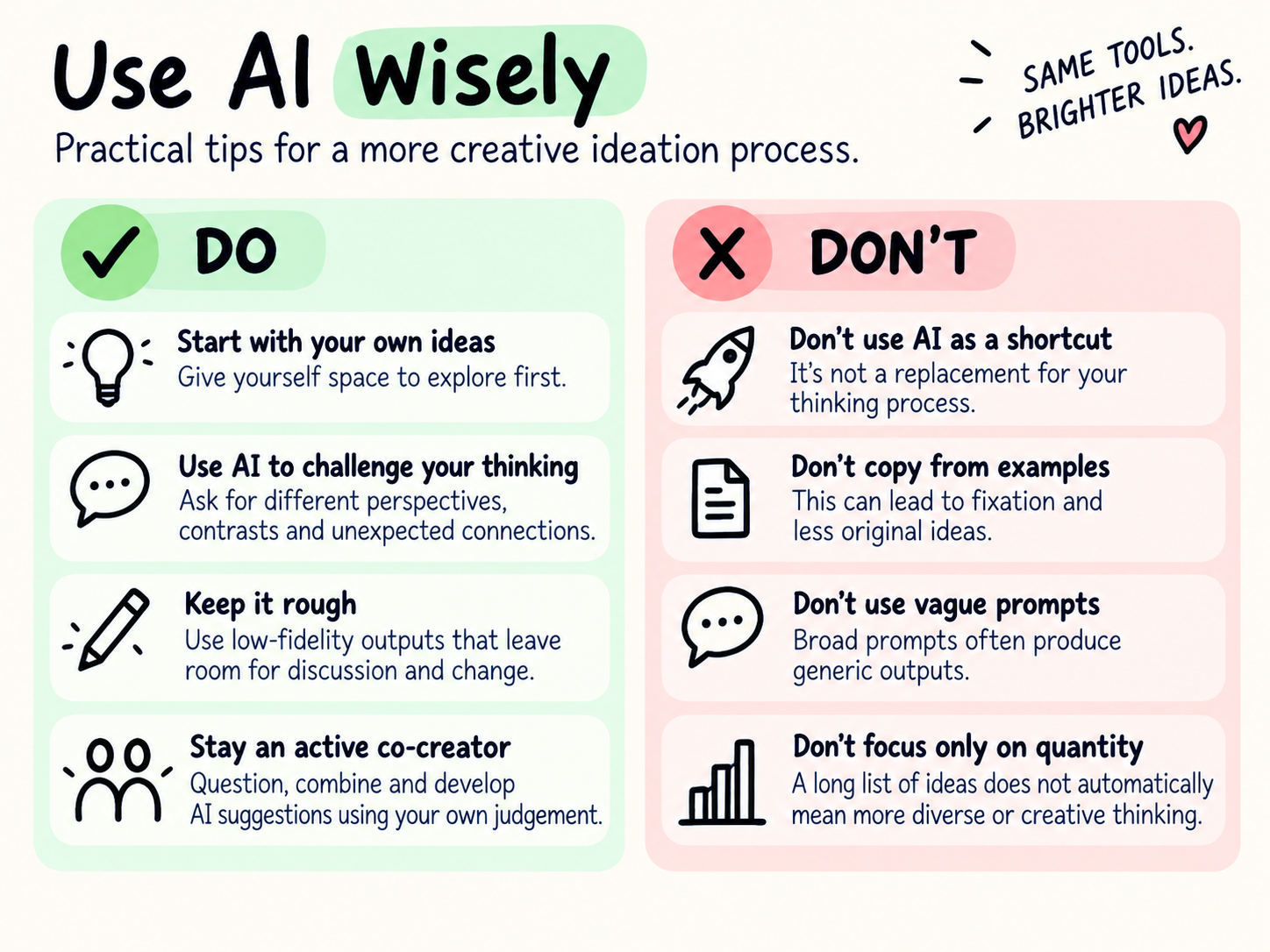
- Think first
Develop our own ideas before introducing AI. Give ourselves space to explore without external examples. - Challenge your thinking
Ask AI for different perspectives, not just more ideas. Use contrasting scenarios, unexpected connections and visual analogies to move beyond familiar solutions. - Keep it rough
Avoid polishing early concepts too quickly. Use rough sketches or low-fidelity AI outputs that leave room for interpretation, discussion and change. - Stay an active co-creator
Question, combine and develop AI suggestions. Use your own judgement rather than simply selecting from ready-made answers.
AI can support collaboration and accelerate parts of the process, but human judgement remains essential. We still need to understand users, evaluate ideas and decide which possibilities are worth exploring.
Perhaps the future of Design Thinking is not about choosing between human creativity and AI. It is about learning when AI should help us move faster and when we should slow down and think for ourselves.
References
Kelley, D. & Kelley, T. (2013) Creative Confidence: Unleashing the Creative Potential Within Us All. Crown Business. http://www.creativeconfidence.com
Baltà-Salvador, R., Brasó-Vives, E., & Peña, M. (2026). Evaluating AI-assisted creative ideation: A crossover study in higher education. Thinking Skills and Creativity, 59, Article 101958. https://doi.org/10.1016/j.tsc.2025.101958
Wadinambiarachchi, S., Kelly, R. M., Pareek, S., Zhou, Q., & Velloso, E. (2024). The effects of generative AI on design fixation and divergent thinking. In Proceedings of the CHI Conference on Human Factors in Computing Systems (Article 380, pp. 1–18). Association for Computing Machinery. https://doi.org/10.1145/3613904.3642919
Tschimmel, K. (2026). Slides Masterclass design thinking: Laurea 2026
Figures
All images were created using ChatGPT, with some based on original photographs and screenshots from our Design Thinking workshop.


Leave a Reply