Who can be a designer?

Reflections on empathy and inclusion in the design field

By Rosa Yang and Stinne Vognæs


Neither of us are designers, so what does it mean to do a part-time service design degree as an adult? Will we ever be able to claim the “title” or “identity” of a Designer? After our first two-day workshop on design thinking, we reflected on the role of designers, and where we fit in all of this. 

This topic has sparked debate among scholars, practitioners and the business world. Johansson-Sköldberg, Woodilla and Çetinkaya (2013, 123) have divided this into two distinct discourses. One being “designerly thinking” which connects theory and practice from a design perspective and is centred around the academic field of design. The other is “design thinking” which applies design methods especially in business and management. It is seen as a tool for creative problem solving for those without formal design background. 

The business world has been criticised for turning design thinking into a simplified tool kit, making it accessible to anyone for problem solving and driving profit (Mootee 2013,30).

For example, IDEO is moving towards social innovation, but they were created as a product innovation company. How does this impact their approach in the social innovation field? However, big corporations have the power to drive change. Thus, shouldn’t we focus on empowering them to do so, rather than taking sides? A company’s greatest assets are its people, and meaningful change begins with us. 

One of the key concepts in Design Thinking is empathy. Instead of focusing on who can and cannot use these concepts, we will utilise the four phases of empathy by Kouprie and Visser (2009, 445) to share how we experienced our first Design Thinking workshop. 

The image shows a pink piece of paper with the text: Europe in Bloom: Cultivating democracy through diversity. How can we design an interactive experience to teach young Europeans about the richness of cultural diversity, democracy and the value of linguistic coexistence?
This was our challenge for the day: Europe in Bloom: Cultivating democracy through diversity.

Discovery

We arrived curious to expand our knowledge and explore the new possibilities of Design Thinking. We discovered that we indeed come from various backgrounds; academic, design, business and social science. Different perspectives presented an opportunity, enabling us to learn from each other. 

Immersion

We all left our current jobs for two days and entered the world of a design thinker. Data collection started immediately since the two-day workshop provided many diverse insights. We were pulled into the design thinking world and started the absorption. 

Some of our takeaways were:

  • Don’t jump to conclusions based on what we want to be true. 
  • We need to actively listen and invest time to understand others’ feelings and how our own feelings can either expand or limit the possibilities of the solution. 
  • It is important to stay long enough in the problem-framing phase and not fall into stereotypes. 
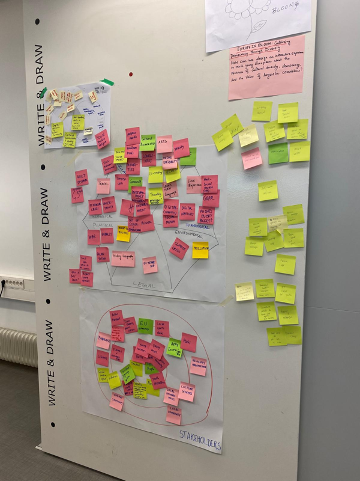
The picture shows flipcharts and papers put up on a white wall. They are full of colorful post-its with ideas on them.
Brainstorming, suspending judgment and finding inspiration is key to design thinking.
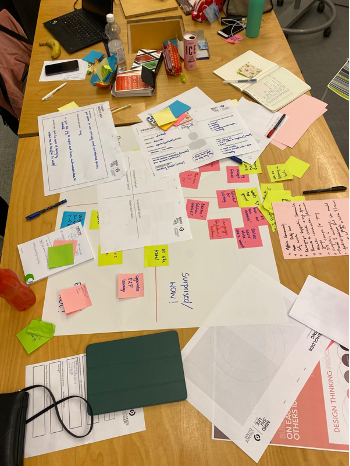
The picture shows a table full of papers, post-its and pens.

Connection 

Once familiar with the principles, methods and tools, the reflection process started. How could we connect the learnings with our own experience? We realised that these tools are applicable and essential, even in small doses to solve complex problems in our own work with multiple stakeholders. 

As Kelley & Kelley (2013) argue in their book; everyone is creative and can apply design thinking and tools to their unique interests and fields. This does not mean that everyone is a designer. Sometimes, approaches like design thinking become tools and methods, removed and detached from their fields. But is that a bad thing? 

Innovation and creativity are so essential in today’s work to solve wicked problems; and all stakeholders need to be included. If we use design thinking to ensure that, isn’t that a good thing? 
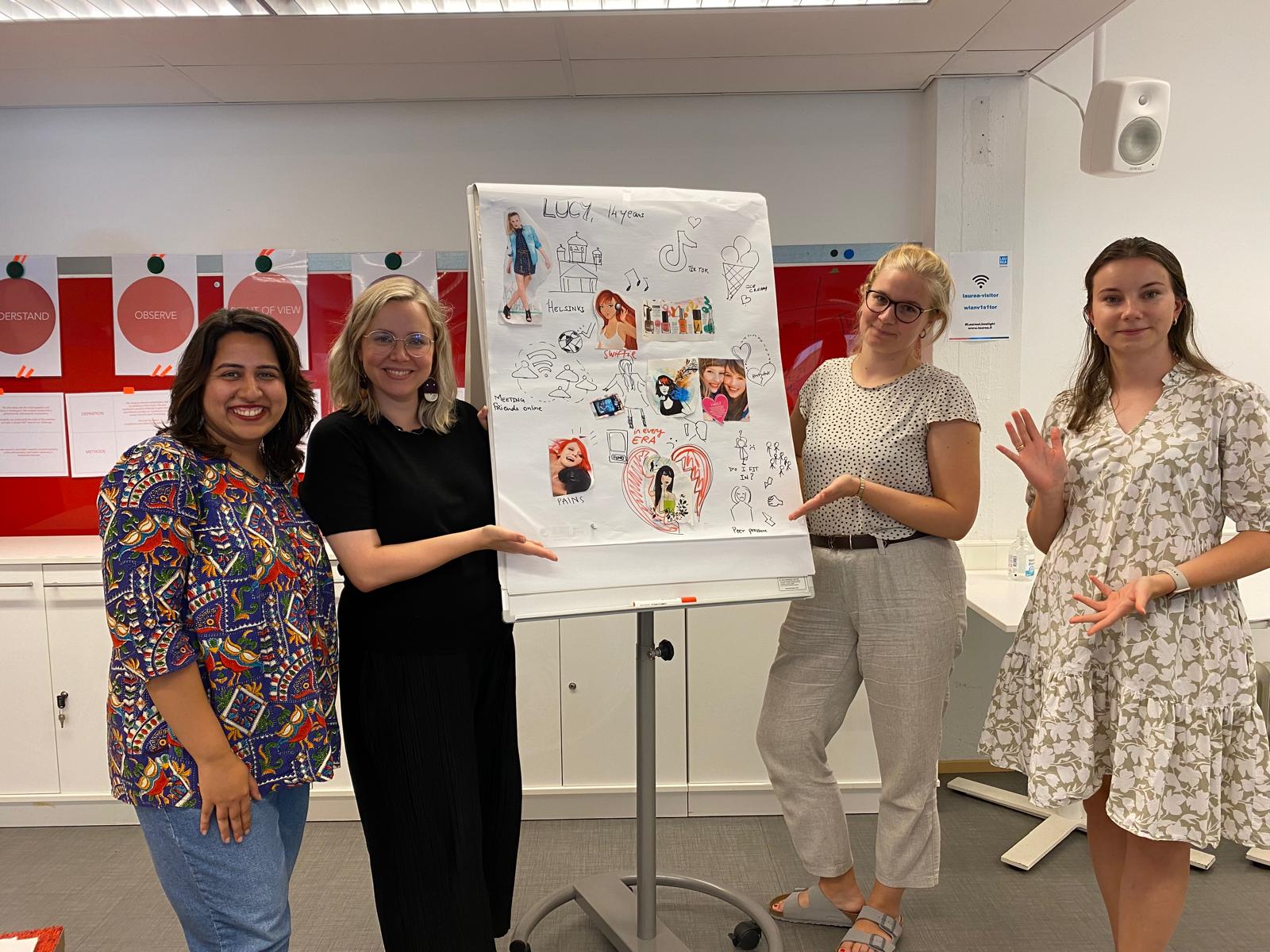
A picture of our team, Namrati, Rosa, Stinne, and Judyta standing in front of our flipchart with Lucy, the persona we created for the challenge.
Teamwork makes the dream work! Our diverse team members and experiences added lots of value and lessons learned in our journey to create a solution that would work for our persona, Lucy.

Detachment

In the end we had to come back to ourselves. Living in the shoes of a designer and testing out the methods was done for this time. So what were we able to take away?

Coming back from the class, we stepped back into our “regular” professional identities. 

We were reflecting on what our relation is with design and the role of designer. Small actions and opportunities emerged that could already impact our work. It left us wondering, shouldn’t we foster an inclusive design environment? If these tools help make us more aware of others’ needs, empathetic, and inclusive isn’t that good? 

References:

Comments

4 responses to “Who can be a designer?”

  1. terokauppinen Avatar
    terokauppinen

    Hi Rosa and Stinne! Thank you for your valuable contribution to the SID blog.

    I enjoyed the reflection about what design thinking is from the perspective of your everyday lives and work. You bring up several interesting points in your post that I would like to comment on.

    From the two presented, I prefer the discourse of design thinking as a method in business to solve problems by Johansson-Sköldberg et al. (2013, 123). It is a useful definition to keep in mind. After all, as you bring up later in the blog post Kelley and Kelley (2013) argue that everyone is creative and can apply design thinking tools. Ultimately, the purpose of organizations is to solve problems of all sizes. I don’t think we should exclude any people from being involved in solving problems.

    I happened to also read the Creative Confidence book for this assignment. I think a few takeaways I’d like to add to your contemplations on design thinking and empathy would be the following:

    • “Empathy in creativity and innovation means to see an experience from another person’s eyes and to recognize why people do what they do” Kelley and Kelley (2013). I think having this end-user empathy is crucial, if we want governments and businesses to start better serving individuals, communities, and even the environment.
    • I believe a lack of empathy can lead to horrible business decisions and political policies. To add to why it is so important that design thinking is incorporated as widely as possible, I’ll finish with a quote of Mark Twain’s from the book: “It’s not what you don’t know that gets you in trouble, it’s what you know for sure that ain’t so” Kelley and Kelley (2013). 
  2. katjaraisanen Avatar
    katjaraisanen

    Thank you for the blog text, which brought well together learnings and experiences of Design thinking workshop session and readings. The crucial role of empathy cannot be overemphasised, which was also well noted on your blog post e.g. in applying the four phases of empathy by Kouprie and Visser (2009, 444). In all of these stages designer’s and user’s relation changes and more profound understanding may happen. I believe with applying the four phase framework to analyse our design thinking session deeper understanding happened. With empathy, as Tim Brown states, the bridges of insight can be build, with the effort to see the world through the eyes of the others (2019, 56).

    I also find the reflection on the differences between design and design thinking fruitful. The blog encourages to use design thinking methods regardless of different backgrounds and industries. I think the blog ends with a key idea: Could design thinking be one of the approaches to increase inclusiveness?

  3. atlasriatson Avatar
    atlasriatson

    Hi Rosa and Stinne! Thank you for the great text. This blog post provides a thoughtful reflection on the evolving role of designers, particularly for individuals without a formal design background. The question of whether engaging with Design Thinking qualifies them as “designers.” Tim Brown’s argues in Change by Design (2009), that Design Thinking isn’t exclusive to traditionally trained designers. Brown describes it as an approach that empowers people from all fields to creatively solve complex problems, which you have demonstrated effectively in your post.

    Your analysis of the two perspectives—“designerly thinking” and “design thinking”—is insightful. As you mention, the business world has embraced this approach, sometimes reducing it to a toolkit, but as Brown (2009) suggests, this accessibility fosters innovation across industries, allowing everyone to contribute meaningfully.

    The focus on empathy as a core principle of Design Thinking is crucial and well-explored here. Your emphasis on Kouprie and Visser’s empathy phases, as they help you step into the users’ shoes, leading to more thoughtful solutions. This empathy-driven design with your experiences of the contact days is a great insight.

    In conclusion, your reflection thoughtfully summarize Design Thinking as a collaborative and inclusive process.

  4. showmenrudra1 Avatar
    showmenrudra1

    It’s not only late, too late to write. Anyway, I read many of the writings of my classmates, and you people discuss them casually and present them very well. Thanks, Rosa and Stinne.  

    Regardless of formal design training, first of all, I support the notion that everyone can use design thinking tools, as you said. Applying creativity, empathy, and problem-solving abilities is what design thinking is all about, so individuals from a variety of backgrounds may participate in the design process. Authors Kelley & Kelley (2013) said that everyone has the capacity for creativity and can use design thinking in different ways. These are mainly helpful in the modern world, where a variety of viewpoints are needed to solve such complex issues. Creativity and empathy are qualities that are useful in a variety of professional tasks, not only those that are officially called “designers.”

    The most significant aspect of empathy in design thinking is something I also concur with you on. The importance of attentively listening to others and comprehending their emotions is emphasized in a two-day lecture. This component of design thinking can aid in the development of more efficient and inclusive solutions. Designing with empathy allows us to consider people’s action needs, which improves the solution of difficult, “wicked” situations—as you mention.

    But I do not think that just because someone uses design thinking, they are a designer. Moreover, design thinking is such a useful tool; there are other aspects to being a designer besides using these techniques. Out there, the design thought process; designers provide specialized knowledge, like an awareness of aesthetics, technical proficiency, and user experience. Although design thinking is a useful tool, it cannot take the place of skilled designers.

    The question of who is entitled to use the term “designer” is a significant one. While many people can contribute to problem-solving through design thinking, I think a designer needs to be able to do more. In the business realm, design thinking has occasionally been streamlined and transformed into a toolbox, making it accessible to anyone, as noted by Mootee (2013). But this can result in oversimplification, ignoring the actual breadth of design expertise.

     I agree with you that anyone can use design thinking to find innovation and compassionate solutions to challenges. It is an effective instrument for encouraging creativity and diversity. However, it’s important to note that being a designer encompasses more than simply applying design thinking. A professional designer’s job is more multipart because they have specialized knowledge in fields like functional and aesthetic. Although anyone may use design thinking, it should be viewed as a tool to enhance rather than replace the work of professional designers.

Leave a reply to atlasriatson Cancel reply