

Reflections on empathy and inclusion in the design field
By Rosa Yang and Stinne Vognæs
Neither of us are designers, so what does it mean to do a part-time service design degree as an adult? Will we ever be able to claim the “title” or “identity” of a Designer? After our first two-day workshop on design thinking, we reflected on the role of designers, and where we fit in all of this.
This topic has sparked debate among scholars, practitioners and the business world. Johansson-Sköldberg, Woodilla and Çetinkaya (2013, 123) have divided this into two distinct discourses. One being “designerly thinking” which connects theory and practice from a design perspective and is centred around the academic field of design. The other is “design thinking” which applies design methods especially in business and management. It is seen as a tool for creative problem solving for those without formal design background.
The business world has been criticised for turning design thinking into a simplified tool kit, making it accessible to anyone for problem solving and driving profit (Mootee 2013,30).
For example, IDEO is moving towards social innovation, but they were created as a product innovation company. How does this impact their approach in the social innovation field? However, big corporations have the power to drive change. Thus, shouldn’t we focus on empowering them to do so, rather than taking sides? A company’s greatest assets are its people, and meaningful change begins with us.
One of the key concepts in Design Thinking is empathy. Instead of focusing on who can and cannot use these concepts, we will utilise the four phases of empathy by Kouprie and Visser (2009, 445) to share how we experienced our first Design Thinking workshop.

Discovery
We arrived curious to expand our knowledge and explore the new possibilities of Design Thinking. We discovered that we indeed come from various backgrounds; academic, design, business and social science. Different perspectives presented an opportunity, enabling us to learn from each other.
Immersion
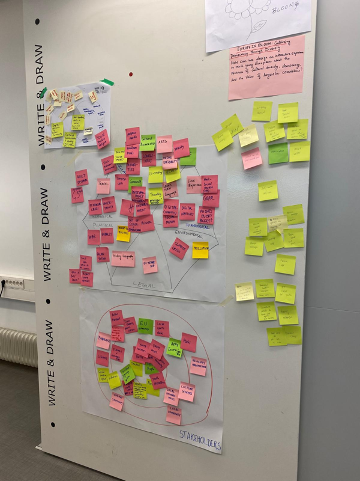
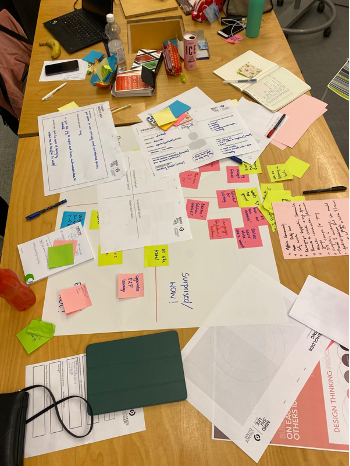
We all left our current jobs for two days and entered the world of a design thinker. Data collection started immediately since the two-day workshop provided many diverse insights. We were pulled into the design thinking world and started the absorption.
Some of our takeaways were:
- Don’t jump to conclusions based on what we want to be true.
- We need to actively listen and invest time to understand others’ feelings and how our own feelings can either expand or limit the possibilities of the solution.
- It is important to stay long enough in the problem-framing phase and not fall into stereotypes.
Connection
Once familiar with the principles, methods and tools, the reflection process started. How could we connect the learnings with our own experience? We realised that these tools are applicable and essential, even in small doses to solve complex problems in our own work with multiple stakeholders.
As Kelley & Kelley (2013) argue in their book; everyone is creative and can apply design thinking and tools to their unique interests and fields. This does not mean that everyone is a designer. Sometimes, approaches like design thinking become tools and methods, removed and detached from their fields. But is that a bad thing?
Innovation and creativity are so essential in today’s work to solve wicked problems; and all stakeholders need to be included. If we use design thinking to ensure that, isn’t that a good thing?
Detachment
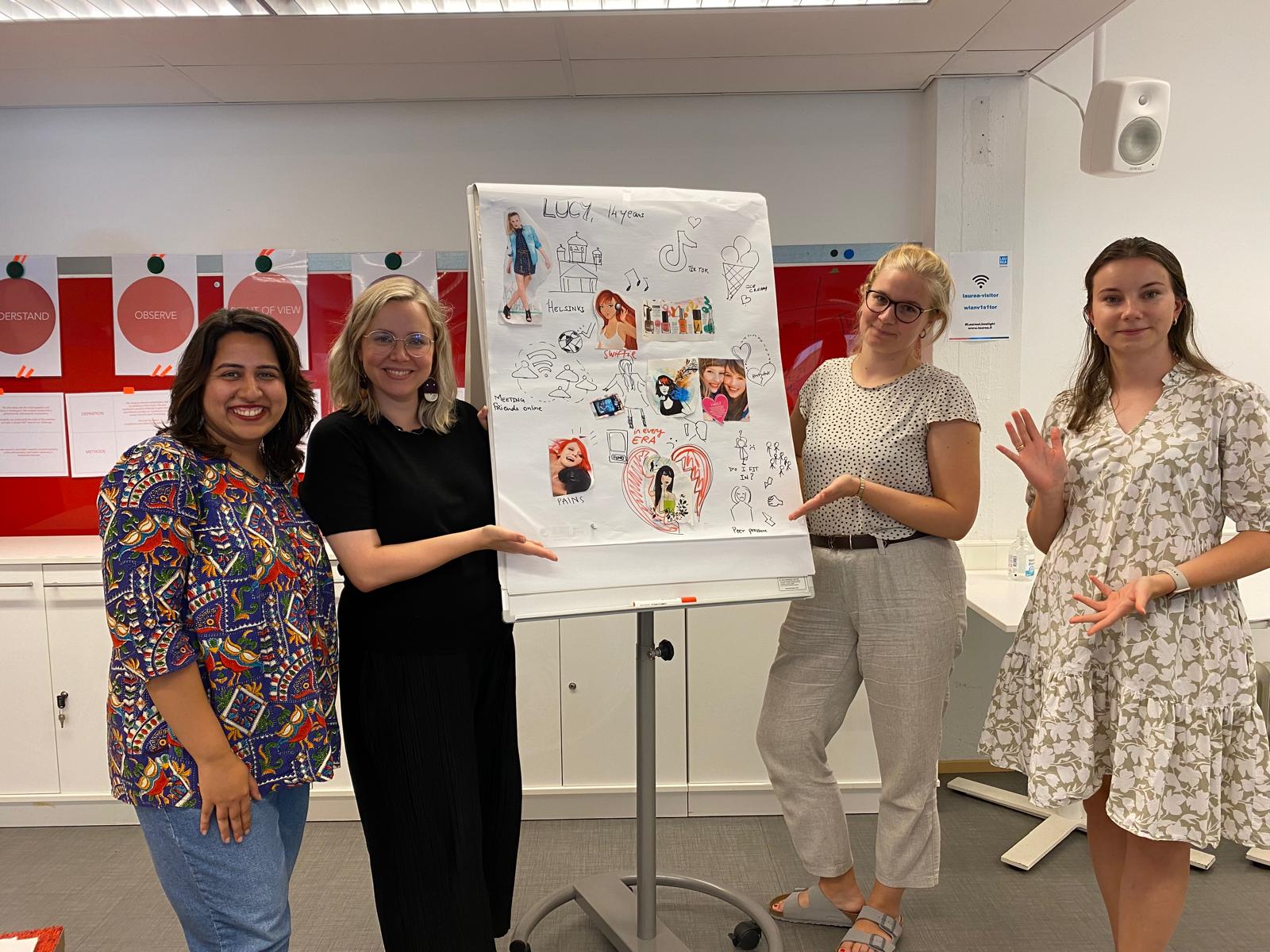
In the end we had to come back to ourselves. Living in the shoes of a designer and testing out the methods was done for this time. So what were we able to take away?
Coming back from the class, we stepped back into our “regular” professional identities.
We were reflecting on what our relation is with design and the role of designer. Small actions and opportunities emerged that could already impact our work. It left us wondering, shouldn’t we foster an inclusive design environment? If these tools help make us more aware of others’ needs, empathetic, and inclusive isn’t that good?
References:
- Johansson-Sköldber, U., Woodilla, J. and Çetinkaya, M. (2013). Design Thinking: Past, Present and Possible Future Creativity and Innovation Management, Vol. 22, Nr. 2. 121-146.
- Kelley, D. & Kelley, T. (2013) Creative Confidence: Unleashing the Creative Potential Within Us All. Crown Business.
- Kouprie, M & Sleeswijk Visser, F. (2009) A framework for empathy in design: stepping into and out of the user’s lifeLinks to an external site. in Journal of Engineering Design Vol. 20, No. 5, October 2009, 437–448
- Moote, I. 2013. Design Thinking for Strategic Innovation : What They Can’t Teach You at Business or Design School. John Wiley & Sons, Incorporated. Accessed 27.9.2024. https://ebookcentral.proquest.com/lib/laurea/reader.action?docID=1358566&query=Design+Thinking+for+Strategic+Innovation+%3A+What+They+Can%27t+Teach+You+at+Business+or+Design+School.


Leave a reply to katjaraisanen Cancel reply