
Written by: Sagar Shrestha and Rupa Kumari Thapa
1.Introduction
The contact sessions held on 1–2 October 2026 provide an opportunity to explore how this approach can be applied in practice. Are you sure the “idea” currently in our mind is the best we can do? How will we implement those ideas to design a service or a product? When do we test it? These are the questions we explored during our Design Thinking masterclass at Laurea with Prof. Elif Oztekin.
2. Learning through design thinking
Design thinking is to understand people’s needs before finding solutions. Sometimes, our first idea may not solve the real problem. Therefore, we should ask questions, listen to others, and learn from their experiences.
During our 2 contact sessions, group discussions and practical activities helped us share ideas and understand problems from different perspectives. We learned that team work and feedback can help us improve our ideas. We should be open to changing our ideas when we discover better solutions.
3.The design thinking process
As shown in the picture that offer a practical structure for understanding problems and developing possible solutions, although teams may move backwards and forwards between them. We had followed these steps from problem to solution.
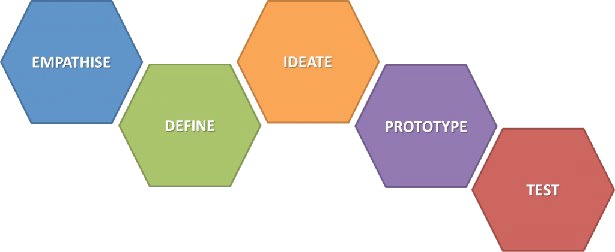
Step 1: Empathize — Understand people through listening, observation, and conversations.
We the Extreme Group start to interview one of the members of the groups. Others were busy at questioning and noting down.
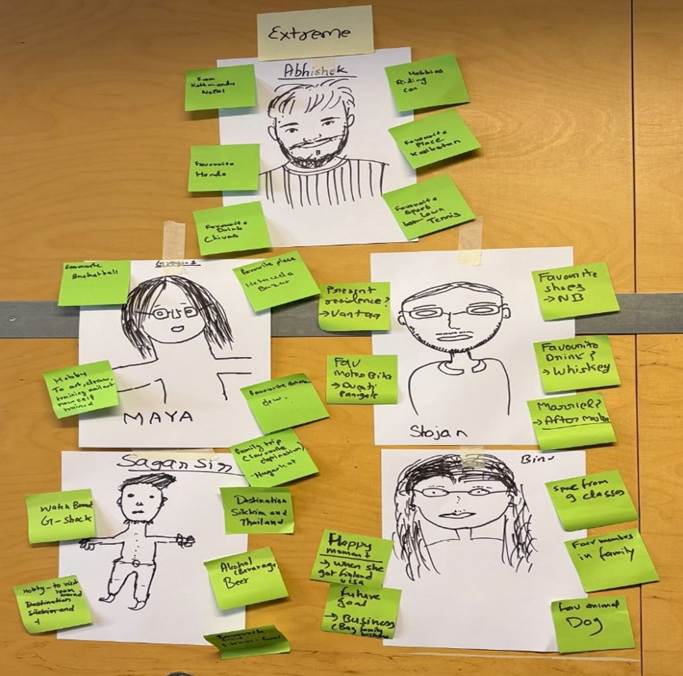
Step 2: Define — Identify the problem and solved through based on research.
As being an applicant, the interviewee had to wait quite long for his visa. After VFX his boss asked him to resign the job. After that, he was totally in dilemma either to start a new journey in Nepal or still wait for Visa?
Secondly, after receiving visa what will be the real challenges as being international students in Finland? What are the basic things the student should do after arriving at Finland?
This was the main problem for us or Wicked Problem. Wicked Problem is a social, cultural, or policy problem that is impossible to solve because it has incomplete, contradictory, and constantly changing requirements.
Step 3: Ideate — Generate a wide range of creative and diverse solutions before selecting a promising direction
The real challenges were searching a room, convenient way to travel, best place to buy groceries and stuff, get remedy from home sickness and get motive to entertain, searching a job, get HSL discount card.
Step 4: Prototype — Make ideas tangible that can be explored and improved.
In this context, Extreme Group began to emerge as an innovative approach to addressing these challenges. As we know Innovation refers to the introduction of a new idea, method, product, or service that provides practical value or solves a problem. After different brainstorming the group find the below solutions
It was better to wait for visa rather to start anything in Nepal. The best solutions were
– to tell the truth to family members and ask to support his monthly expenses
– research more about Finland rules, news and on many things.
-get some training like Barista, Hair Cutting, Driving, Cooking and so on.
The solution after getting visa were
– all the required documents like Passport, Residence Permit, driving license, Study and Experience Certificate, NOC letter are to be kept along with before travelling.
– what to pack not to pack before travelling. How to book HOAS room from online?
– pick-up service from airport, teaching the convenient way to travel, use the HSL app and step for DVV registration process, police card and bank account.
– use of WhatsApp and Messenger, making more friends, explore different mart and compare the price.
Step 5. Test — Put prototypes in front of real users, gather and learn from feedback
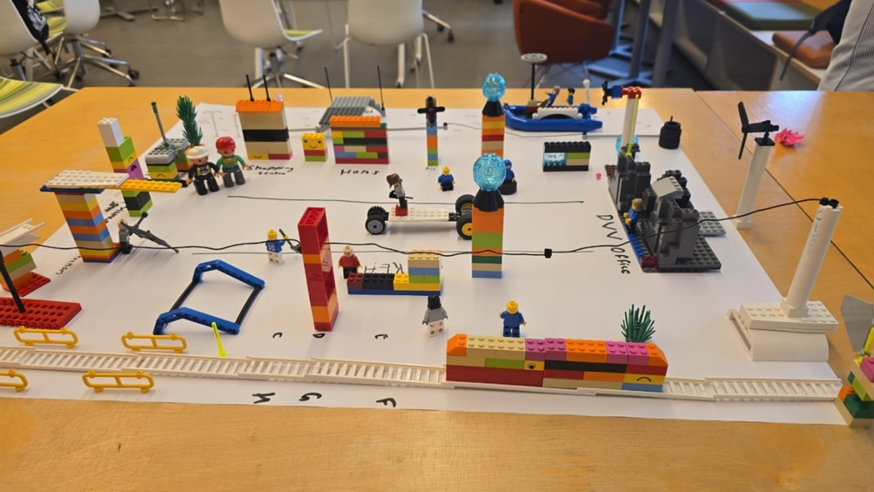
Finally, we converted our ideas into reality through hands-on prototyping. Using Lego bricks and other materials, we created a 3D model of our service. This helped us understand user journeys and identify key touchpoints. Working together, we tested ideas, found problems, and improved our solutions.
4. Conclusion:
In conclusion, design thinking is a flexible approach to solving problems and creating new ideas. It focuses on understanding people’s needs and experiences. In academic sector, it helps students think creatively and work in a team. In business, it helps companies understand customers and improve products and services. However, its success depends on how it is used. Continued practice and research can help improve its use in different fields.
References:
i) Design thinking as an effective method for problem‑setting and need finding for entrepreneurial teams addressing wicked problems
-Rahmin Bender‑Salazar
ii) Design Thinking: Past, Present and Possible Futures
-Ulla Johansson-Sköldberg, Jill Woodilla and Mehves Çetinkaya


Leave a Reply