
By Shila KC & Annamari Sandlund
Starting point: Seeing things from different perspectives
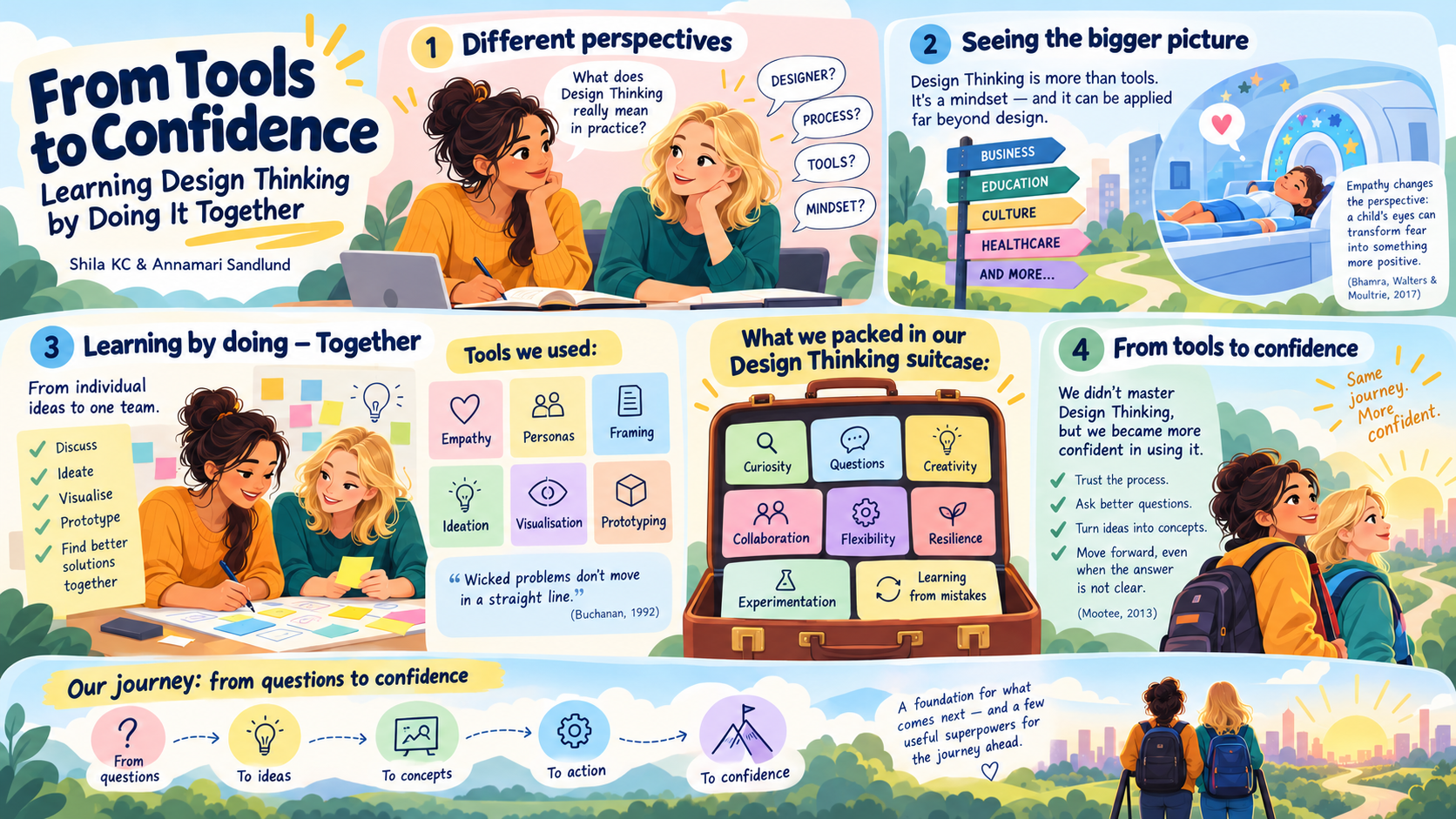
When we walked into our first Design Thinking course, we came from different professional, cultural and educational backgrounds. We also had different ideas about what Design Thinking was. Shila associated design mainly with designers and physical products, while Annamari expected it to be mostly a process supported by different methods and tools. We were both asking the same question: What does Design Thinking really mean in practice?
Already on the first day, Design Thinking became more concrete through examples and hands-on exercises. Exploring its evolution was also one of our first key learnings. We started to understand that Design Thinking is more than a set of tools, and Johansson-Sköldberg et al. (2013, 131) made a similar point. Seeing Design Thinking as a mindset also helped us understand why it can be applied far beyond traditional design fields. Tschimmel (2026) also pointed out that innovations are adopted more slowly in fields such as education and culture. This broadened our view how Design Thinking can support new approaches in those fields.
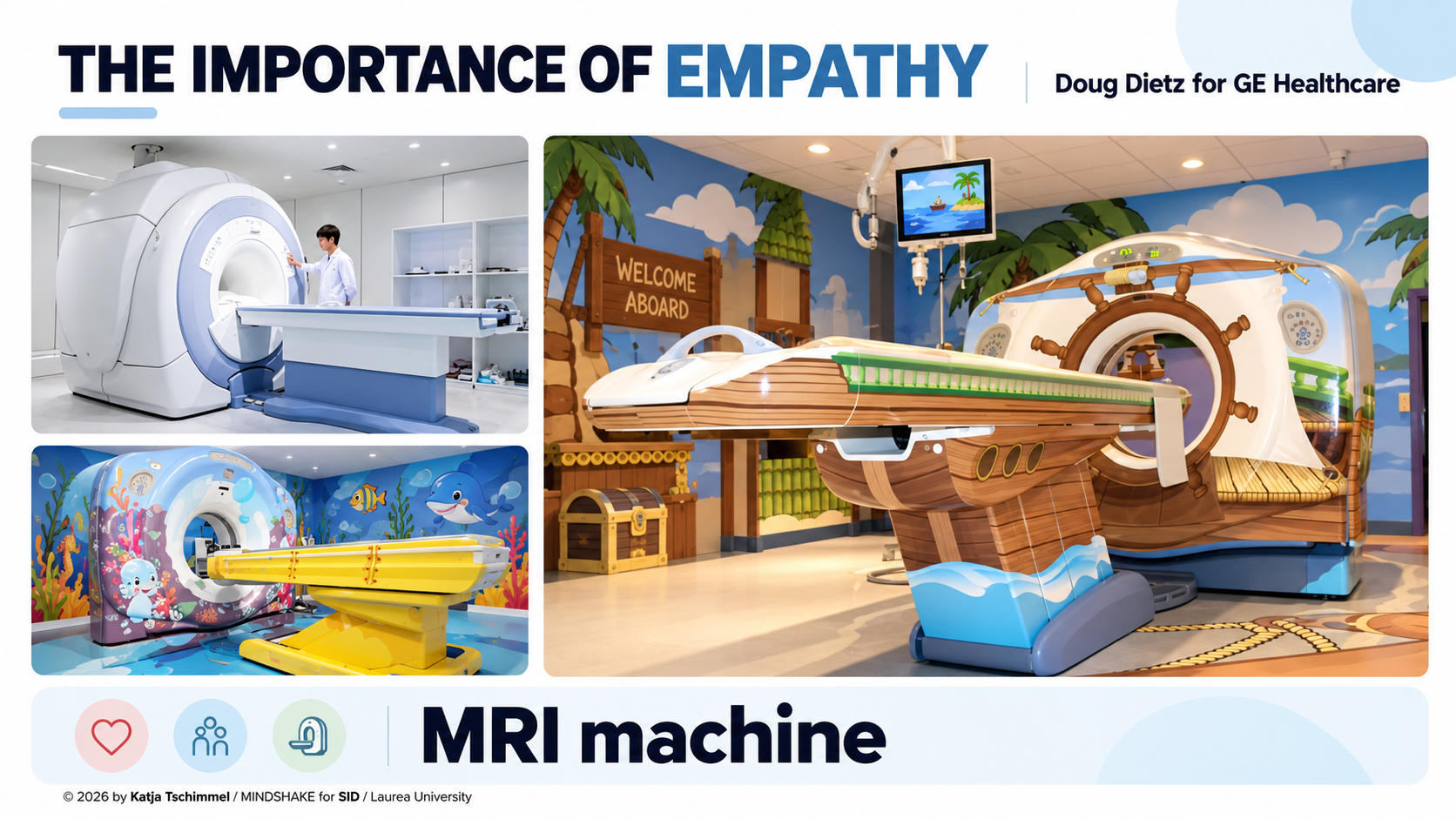
For Shila, one example stayed especially clear: Doug Dietz’s redesign of the MRI experience for children. Hospitals may buy machines, but the patients are the real users. Looking at the situation through a frightened child’s eyes showed how a technically functioning solution can still fail from a human perspective. It made empathy more concrete: good design starts with understanding who the real user is, how they experience a situation, and where design thinking can create the most value. The same idea is supported by (Bhamra, Walters & Moultrie 2017, 209) which explains that service design places emphasis on understanding users’ experiences and empathizing with them at different points of interaction.
Learning by doing – Together
Our own teamwork gave us another lesson. We started as individuals with different perspectives, but through discussions, ideation, visualization and prototyping, we gradually became one team. We learned that the first idea is rarely the final or best one. For Annamari, one of the biggest shifts was learning to trust the process instead of trying to find the right solution too quickly. We had to ask question after question, challenge assumptions and sometimes go back before moving forward.
Different methods helped us move from broad questions towards more concrete ideas. Semantic confrontation pushed us to combine seemingly unrelated ideas and explore something new. Framing, personas, ideation, visualization and prototyping helped us make our thinking visible and gradually find a shared direction. Buchanan’s (1992, 15) discussion of wicked problems also helped us understand why the process did not always move forward in a straight line. Experimenting, making mistakes and trying again started to feel like part of learning, not something to avoid.
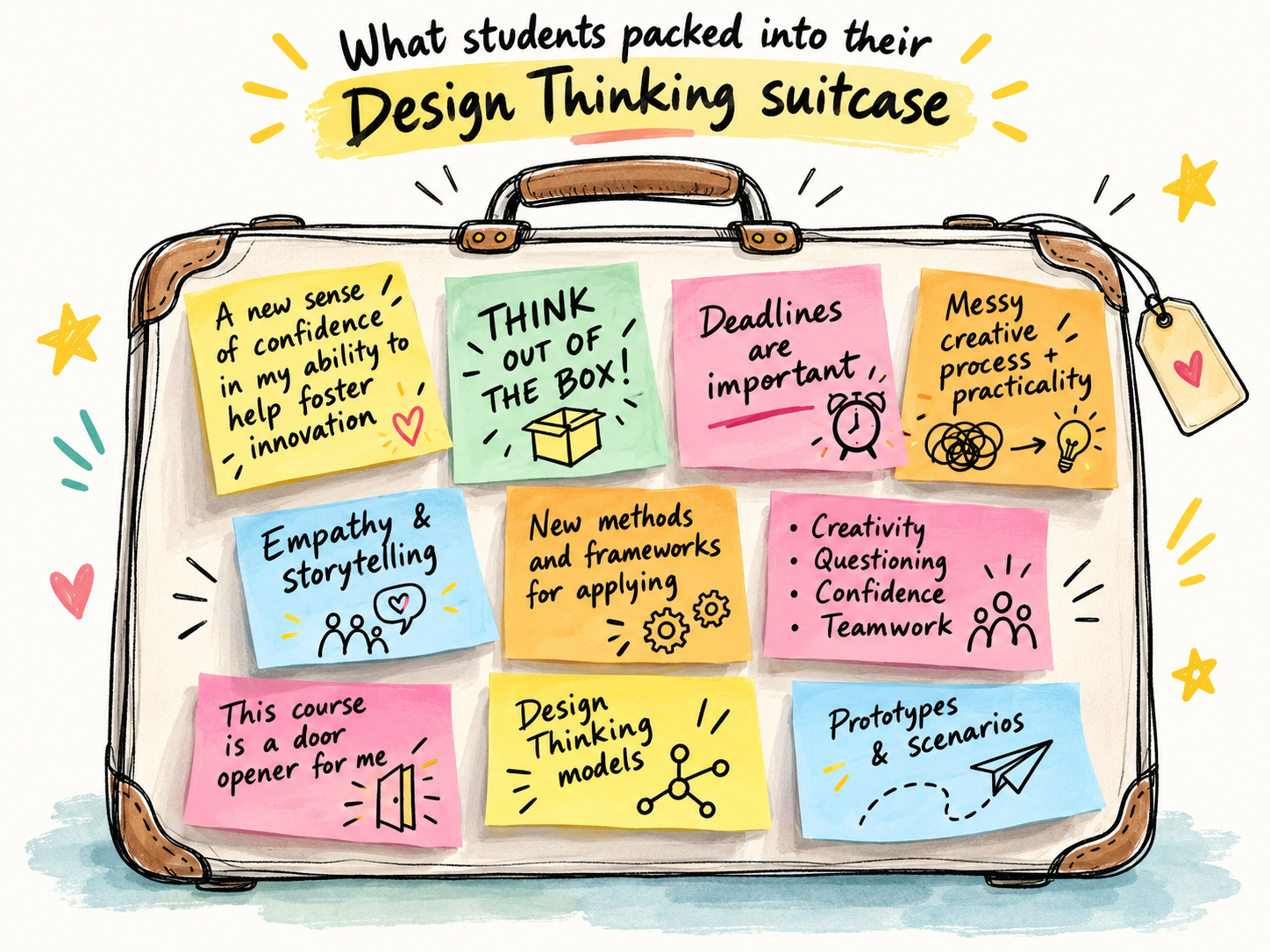
Students’ reflections on the most important learnings from the course.
From tools to confidence
By the end of the course, we had not mastered Design Thinking, but we had become more confident in using it. We learned to trust the process, ask better questions, turn ideas into concepts and move forward even when the answer was not clear. Mootee (2013, 66–69) also helped us understand how making ideas tangible and experimenting can turn uncertainty into learning.
And perhaps that is why Design Thinking was our first course. It gave us a foundation for our SID studies – and hopefully a few useful superpowers for whatever comes next in our working lives.
References
- Bhamra, T., Walters, A.T. & Moultrie, J. 2017. The potential of service design as a route to product service systems. In: Sangiorgi, D. & Prendiville, A. (eds.) Designing for service: key issues and new directions. London: Bloomsbury Publishing.
- Buchanan, R. 1992. Wicked problems in design thinking. Design Issues, 8 (2), 5-21. https://doi.org/10.2307/1511637
- Johansson-Sköldberg, U., Woodilla, J. & Çetinkaya, M. 2013. Design thinking: past, present and possible future. Creativity and Innovation Management, 22 (2), 121-146. https://doi.org/10.1111/caim.12023
- Mootee, I. 2013. Design thinking for strategic innovation: what they can’t teach you at business or design school. Hoboken: Wiley. Accessed 28 September 2026. https://laurea.finna.fi/Record/nelli01.2550000001111847
- Tschimmel, K. 2026. Design thinking masterclass at Laurea UAS. [lecture]. Held on 4-5 September. Laurea University of Applied Sciences.
Visuals
Header and summary images created with AI based on our prompts. Suitcase image created with AI based on our original photo. MRI image: Doug Dietz for GE Healthcare, presented in Katja Tschimmel’s Design Thinking Masterclass material.


Leave a Reply