Beyond the Sticky Notes: What Design Thinking Actually Means Today

Written by Nirmal Shrestha & Kiran Timalsina

Have you ever questioned why certain businesses are able to repeatedly develop goods that go off perfectly with consumers? This success often comes down to a well-known trendy phrase: Design Thinking. But what does this idea really mean? In order to figure out how this idea is both appreciated and criticized in the modern world, we shall eliminate the corporate terms.

Start With People, Not Technology

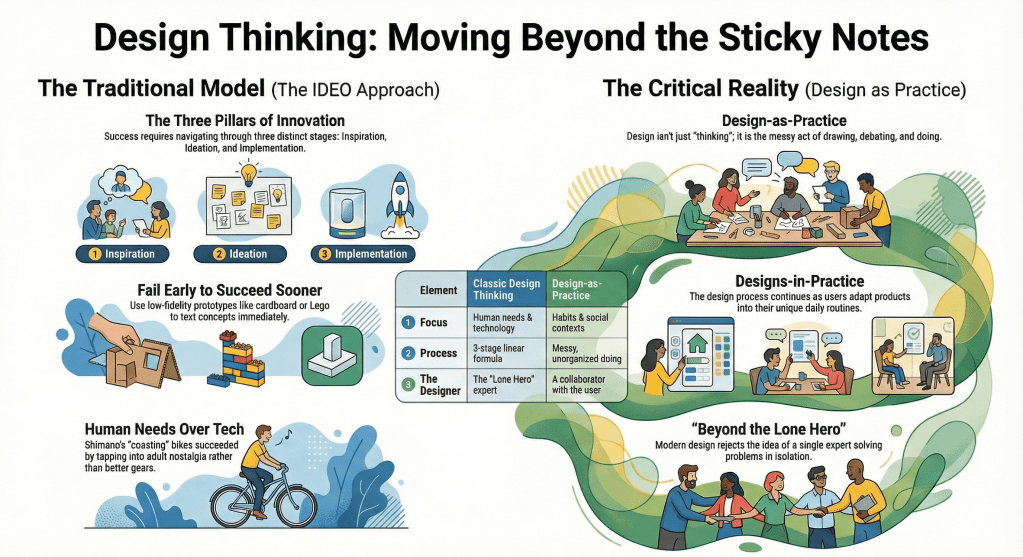
Design thinking is a method of problem-solving that prioritizes human needs, according to Tim Brown, CEO of the design firm IDEO. Design thinkers begin by observing, listening, and searching for needs that people haven’t even stated yet in the actual world, rather than creating a brand-new technology and hope that people would use it. A great example: when bike company Shimano wanted to grow its sales, IDEO didn’t just engineer better gears. They talked to people and discovered that many adults simply missed the carefree joy of riding a bike as a child. That insight led to a whole new category of “coasting” bikes and a big commercial success.

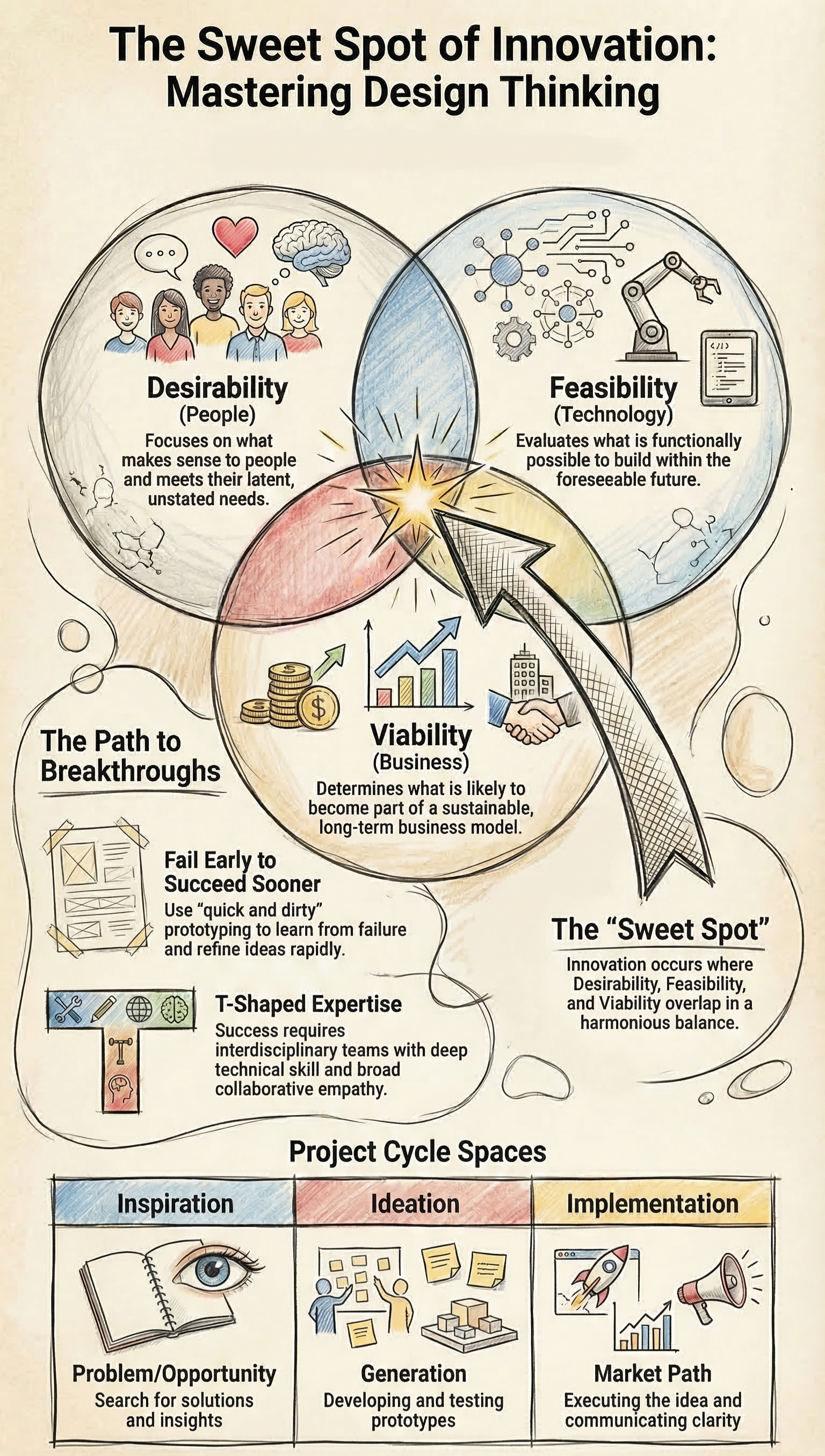
Brown breaks the process into three stages:

  • Inspiration: understanding the real problem.
  • Ideation: coming up with bold, unexpected solutions.
  • Implementation: bringing the idea to life.

One important guideline is to quickly create basic prototypes. Paper, cardboard, Lego whatever makes a concept immediately tested. The exact principle is “Fail Early To Succeed Sooner”
But Wait, Is It That Simple?

Design researcher Lucy Kimbell introduces a different perspective, proposing that we should slow down and reconsider this view. Kimbell observes that the business world has taken on design thinking like it were a perfect, balanced formula for coming up with fresh concepts. She argues that this popular way of thinking has a serious blind weakness in that it views the designer as a lone hero who gets involved, quickly recognizes everyone’s viewpoint, and resolves the issue on their own. Additionally, it artificially isolates “thinking” about ideas from “doing” the labor, completely ignoring how disorganized and unpredictable the process is in practice.

Design Is What People Actually Do

Kimbell encourages us to look at real-world, contextually specific habits rather than focusing just on the thought processes of experts. She offers a few ideas to help explain how design really happens:

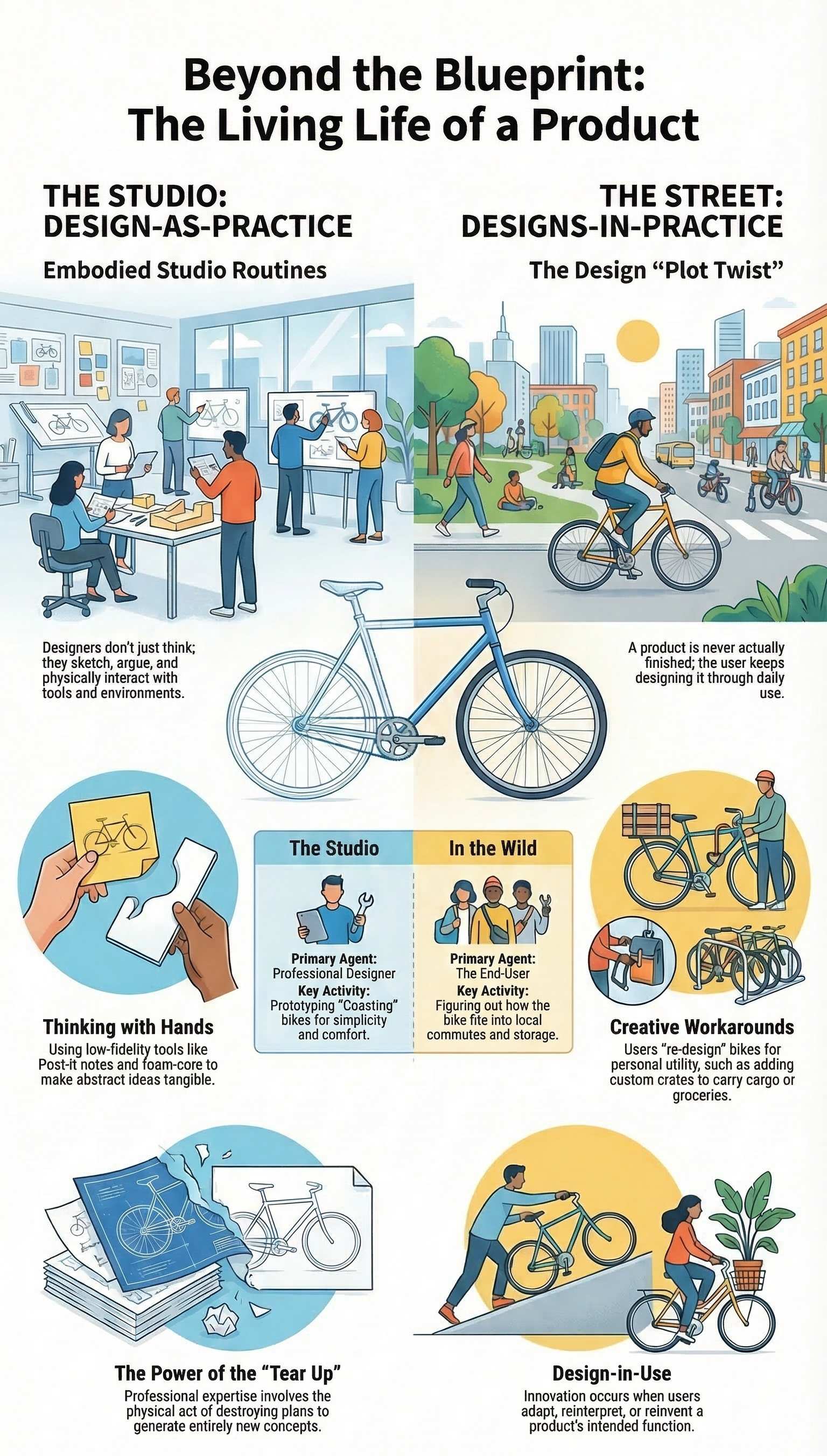
  • Design-as-Practice: Instead of just thinking, designers draw, debate, re-organize, and work with actual tools and environments.
  • Designs-in-Practice: The design is not truly complete once it departs from the manufacturing facility. The final consumer continues the “design” process by determining how to implement the item into their daily routines.
Conclusions

Design thinking is not a simple, pre-made checklist that can be applied to any company. It is a continuous, complex cooperative effort. While it undeniably depends on understanding users and building rapid models, it also demands the recognition that regular individuals utilizing these items possess the same amount of creative influence as the trained experts. The sticky notes on the whiteboard are just the beginning.

References & Links:

Comments

4 responses to “Beyond the Sticky Notes: What Design Thinking Actually Means Today”

  1. mih00322 Avatar
    mih00322

    I really enjoyed reading this blog post! I like how you highlighted the difference between the simplified corporate view of design thinking and the more nuanced, real-world approach that Lucy Kimbell suggests. I have also read her articles and can relate to this perspective. The Shimano example clearly shows how understanding human emotions and needs can lead to innovation beyond just technical improvements.

    I also appreciate the emphasis on design-as-practice and designs-in-practice, it is a good reminder that users play a crucial role in shaping products, not just designers. It made me reflect on how my last company relied too heavily on structured processes like sticky notes and workshops, forgetting that actual doingand user engagement are equally important.

    Overall, this post does a great job of showing why design thinking is both a mindset and a hands-on process, not just a checklist.

  2. bharatgautam844f5194b8 Avatar
    bharatgautam844f5194b8

    Your blog is clear, engaging, and does a great job contrasting Tim Brown’s optimistic view of design thinking with Kimbell’s more critical perspective. However, the reflection stays mostly theoretical, and the post would benefit from connecting these ideas to a concrete example or personal experience from your own design process. Right now, the arguments are strong but feel detached from practice.

    You also present Kimbell’s critique well, but you could deepen the analysis by explaining how her ideas challenge or complicate Brown’s three‑stage model rather than simply presenting them side by side. Adding one specific tension, limitation, or real‑world implication would make your conclusion more impactful. Overall, it’s a well‑written piece that could be even stronger with more applied reflection and clearer synthesis between the two viewpoint.

  3. nikeshthapa91e50c80d5 Avatar
    nikeshthapa91e50c80d5

    Dear Friends,

    Your discussion on design thinking in the 21st century provides a clear perspective on how organizations approach innovation today. I particularly appreciate how you began by raising thought and questions, as it effectively captures the reader’s attention.

    Firstly, the example of Shimano makes this idea clearer, as it demonstrates how focusing on human experiences rather than on technology can lead to meaningful and successful innovation. This shows how well design thinking is connected to human centred approach.

    Additionally, your thoughts about “fail early to succeed sooner” was more convincing to me. The importance of prototyping, experimenting and learning is important for better outcomes. I also find your post on design thinking as an ongoing practice rather than a one time process. By recognizing the fact that design continues even after a product reaches to its end users.

    Moreover, your point that design thinking can be complex and challenging, yet capable of solving bigger organizational problems. My personal suggestion is that design thinking is future oriented process and including it connecting it with today’s context would be more meaningful.

    Overall, your blog present design thinking as a ongoing human oriented process that is most essential in today’s changing world.

  4. sab00075 Avatar

    I state your blog post as a guide or a reminder of Kimbell’s thoughts on Design thinking. You start the blog and give a sweet business-related example of how Design is everyone’s daily need in the service sector. And I agree with you that through the design we can make more benefits, make the service more flexible, comfortable, and easily accessible to the public.

    However, Lucy Kimbell argues that design thinking is often oversimplified in the business context. Kimbell offers and encourages us to look at real-world, context-specific habits rather than focusing solely on experts’ thought processes. Design as practice and Design in practice. In my point, design is not just a thinking but also a practice, ongoing activities shaped by tools, environment, and users. Design is complex, but it is today’s need in every new path

Leave a reply to nikeshthapa91e50c80d5 Cancel reply