The Courage to Share Rough Ideas: Why Prototyping Drives Innovation

Written by Marin Anita & Sarker Md Saddam Hossain 

In most workplaces, and even in everyday life, we are under pressure to deliver ready and polished solutions. However, Design Thinking shows us a counterintuitive paradox: incomplete prototypes, messy drawings, crude models, rapid mock-ups — this is where magic happens.

Prototyping is not just a design tool. It is an act of human courage that unlocks creativity and fuels innovation. 

The Human Side of Prototypes 

A design culture is nurturing. It doesn’t encourage failure, but the iterative nature of the design process recognizes that it’s rare to get things right the first time. 

Kolko, J. (2015). Design Thinking Comes of Age

At the heart of prototyping are people, not perfection. Kolko reminds us that a true design culture is nurturing, and that progress does not come from waiting until something feels complete.

MIT Media Lab’s “Demo or die” is the perfect reflection of this: an idea does not quite exist until it is brought to life. A sketch or a quick demo create a human connection, that you never find in a polished report. Providing something rough is not a weakness, it is the spark that inspires others to enter.

While Apple is known for its big successes, its history also includes less successful products such as the Newton tablet, the Pippin game console, and the Copland operating system (Kolko, J., 2015. Design Thinking Comes of Age). These efforts were not disasters but part of the company’s learning curve. Each of them showed, that progress comes from trying again and again.

Prototypes as Conversation Starters 

GE’s Greg Petroff explains how teams are abandoning “comprehensive product specifications.” Rather, they learn by doing — prototyping, iterating, and pivoting. IBM makes use of similar practices to transform ideas into conversations (Kolko, J., 2015. Design Thinking Comes of Age). 

This aligns with what is called the Tangibility Rule: making ideas visible changes the way we think (Plattner, Meinel, & Leifer, 2011, Design Thinking: Understand – Improve – Apply, p. XV). A prototype is not a technical object standing alone, it is a story in progress. Each sketch or model is an invitation to conversation and co-creation.

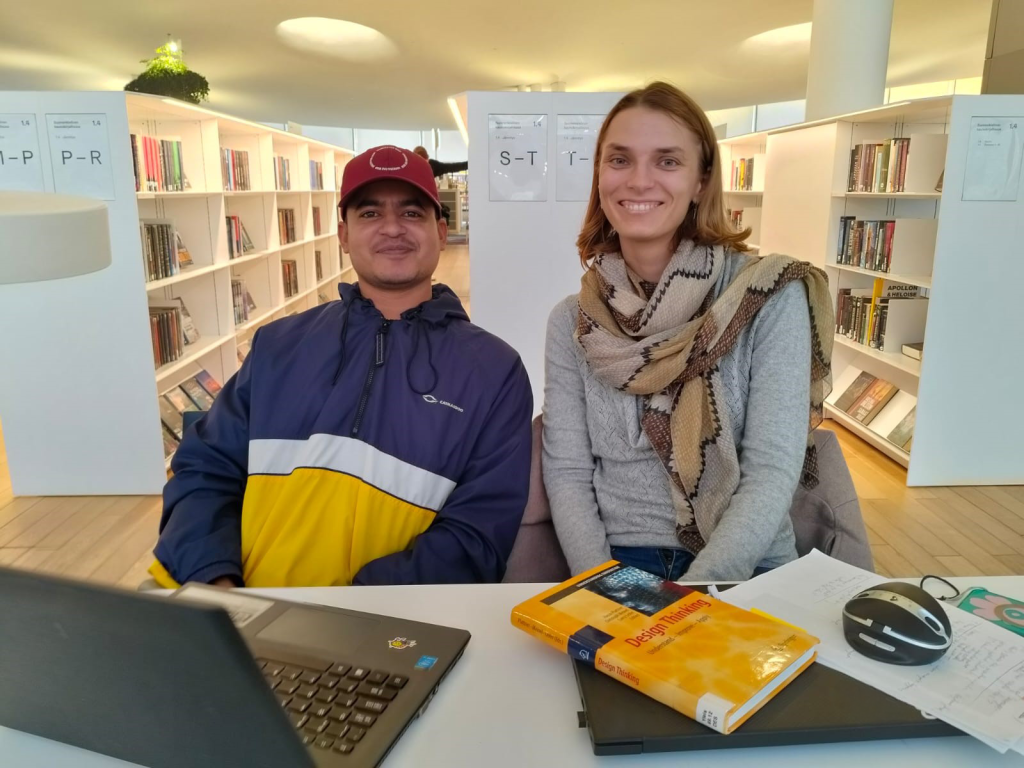
Hesa team draw portraits and learned more about each other 

The Courage to Go First

Prototyping is an act of bravery. It is a way of saying, “I do not have every answer, but I am willing to try.” The next time you have an idea, resist the urge to wait until it feels perfect. Sketch it. Mock it up. Share it. Remember, that innovation begins when someone is willing to show something incomplete and invites others to shape it into something greater. 

Hesa team getting ready to present the first low-fidelity prototype

References

Comments

8 responses to “The Courage to Share Rough Ideas: Why Prototyping Drives Innovation”

  1. baonguyen88846a90cc Avatar
    baonguyen88846a90cc

    Thanks for this inspiring blog post! I like how you framed prototyping not just as a design tool but as an act of courage. The part about messy sketches and rough mockups being the spark that invites others, it shifts the mindset from “getting it right” to “getting it started”

    I also like the examples of Apple’s early failures. It shows that the most successful company in the world grow through trials and errors, which makes the process feel more human and less intimidating. The Tangibility Rule you guys mentioned is something I often notice in my daily work as a visual designer too, once you have an idea and it became visible, even in a very rough form, it opens up space for collaboration and feedback.

    I think innovation does not come from perfection, but from having the courage to put your ideas out there and let others help you to shape it.

    1. anita.marin Avatar

      I am glad the message about the courage in prototyping resonated with you. Innovation indeed starts when we are dare to start, not when everything is perfect.

  2. mallika.kauppinen Avatar
    mallika.kauppinen

    I appreciate the message here that it encourages people to try out and to understand that being imperfect is part of the process that later leads to innovation. I got inspired not be afraid of sharing an unfinished piece of work with others. I suddenly realised – how can a product be developed when we have no ideas what it looks like? In my view, how perfect that product is does not matter as much as having one, because there will always be room for improvement.

    I agree with the Tangibility Rule: making ideas visible changes the way we think. It reminds me of the Wittgentein’s saying “Don’t Think. Look. This highlights the value of turning ideas into visuals, as it allows us to see problems differently. When we were doing activities in the Design Thinking session, working with visuals, models and prototyping really expanded my thoughts and perspectives. I was deeply struck with how effective visuals can be, and I will definitely apply this approach in my future work.

    Thank you for the inspiring blog post!

    1. anita.marin Avatar

      Thank you for sharing your reflection. Interesting to see, that you found a connection of Plattner’s tangibility rule to another resource you read.

  3. julletakanen Avatar

    Thank you for the thought and emotion-provoking blog post. Prototyping is indeed an act of bravery. This evoked in me the idea that to be brave one also has to be vulnerable. Daring to share your ideas even if they can be rejected, which can feel harsh. Also one has to deal with our own emotions of possible shame for example, that can be related to protyping, sharing unfinished work.

    I wasn’t aware of the bad Apples, their not successful products. To me this confirms the pull toward seeing only the success stories of any company and anyone, I guess. This reenforces the invisible walls we have to, as persons, to overcome to have courage to share our ideas and overcome our hindering emotions. The walls we build only by ourselves.

  4. anita.marin Avatar

    Thank you for the comment. Indeed, we are often much affected by success stories, that we do not notice how many failures are hidden behind.

    Regarding the invisible walls – remember the 9-dots task we had during contact days? This is for me the best illustration for this concept!

  5. Satu Wilson Avatar
    Satu Wilson

    Your blog post is really thought provoking.

    ‘Prototyping is not just a design tool. It is an act of human courage that unlocks creativity and fuels innovation.’

    I love the way you humanize the act of prototyping in the design process. It does in deed take up a lot of courage to put together your first prototype and present it. You feel very vulnerable presenting an unfinished work sample up for critisism. This feels especially difficult in contrast with the high demands of the work-life, where many of us are expected to produce flawless results.

    Prior to the design thinking studies I had not given too much weight on prototyping as part of the design process, but as you say, it is indeed essential part of the process to begin innovation.

  6. heidieaho Avatar
    heidieaho

    I enjoyed reading your blog post and I agree with you about the courage! In today’s world we are bombarded with perfection in many ways, in example social media where you can see the picture-perfect businesses, lives, parenting, looks, sports or whatever else there is. Perfection is highly idolised by many people, but it tends to be forgotten that nothing begins of being perfect as you have shown in the examples. There is rarely showcased the failed ideas or attempts. The perfected thing might have began as something very imperfect, until it was refined through experimentation and testing – key here is to begin somewhere as you mentioned.

    I have noticed this at my work as well as the tangibility rule. Often when talking with colleagues in the beginning of projects, when nothing is yet actually done, there is a lot of uncertainty. Some might see it as overwhelming, a too large project, too far fetched or simply not understand how we can get to the outcome that is wished. However, once someone is courageous enough to begin lining out the project, whether it is by sketching it out or writing a plan, it becomes easier for many to visualize and handle.
    The key here is, as you point out, when something feels or seems impossible (too big of a project, too distant, too farfetched) it requires courage to begin the work and start prototyping and testing. Once someone takes that daring step of beginning to ideate, others may jump in as well, especially in a nurturing environment. Once everyone understands that it does not need to be the final product, it becomes easier to throw ideas out there.

    I have worked in workplaces, where prototyping and testing was part of the whole play, ideas were welcomed (even the craziest once) and you were not ever judged for trying. It is freeing and existing to test your idea and if it does not work, well next time it will be tested in a different way. This nurtures people to dare try out their ideas, without having the fear of being told off. Nurturing environment is everything to build courageous people who dare to try!

Leave a reply to anita.marin Cancel reply