
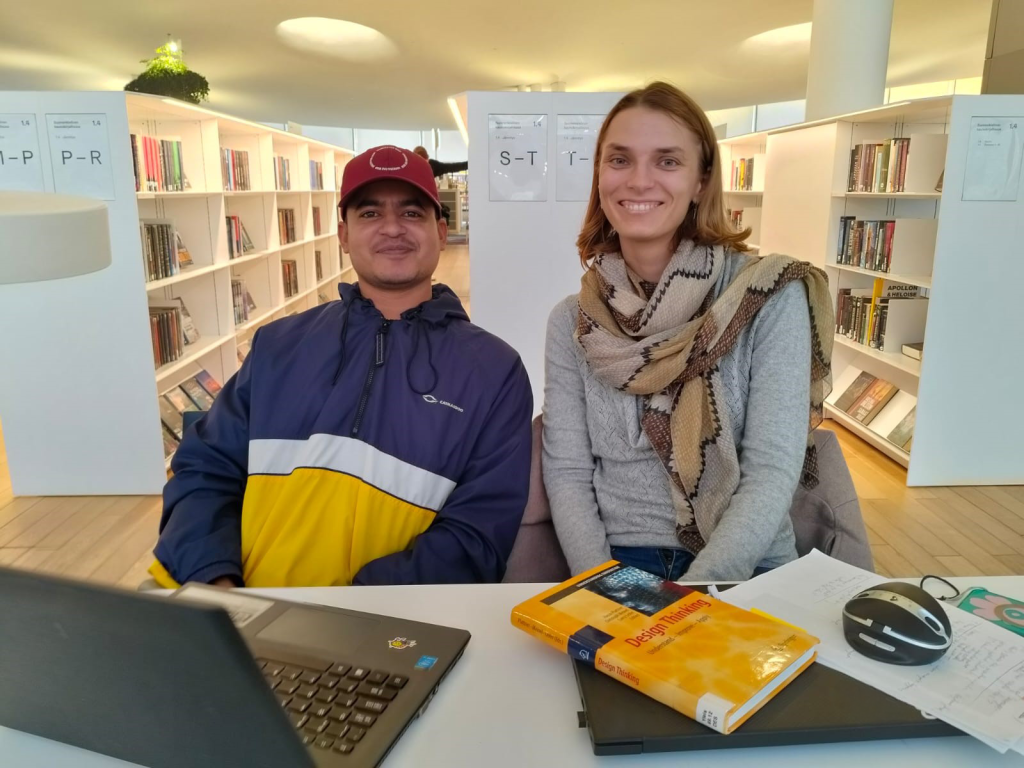
Written by Marin Anita & Sarker Md Saddam Hossain
In most workplaces, and even in everyday life, we are under pressure to deliver ready and polished solutions. However, Design Thinking shows us a counterintuitive paradox: incomplete prototypes, messy drawings, crude models, rapid mock-ups — this is where magic happens.
Prototyping is not just a design tool. It is an act of human courage that unlocks creativity and fuels innovation.
The Human Side of Prototypes
A design culture is nurturing. It doesn’t encourage failure, but the iterative nature of the design process recognizes that it’s rare to get things right the first time.
Kolko, J. (2015). Design Thinking Comes of Age
At the heart of prototyping are people, not perfection. Kolko reminds us that a true design culture is nurturing, and that progress does not come from waiting until something feels complete.
MIT Media Lab’s “Demo or die” is the perfect reflection of this: an idea does not quite exist until it is brought to life. A sketch or a quick demo create a human connection, that you never find in a polished report. Providing something rough is not a weakness, it is the spark that inspires others to enter.
While Apple is known for its big successes, its history also includes less successful products such as the Newton tablet, the Pippin game console, and the Copland operating system (Kolko, J., 2015. Design Thinking Comes of Age). These efforts were not disasters but part of the company’s learning curve. Each of them showed, that progress comes from trying again and again.
Prototypes as Conversation Starters
GE’s Greg Petroff explains how teams are abandoning “comprehensive product specifications.” Rather, they learn by doing — prototyping, iterating, and pivoting. IBM makes use of similar practices to transform ideas into conversations (Kolko, J., 2015. Design Thinking Comes of Age).
This aligns with what is called the Tangibility Rule: making ideas visible changes the way we think (Plattner, Meinel, & Leifer, 2011, Design Thinking: Understand – Improve – Apply, p. XV). A prototype is not a technical object standing alone, it is a story in progress. Each sketch or model is an invitation to conversation and co-creation.

The Courage to Go First
Prototyping is an act of bravery. It is a way of saying, “I do not have every answer, but I am willing to try.” The next time you have an idea, resist the urge to wait until it feels perfect. Sketch it. Mock it up. Share it. Remember, that innovation begins when someone is willing to show something incomplete and invites others to shape it into something greater.

References
- Bender, W. (2004). The seven secrets of the Media Lab. BT Technology Journal, 22(4), 191–199. https://doi.org/10.1023/B:BTTJ.0000047629.12018.33
- Case Study: The MIT Media Lab. (n.d.). In Lab Space Case Study. Manifold/University of Minnesota Press. Retrieved from https://manifold.umn.edu
- Kolko, J. (2015). Design thinking comes of age. The approach, once used primarily in product design, is now infusing corporate culture. Harvard Business Review September 2015, 66-71.
- Meinel, C. (2011). Design Thinking: Understand – Improve – Apply. Dordrecht: Springer.


Leave a reply to baonguyen88846a90cc Cancel reply