
Written by Linh Duong and Mira Airola.
Do you know that Finland is in fact the forerunner in the service design field? Finland has the highest proportion of service and business designers, at least until 2016 (Adair, 2018 from LinkedIn Mar 9, 2016).
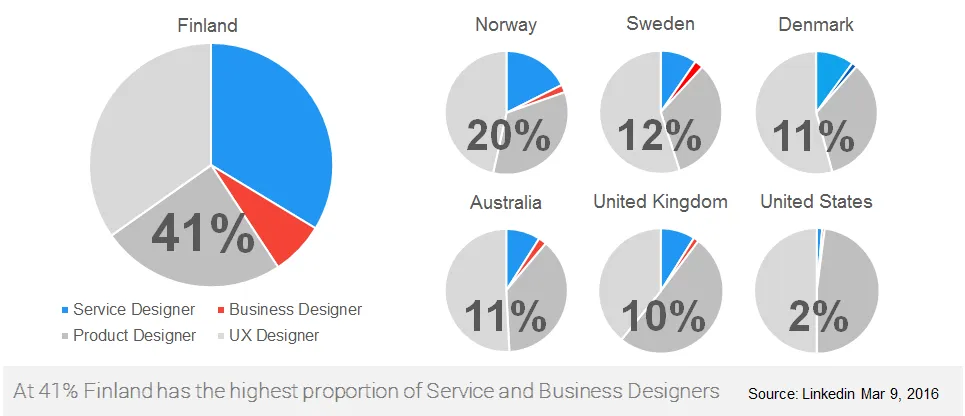
Finland has the highest proportion of service and business designers (Source: Adair, 2018).
Great news, indeed! Yet, if we look closer, we will realize that the prospective number of service designers in Finland does not translate into a smooth adoption of a design-centric culture (Kolko, 2015), which helps employees to be more engaged to new, innovative ideas, and more willing to put feelings in their work. What also needs to be discussed is the implementation of Design Thinking in management education and in the MBA programs around the world (Dunne & Martin, 2006). Martin talks about businesses as design shops who solve wicked problems, and not just hard core money making organizations.
Paulo Dziobczenski, a design researcher, has monitored design job posts for several years, and he integrates the set of skills required by companies for design jobs. Guess what? Empathy is nowhere to be seen, even though it has been repeatedly emphasized in almost every class and every material that it is very important in the design thinking process.

Skills requested by companies for design jobs (Source: Dziobczensk, 2020)
The problem lies deeper than what kinds of skills should be input in the job description. It is about how organizations can be understanding, embracing, and willing to apply design thinking’s core elements: empathy, collaboration, curiosity, and creative experiments (Brown, 2019; Dunne & Martin, 2006; Kolko, 2015).
Logically, at this point, we would be wondering: How organizations revolutionize their way of doing?
According to Cambridge dictionary, organization is defined as “a group of people who work together in an organized way for a shared purpose”. The people are what makes the organization. So, the question perhaps is better to be rephrased as: How to nudge people in organizations so that they will revolutionize their way of doing?
There is no silver bullet answer. Instead, it is an integrative approach to bring elements of design thinking into the people’s lives. Let’s start with the humble beginning: first, understand that principles and elements of design thinking can be applied by everyone (Brown, 2019).
Second, it is to practice observation. It might sound obvious, but still, it is important. We do not observe enough as we think. For example, by observing your customers, you would know their buying habits, how they find the products, and perhaps even the meaning and emotional attachment to the things (Brown, 2019). In other words, observation helps us to understand the user experiences.

Picture. Customers look for products in a grocery store. (Source: Unsplash).
The third step to change an organizational people’s mindset is to acknowledge the importance of empathy in solving work life issues. While sympathy means you acknowledge, support, and give comfort to someone when they face challenges, empathy means “standing in the shoes of others” (Brown, 2019). Kolko (2015) suggests to let employees observe and tell the needs and wants of others, as well as to apply and use more emotional language (i.e. words that describe aspirations, pains, desires) when discussing the products and users.
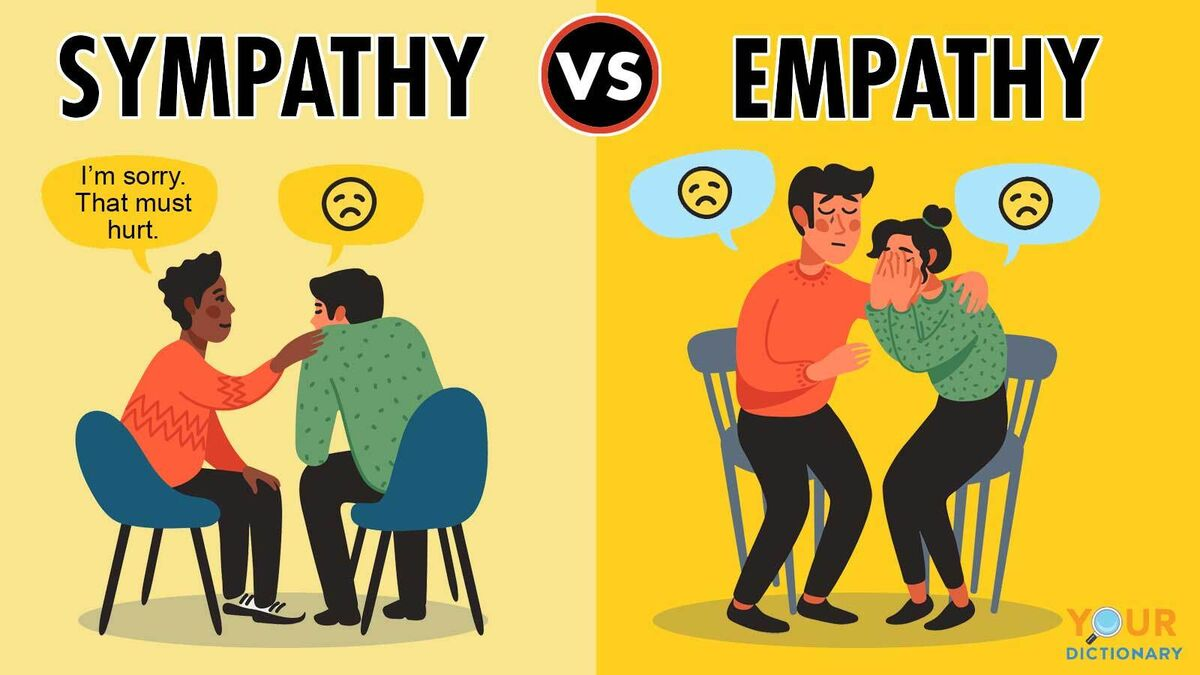
Picture. Sympathy vs. Empathy (Source: White, 2020).
The fourth step is collaboration.
The formula is easy: work with people who are different from you. Collaborative work doesn’t mean finding someone with the same background and logical thinking as you. It is a gem to be able to learn to listen to other people, understand their reasoning process, and acknowledge their inputs (Dunne & Martin, 2006). This also goes back to the management strategies – do you recruit people you already agree with, and share the same views as you, or somebody who challenges the old views and brings something new to the table?
Okay, last but not least, fifth, get your hands dirty. It means prototyping. The motto behind prototyping is to fail early, fail often (Brown, 2019). Prototypes do not need to be perfect, as it shows in this picture. Prototype is a bridge to make sense of your ideas and solutions to the users, testing how they perceive the ideas and elements of the ideas.

Picture. Prototype from the workshop day.
From design thinking at work to design thinking in life.
We’ve talked a lot about work, but indeed, empathy can be embraced in various aspects of life. Before going to work, many of us spent time studying. Thus, it is crucial to include empathy training in education, especially business education (Dunne & Martin, 2006). On a more personal level, Brown (2009) advocates for bringing a design thinking mindset into our lives – design your life. In specific, design your life in a way that:
- Learn to take joy in small things/parts of life.
- Life can be seen as a continuous prototype, where changes, experiments and discoveries are embraced and accepted.
- Focus on your “touch point” in your life. Rewards are not evaluated by the world around us.
Design your life actually is a timely topic nowadays. Bill Burnett and Dave Evans from Stanford Design School are famous for their book and concept of designing your life. Check them out if you’re interested in how design thinking can help you bits by bits to create a more meaningful and fulfilling life.
(Source: Design your life)
References
Adair, M. (2018). Service Design, Finland and the Grey Wolf. https://medium.com/@digitalproductpeople/service-design-finland-and-the-grey-wolf-ed855814f87c
Brown, T. (2019). Change by design: how design thinking can transform organizations and inspire innovation. New York: HarperCollins Publishers.
Cambridge dictionary. (2023). Organization. https://dictionary.cambridge.org/dictionary/english/organization
Designing your life. (2023). https://designingyour.life/
Dunne, D. & Martin, R. (2006) Design Thinking and How It Will Change Management Education: Links to an external site. An Interview and Discussion. Academy of Management Learning & Education, 2006, Vol. 5, No. 4, 512–52.
Dziobczensk, P. (2020). The state of the design job market in Helsinki — present, past and future.https://uxdesign.cc/the-state-of-design-job-market-in-helsinki-present-past-and-future-225da4322ac8
Kolko, J. (2015) Design Thinking Comes of Age. https://hbr.org/2015/09/design-thinking-comes-of-age
White, M. (2020). What’s the Difference Between Sympathy and Empathy? https://www.yourdictionary.com/articles/sympathy-empathy-difference


Leave a reply to suvisaa Cancel reply