From design thinking to design your life: Don’t think, experience!

Written by Linh Duong and Mira Airola. 

Do you know that Finland is in fact the forerunner in the service design field? Finland has the highest proportion of service and business designers, at least until 2016 (Adair, 2018 from LinkedIn Mar 9, 2016).
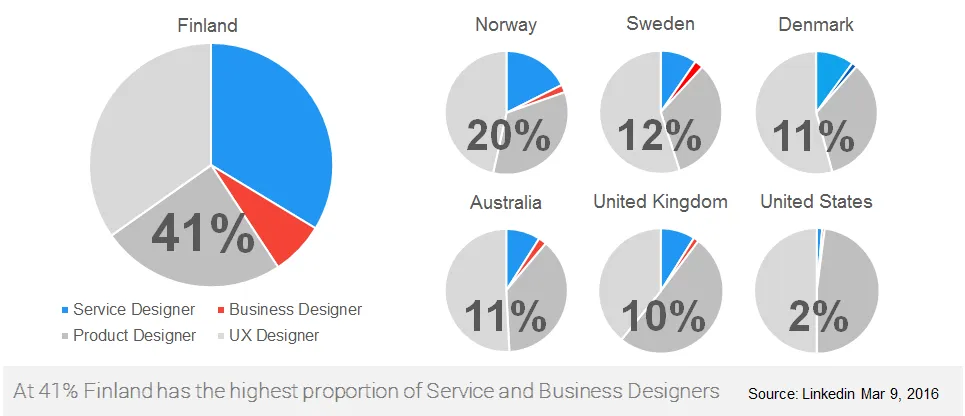
Finland has the highest proportion of service and business designers (Source: Adair, 2018).

Great news, indeed! Yet, if we look closer, we will realize that the prospective number of service designers in Finland does not translate into a smooth adoption of a design-centric culture (Kolko, 2015), which helps employees to be more engaged to new, innovative ideas, and more willing to put feelings in their work. What also needs to be discussed is the implementation of Design Thinking in management education and in the MBA programs around the world (Dunne & Martin, 2006). Martin talks about businesses as design shops who solve wicked problems, and not just hard core money making organizations. 


Paulo Dziobczenski, a design researcher, has monitored design job posts for several years, and he integrates the set of skills required by companies for design jobs. Guess what? Empathy is nowhere to be seen, even though it has been repeatedly emphasized in almost every class and every material that it is very important in the design thinking process.

Skills requested by companies for design jobs (Source: Dziobczensk, 2020)

The problem lies deeper than what kinds of skills should be input in the job description. It is about how organizations can be understanding, embracing, and willing to apply design thinking’s core elements: empathy, collaboration, curiosity, and creative experiments (Brown, 2019; Dunne & Martin, 2006; Kolko, 2015). 

Logically, at this point, we would be wondering: How organizations revolutionize their way of doing? 

According to Cambridge dictionary, organization is defined as “a group of people who work together in an organized way for a shared purpose”. The people are what makes the organization. So, the question perhaps is better to be rephrased as: How to nudge people in organizations so that they will revolutionize their way of doing? 

There is no silver bullet answer. Instead, it is an integrative approach to bring elements of design thinking into the people’s lives. Let’s start with the humble beginning: first, understand that principles and elements of design thinking can be applied by everyone (Brown, 2019). 

Second, it is to practice observation. It might sound obvious, but still, it is important. We do not observe enough as we think. For example, by observing your customers, you would know their buying habits, how they find the products, and perhaps even the meaning and emotional attachment to the things (Brown, 2019). In other words, observation helps us to understand the user experiences. 

Picture. Customers look for products in a grocery store. (Source: Unsplash).


The third step to change an organizational people’s mindset is to acknowledge the importance of empathy in solving work life issues. While sympathy means you acknowledge, support, and give comfort to someone when they face challenges, empathy means “standing in the shoes of others” (Brown, 2019). Kolko (2015) suggests to let employees observe and tell the needs and wants of others, as well as to apply and use more emotional language (i.e. words that describe aspirations, pains, desires) when discussing the products and users.
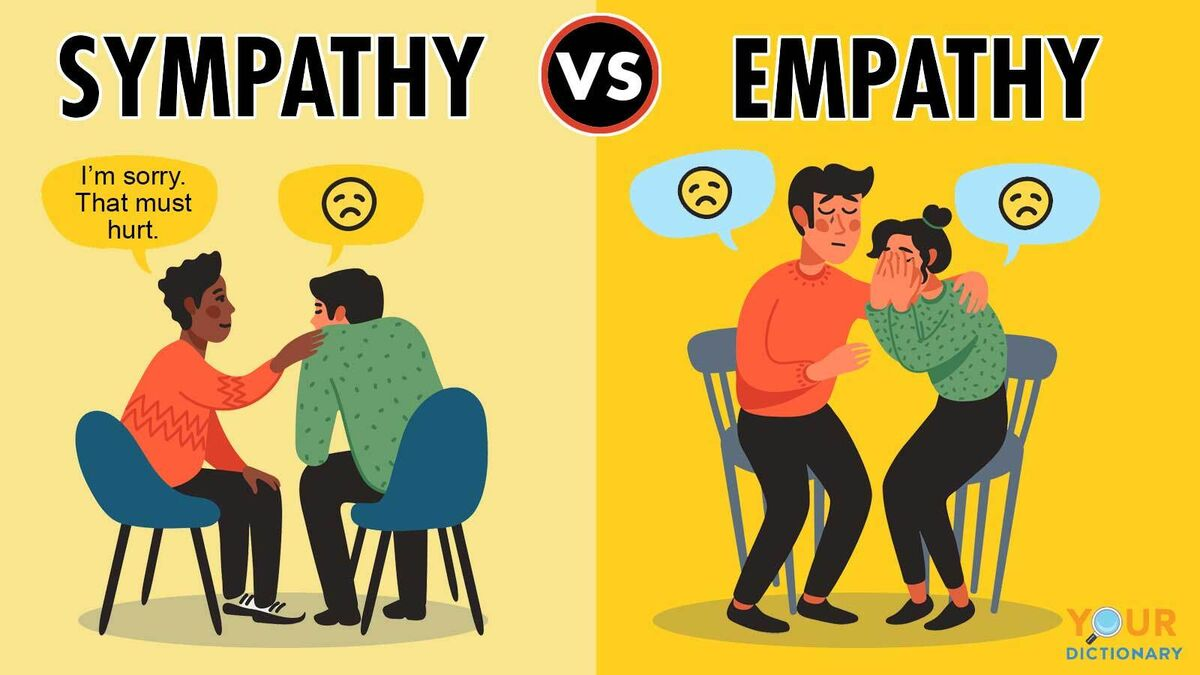
Picture. Sympathy vs. Empathy (Source: White, 2020).

The fourth step is collaboration

The formula is easy: work with people who are different from you. Collaborative work doesn’t mean finding someone with the same background and logical thinking as you. It is a gem to be able to learn to listen to other people, understand their reasoning process, and acknowledge their inputs (Dunne & Martin, 2006). This also goes back to the management strategies – do you recruit people you already agree with, and share the same views as you, or somebody who challenges the old views and brings something new to the table?

Okay, last but not least, fifth, get your hands dirty. It means prototyping. The motto behind prototyping is to fail early, fail often (Brown, 2019). Prototypes do not need to be perfect, as it shows in this picture. Prototype is a bridge to make sense of your ideas and solutions to the users, testing how they perceive the ideas and elements of the ideas. 

Picture. Prototype from the workshop day.

From design thinking at work to design thinking in life.

We’ve talked a lot about work, but indeed, empathy can be embraced in various aspects of life. Before going to work, many of us spent time studying. Thus, it is crucial to include empathy training in education, especially business education (Dunne & Martin, 2006). On a more personal level, Brown (2009) advocates for bringing a design thinking mindset into our lives – design your life. In specific, design your life in a way that:

  • Learn to take joy in small things/parts of life. 
  • Life can be seen as a continuous prototype, where changes, experiments and discoveries are embraced and accepted. 
  • Focus on your “touch point” in your life. Rewards are not evaluated by the world around us. 

Design your life actually is a timely topic nowadays. Bill Burnett and Dave Evans from Stanford Design School are famous for their book and concept of designing your life. Check them out if you’re interested in how design thinking can help you bits by bits to create a more meaningful and fulfilling life. 

(Source: Design your life)

References

Adair, M. (2018). Service Design, Finland and the Grey Wolf. https://medium.com/@digitalproductpeople/service-design-finland-and-the-grey-wolf-ed855814f87c

Brown, T. (2019). Change by design: how design thinking can transform organizations and inspire innovation. New York: HarperCollins Publishers.

Cambridge dictionary. (2023). Organization. https://dictionary.cambridge.org/dictionary/english/organization

Designing your life. (2023). https://designingyour.life/ 

Dunne, D. & Martin, R. (2006) Design Thinking and How It Will Change Management Education: Links to an external site. An Interview and Discussion. Academy of Management Learning & Education, 2006, Vol. 5, No. 4, 512–52. 

Dziobczensk, P. (2020). The state of the design job market in Helsinki — present, past and future.https://uxdesign.cc/the-state-of-design-job-market-in-helsinki-present-past-and-future-225da4322ac8

Kolko, J. (2015) Design Thinking Comes of Age. https://hbr.org/2015/09/design-thinking-comes-of-age 

White, M. (2020). What’s the Difference Between Sympathy and Empathy? https://www.yourdictionary.com/articles/sympathy-empathy-difference 


Posted

in

by

Comments

9 responses to “From design thinking to design your life: Don’t think, experience!”

  1. juliareinhardatlaurea Avatar
    juliareinhardatlaurea

    I really enjoyed how you began by addressing the state of service design and design thinking in Finland. What really stood out to me was the contrast between the high number of service and business designers in Finland and the apparent gap in actually implementing a design-centric culture.

    The emphasis on empathy in the blog also resonates strongly with the core principles of Design Thinking. As we are learning, understanding and connecting with users’ needs and emotions can often the key to successful innovation and problem-solving.

    Furthermore, the idea of applying design thinking principles to personal life and education is intriguing. It suggests that design thinking can have a broader impact beyond the workplace, fostering a mindset of continuous improvement and a deeper understanding of human needs and desires.

  2. carolinalimadefaria Avatar
    carolinalimadefaria

    Hello! This is a engaging and catchy article, thank you for the pleasant read!
    In the beginning you mention how empathy is an important skill for a service designer, but, surprisingly, not often mentioned in recruitment post. I would argue that it is quite hard to measure or prove compared to the other skills on the list. Still, it is interesting to consider it for blogposts, since it is a core skill for a designer.
    Regarding observation, I agree that we do not observe our customers enough. Also, not with a beginner’s mindset. It is helpful to forget what we “know” about the customers and observe them as if we never did, so that we can notice new opportunities, hidden in the everyday routine.
    Lastly, the book “Designing your life” seems to be very inspiring, by providing motivation and a process to try something new and pursue our dreams.

  3. raquelalonsomiranda Avatar
    raquelalonsomiranda

    Thank you for your post, Linh and Mira! I find very interesting the idea of applying a Design Thinking mindset to design own´s life. I agree with you that a DT mindset can be very fruitful in all aspects of life.

    When I was reading Tom & David’s Keller Creative Confidence book (2014) for the course, I came across the concept for the first time and I found it very inspiring, “Once you start to think about your life and career as just another creative challenge, many different possibilities may come to the light”, (p. 166).

    Thank you for writing about this topic, I am looking forward to learning more about it!

  4. Anastasia Strelnikova Avatar
    Anastasia Strelnikova

    Linh and Mira, it was a pleasure to read your article: well-structured, valid, and practice-oriented.
    The question of changing organizational mindset is crucial and challenging in today’s business landscape. Speaking about this topic I want to mention that Daniela Marzavan describes 2 mode of operating business: exploitative (when companies just use available resources and sell things) and exploring mode (where they open to changes and move towards uncertainty). Of course, both are meaningful. But in order to revolutionise organizational mindset we need to make this shift from one mode to another and to build dynamic capabilities.
    I love your sequence of steps, which can help to nudge people make changes, both in organisational and personal level.
    And let me further elaborate on this direction.
    I still have question how to inject new mindset into corporative culture.
    It could a be person or a company who can provide this transition (in-house designers / design agencies), they are giving expertise and guiding the initial stages of implementation.
    Workshops for employees can be effective in introducing new concepts, fostering a culture of continuous learning, embedding these principles into daily operations.
    However, for sustained change, it’s essential that leadership actively supports the shift in organizational mindset.
    Popularizing design thinking methodology in broader business and academic spheres can create an environment where individuals are more receptive to the concept. 

    Anyway, I am sure that this will inevitably lead to changes in the entire company, its processes, and, consequently, the overall strategy, prompting a redesign of the organization.

    1. irinatikanvaara Avatar
      irinatikanvaara

      I agree with you that from the company perspective, it can be a challenge to change the employees’ mindset toward design thinking. However, I think that the following steps may help such as raising the evidence of its importance in organizations, motivating people to get continuous education, and extending the horizon of their knowledge by way of their own library of books or collection of articles. Such a strategic approach was used in Zappos company when the owner decided to build a giant and leading company. It is worth also saying that people living in Finland feel the need to move toward servitisation in a wide spectrum of industries. Probably that can explain such a drastic difference between the ratio of service designers here and other Nordic countries.

  5. mia00058laureafi Avatar
    mia00058laureafi

    Thank you Anastasia for your very insightfull comment! I totally agree that the change towards more design thinking culture in an organization needs certain people, I like calling them change agents, that assure that the mindset is incorporated in all the functions across the organization.

    I think that in an ideal case the whole management and company’s strategy would have recognised this, and would have it as a focus point for succesfull results.

  6. marijasilinskiene Avatar
    marijasilinskiene

    thank you for sharing the stats! very interesting 🙂
    Two things that came up for me:
    1. Based on my experience, companies often do not know what they actually need/want. Defining what is actually needed, as we already know, is a process in itself that requires significant amount of time and effort. A poorly defined job description will not attract the talent company is looking for. I wonder if there is some disconnect between what companies think they need and what they actually need.
    2. It seems that when hiring service designers, employers are looking for primarily technical skills – UX/UI, Presentation, Coding, etc… It also appears that many design position adverts target mid-level job seekers. This correlates with the fact that entry to mid-level jobs require more technical skills while senior/leadership positions are more focused on soft/people skills such as empathy, thinking (creativity, design thinking, etc).
    3. I wonder if there is some disconnect between university curriculums and the business in terms of what service design is, its terminology and what are the essential skills that designers need.

  7. suvisaa Avatar
    suvisaa

    Oh, what a fantastic choice of topic, this is one of my favourite ponderings and your article just might be the needed nudge towards determining my thesis topic. Thank you!

    What really intrigues me in the topic is the skillsets we use privately in our everyday lives as individuals. I´d say empathy is highly present. But when we enter the corporate world daily grind it almost seems as there is no room for it. After all, many of us are managed basically with excel sheets.

    Some companies do promote themselves as “diversity welcome and empathy celebrated” and I would be curious to know how failing fast and sensitivity to different kinds of people works in reality. Does some other commentator have some insights into this?

    Canada has understood the importance of empathy and they actually offer a roots for empathy course in schools (https://rootsofempathy.org/). I would like to see this approach in other countries as well as this could be the nudge we need as a society to start bringing our truest selfs into the office as well.

  8. marikarjalainen7fd01cf211 Avatar
    marikarjalainen7fd01cf211

    Thank you for the blog.

    I would like to know what the current state of service design is in Finland. Do we still have the highest proportion of service and business designers? In 2018 Finnish Broadcasting Company Yle published an article stating that the service design sector has grown rapidly and that service designers are wanted in the companies. I hope future professionals will continue to be well employed in the future.

    Some thoughts about the empathy. I agree that empathy is very important in order to design human-centered services. But there is something about the word and its use, e.g. in the public sphere and in the labour market, that is weird – in a bad way. I think that the word empathy has become a buzzword especially in the business world. Not always, but sometimes. These are the moments when rich businessmen talk about the importance of empathy as if they have learned it for the first time in their lives. At the same time, their motive for empathy is making profit, which make me feel ill. The description of the situation is a caricature but it is an attempt to describe the toxic phenomenon that has developed around the word empathy. There is something similar with the toxic positivity.

    Your text about designing life made me think about the Career Design Lab at Aalto University. I agree that design thinking can be useful tool to plan your career and life.

    But again, I have some critique. This trend creates and reinforces the idea that everyone can create the life they want. It ignores the fact that everyone doesn´t have equal opportunities to pursue the life they want. We are born and live in unequal situations. Not everyone has the same rights and opportunities. Needless to say it´s not ok and fair.

    The linked video (DESIGNING YOUR LIFE by Bill Burnett & Dave Evans) in the blog states that the method works for anyone. I think it´s not true. The method certainly works well with the wealthy and prosperous people. But the vulnerable people do not have equal opportunities to design their lives and choose the best ideas or pilots.

    As I said, design thinking can be a great tool for life planning. My intention is to broaden the perspective of life designing and place it in a broader social context.

Leave a reply to irinatikanvaara Cancel reply