Empowering everyone to be creative with Design Thinking

By Leonardo Caetano & Mahlet Adenew
Decorative image with the text "Get the creativity flowing"
Photo by Tim Mossholder on Unsplash

“HOW CAN WE solve the problem of single-use plastic that comes from cigarette butts?” – this was the question we chose to solve in just one day as part of our Design Thinking masterclass with Daniela Marzavan.

It was a brief but intense journey where we witnessed the transformative power of Design Thinking and its potential to reshape products, services, strategies and solutions, including for some of our most pressing global challenges. It also has shown us that it’s not limited to designers, being a tool for all individuals seeking innovative solutions.

Creativity lives in all of us

Design Thinking is a human-centred approach that could minimise the complexity of innovation challenges and influence positive behavioural changes. In “Change by Design” (2009), Tim Brown explains that it’s a powerful creative approach that could be used in an organisation or socially to bring new ideas and make a significant change.

However, according to David Kelley and Tom Kelley in “Creative Confidence” (2013), a myth equates being creative with artistic, leading us to believe that professionals such as designers are paid to be creative thinkers. In contrast, other disciplines, such as lawyers, doctors, and CEOs, are not. Part of this “creative myth” is that most people believe creativity is something fixed that a person is born with.

This activity showed us that creativity lives in all of us and that Design Thinking allows everyone’s creativity to flow in favour of innovation. Collaboratively, ideas are created on top of others, leading to highly creative and innovative solutions.

Human factors inspire innovation

Balancing feasibility, viability, and desirability constraints is crucial in Design Thinking, as Brown (2009) explained. It must be within the three innovation spaces – inspiration, ideation, and implementation. Inspiration is where the designer observes to gather information and empathises without making assumptions. In ideation, people change the insights gained into ideas using divergent and convergent thinking and prototyping to get quick user feedback and improve the solution. Implementation is about executing the vision.
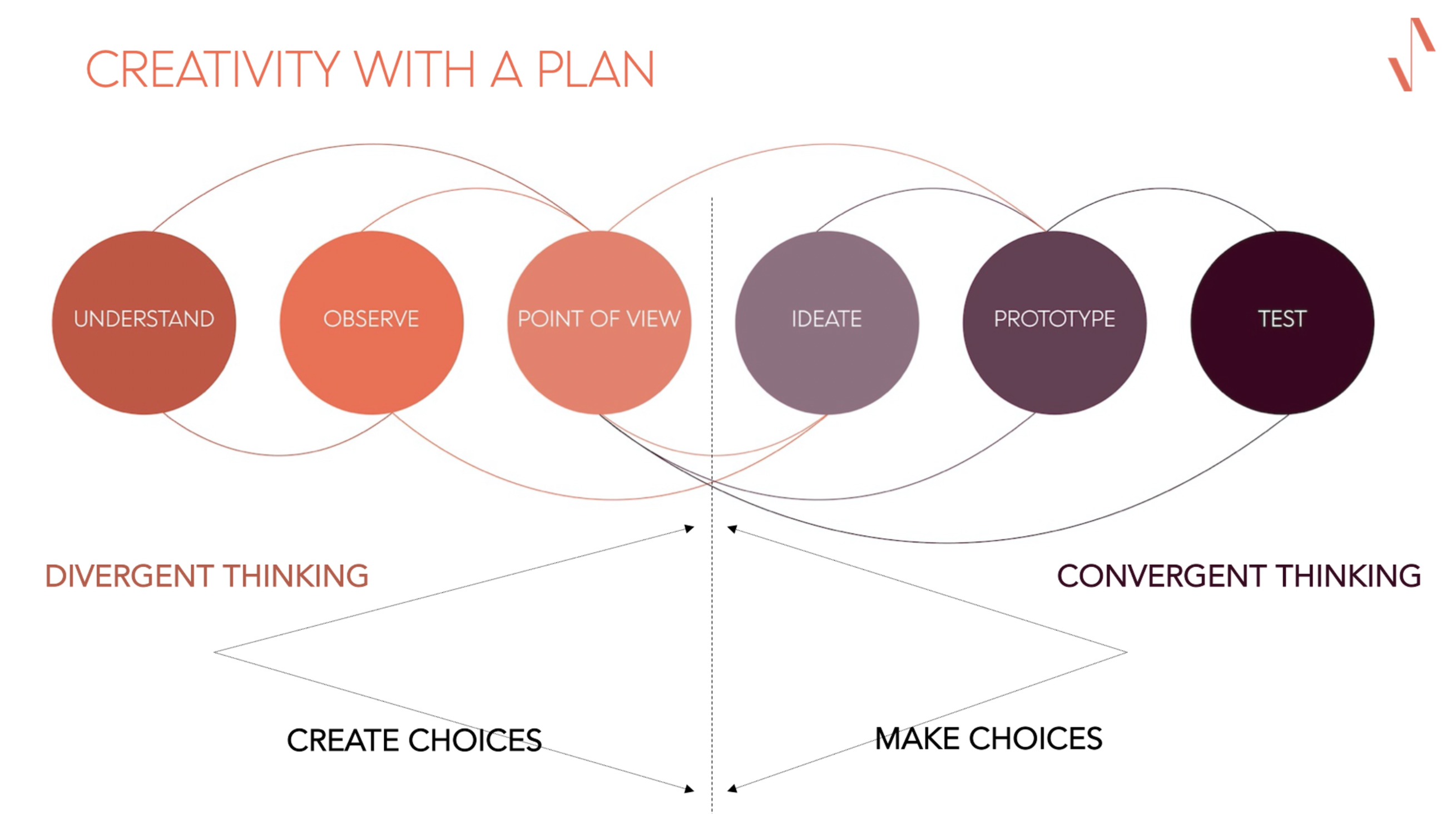
Diagram showing 6 circles with the texts "understand", "observe", "point of view", "ideate", "prototype" and "test" with lines showing the non-linear process. The three first circles are in an area called "divergent thinking/create choices" while the others are in "convergent thinking/make choices".
The progression is not linear. Understanding, observing, and point of view are where “divergent thinking” creates multiple insights and choices. We decide on “convergent thinking” options in ideate, prototype and test. Diagram by Marzavan, Creativity with a Plan.

According to Kelley (2013), comprehending human needs and people’s fundamental motivations and beliefs – human factors – should be the starting point as it offers “some of the best opportunities for innovation”. Having a diverse team of people allowed us to have very peculiar insights, and, according to Brown (2009), the most minor perceived details are those that inspire innovation.

Empathy is key
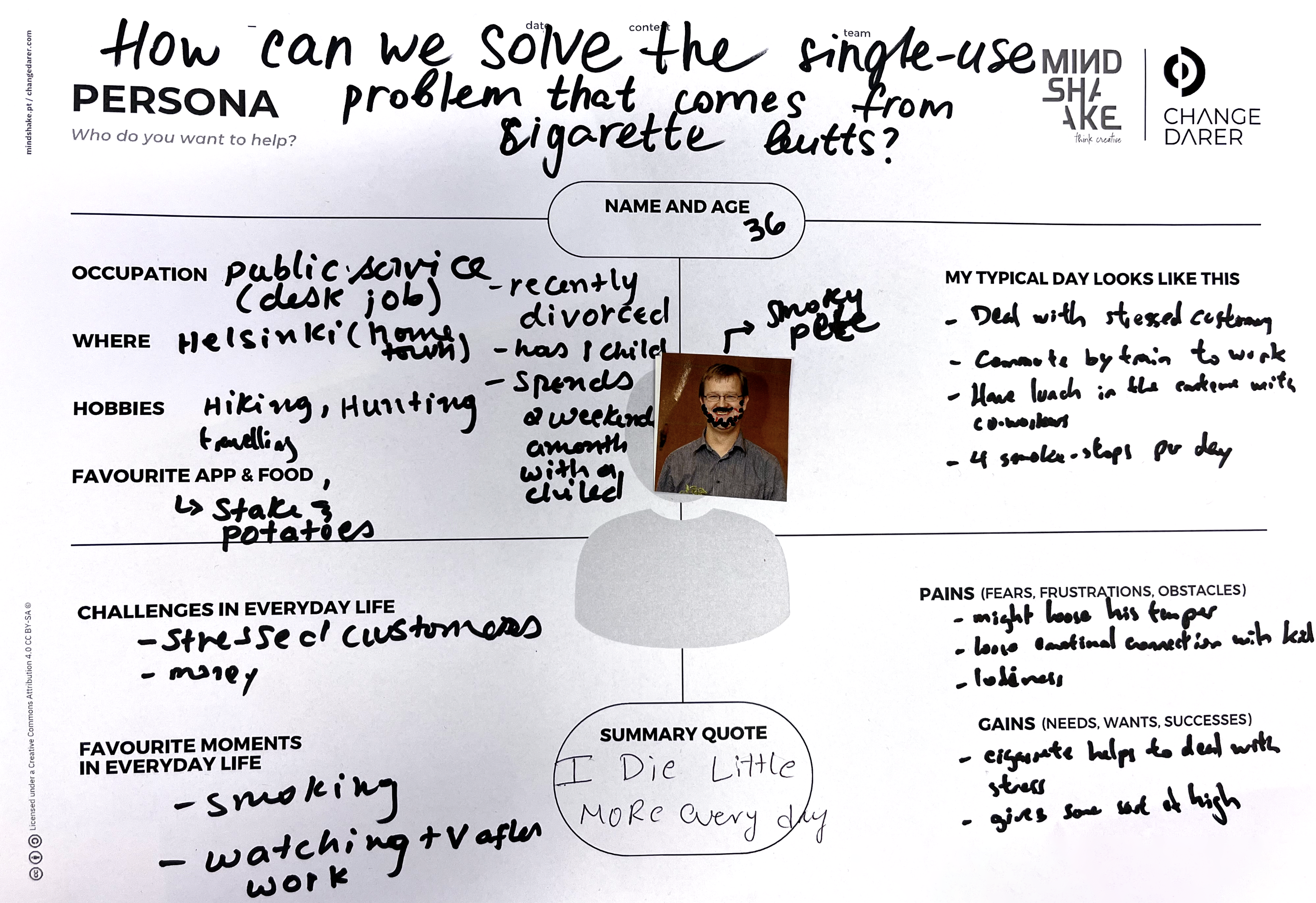
Decorative image showing a persona with their occupation, location, hobbies, favourite apps and food, typical day, challenges in everyday life, favourite moments in everyday life, pains and gains.
Our proto-persona, Smokey Pete, helped us empathise with many stakeholders.

Leaving our comfort zone to interview people can take much work. For example, we realised that people felt judged when we started to talk about smoking with them. So, to be successful in this process, it’s important to create empathy when immersing in someone else’s world.

Merlijn Kouprie and Sleeswijk Visser, in “A Framework for Empathy in Design” (2009), explore the integration of empathy in Design and show its importance. They reiterate the clear difference between empathy and sympathy. Empathy is relating oneself to someone else and seeing the world in their shoes; it doesn’t judge but relates. Everyone has their own empathetic horizon, but some techniques can expand by working through the phases of using empathy in Design – discovery, immersion connection and detachment.

“Brené Brown on Empathy” (2013)

Channelling creativity

Another vital tool in the creative process of Design Thinking is framing the insights and problem into a question using the format “How might we…?”.

“The ‘how’ suggests that improvement is always possible – that the only question remaining is how we will find success. The word ‘might’ temporarily lowers the bar a little. It allows us to consider wild or improbable ideas instead of self-editing from the very beginning, giving us more chance of a breakthrough. And the ‘we’ establishes ownership of the challenge, making it clear that not only will it be a group effort, but it will be our group.”

David & Tom Kelley (2013)

This last point is super important: what can this single group achieve with its capabilities?

Although finding consensus among such a diverse group can be challenging, framing the problem in this way leads to a channelling of creativity to explore solutions in a specific context, helping the team to reach a solution together. This emphasis on collaboration and learning is the most impressive factor in Design Thinking; it encourages people to iterate, learn and pivot, recognising that innovation often emerges from unexpected sources. As Richard Buchanan suggests in “Wicked Problems in Design Thinking” (1992), it’s “a new liberal art of technological culture” that “connects and integrates useful knowledge from the arts and sciences alike, but in ways that are suited to the problems and purposes of the present.”.

According to him, designers work on “indeterminate” and “wicked” problems, being “universal in scope, because Design Thinking may be applied to any area of human experience.”. In other words, it unites disciplines and promotes a constructive mindset. It teaches us to embrace uncertainty and seek inspiration in unexpected places for any wicked – complex, multifaceted and often defying easy solutions – problems.


In the ever-evolving landscape of business and society, Design Thinking is a lighthouse of hope – a way to navigate complex problems, unlock creative potential, and make a positive impact. It’s a way of approaching the world with curiosity, empathy and the belief that we can create a better future.


References

Brown, T. 2009. Change by Design: How Design Thinking Transforms Organizations and Inspires Innovation. New York: HarperCollins Publishers.

Buchanan, R. 1992. Wicked Problems in Design Thinking. In: The MIT Press (ed.) Design Issues Vol. 8.

Kelley, D. & Kelley, T. 2013. Creative Confidence: Unleashing the Creative Potential with us all. London: William Collins.

Kouprie, M. & Sleeswijk Visser, F. 2009. A framework for empathy in design: Stepping into and out of the user’s life. In: Taylor & Francis Group (ed.) Journal of Engineering Design Vol. 20.

Comments

5 responses to “Empowering everyone to be creative with Design Thinking”

  1. irynabohun Avatar
    irynabohun

    Thank you for such an informative post!
    It was interesting to read about creativity which “lives in all of us”. Your statement regarding Design Thinking as a human-centered approach is correct. It has the potential to simplify complicated innovation challenges while also influencing good behavioural changes. “Change by Design” by Tim Brown emphasises its potential to bring new ideas and promote major change, both within organisations and on a larger social scale.
    The idea that creativity is only found in the arts, as explored by David Kelley and Tom Kelley in “Creative Confidence,” is a limiting belief. Design Thinking demonstrates that creativity is a dynamic and accessible ability that we all possess. It proves that true innovative and creative solutions may emerge when people collaborate and build on one another’s ideas. This demonstrates Design Thinking’s inclusive and transformative nature.
    It is worth noting the significance of empathy as a vital component in Design Thinking. As it was mentioned, we should start to “create empathy when immersing in someone else’s world”. The difference between sympathy and empathy defined by Merlijn Kouprie and Sleeswijk Visser is crucial for understanding that empathy is all about seeing the world being in somebody’s else shoes. It proves that we are all human beings who want to be understood that’s why empathy can significantly help to solve multiple problems via human- centered approach.

  2. mamatha02 Avatar
    mamatha02

    Your post holds readers till the end, and I liked the idea of the post as it intrigued me to find out about it more.I do agree that as mentioned in the blog , we commonly believe “creative myth” tying it to our origin or birth. As mentioned in the blog , currently most of innovation and ideation are around keeping humans in center point and empathy into consideration is what I agree the most.
    As briefed in Tim Brown’s “Change by design” and in the post , Having a diverse team definitely helps bring different ideas,cultural factors into the discussion table and most of the time results amazes us.
    Merlijn Kouprie and Sleeswijk Visser articles on Empathy are truly inspiring and interesting to read,Empathy holds at most important part in all stages of the design thinking process.Loved the video example as it tells a lot and makes an impact, As your depicted pictures speaks lot and makes readers understand better and keep them going. Thanks for your efforts bringing these points clearly in your post.

  3. tommiku Avatar
    tommiku

    The notion of the creative myth is something that I bought into before joining this programme. I always thought of myself as not being creative. Just like you, I also learned during this course that creativity is something found in all of us. I feel like this is one of the main themes to take away from this course. Design thinking is a way of getting people to be creative together.

    Thank you for bringing up the interviews you made during the workshop. I already found them interesting to hear about back during the presentations of the workshop but now with a bit more knowledge about design thinking I see the importance of empathy, especially in the divergent thinking phases of design thinking. This is also a very current topic for us while participating in the ethnography course.

  4. irinatikanvaara Avatar
    irinatikanvaara

    Dear Leonardo and Mahlet,

    I wanted to express my gratitude for your incredibly insightful blog post. I resonate deeply with your perspective on creativity. There’s a prevalent myth that creativity is an innate aspect of one’s character, a trait you either possess or lack. People often categorize individuals as “creative” or “not creative.” However, I firmly believe that creativity is not merely an inherent quality but rather a skill that can be developed. It’s more akin to a personal “muscle” that can be trained with specific techniques.

    In her book, “Power up your Creativity,” the accomplished designer R. Tayler brilliantly illustrates valuable methods that can empower designers to elevate their creativity and bolster their creative motivation. Her central proposition revolves around a 5-step approach:

    Identify how to kickstart, find, and sustain inspiration while nurturing creative courage.
    Clarify your vision and contemplate the necessary steps for your evolution.
    Maintain motivation and establish creative longevity.
    Shift gears as you set your sights on new goals with each milestone.
    Create with intention, recognizing and embracing your creative power.
    Whether one is at the inception of their creative journey or seeking to effectively channel their creative practice toward a professional career or side hustle, these creativity practices can serve as a guiding force for enhancing one’s creative abilities and turning their dreams into reality.

  5. jasmintossavainen Avatar

    Thank you for this insightful blog post! I especially liked how you used examples of your own case of cigarette butts and used them to bring across your point of empathy.

    What you wrote about creativity and being artistic, or the term creative confidence really resonated with me. Working as a data analyst, I have struggled with the concept quite a bit, mostly with others’ perspectives and stereotypes that they hold dear. After talking to my manager about wanting to be able to use my creativity more, she told me that “you know, analysts typically aren’t that creative”.

    It’s refreshing to see that Design Thinking breaks down these conventional barriers and encourages the blossoming of creativity in unexpected places. The emphasis on empathy and collaboration resonates deeply with me, as it’s an aspect that’s often overlooked in the analytical field. Your post underscores the universal applicability of Design Thinking, serving as a source of inspiration for those like me who are seeking to infuse creativity into their work.

Leave a reply to jasmintossavainen Cancel reply