
By Leonardo Caetano & Mahlet Adenew
“HOW CAN WE solve the problem of single-use plastic that comes from cigarette butts?” – this was the question we chose to solve in just one day as part of our Design Thinking masterclass with Daniela Marzavan.
It was a brief but intense journey where we witnessed the transformative power of Design Thinking and its potential to reshape products, services, strategies and solutions, including for some of our most pressing global challenges. It also has shown us that it’s not limited to designers, being a tool for all individuals seeking innovative solutions.
Creativity lives in all of us
Design Thinking is a human-centred approach that could minimise the complexity of innovation challenges and influence positive behavioural changes. In “Change by Design” (2009), Tim Brown explains that it’s a powerful creative approach that could be used in an organisation or socially to bring new ideas and make a significant change.
However, according to David Kelley and Tom Kelley in “Creative Confidence” (2013), a myth equates being creative with artistic, leading us to believe that professionals such as designers are paid to be creative thinkers. In contrast, other disciplines, such as lawyers, doctors, and CEOs, are not. Part of this “creative myth” is that most people believe creativity is something fixed that a person is born with.
This activity showed us that creativity lives in all of us and that Design Thinking allows everyone’s creativity to flow in favour of innovation. Collaboratively, ideas are created on top of others, leading to highly creative and innovative solutions.
Human factors inspire innovation
Balancing feasibility, viability, and desirability constraints is crucial in Design Thinking, as Brown (2009) explained. It must be within the three innovation spaces – inspiration, ideation, and implementation. Inspiration is where the designer observes to gather information and empathises without making assumptions. In ideation, people change the insights gained into ideas using divergent and convergent thinking and prototyping to get quick user feedback and improve the solution. Implementation is about executing the vision.
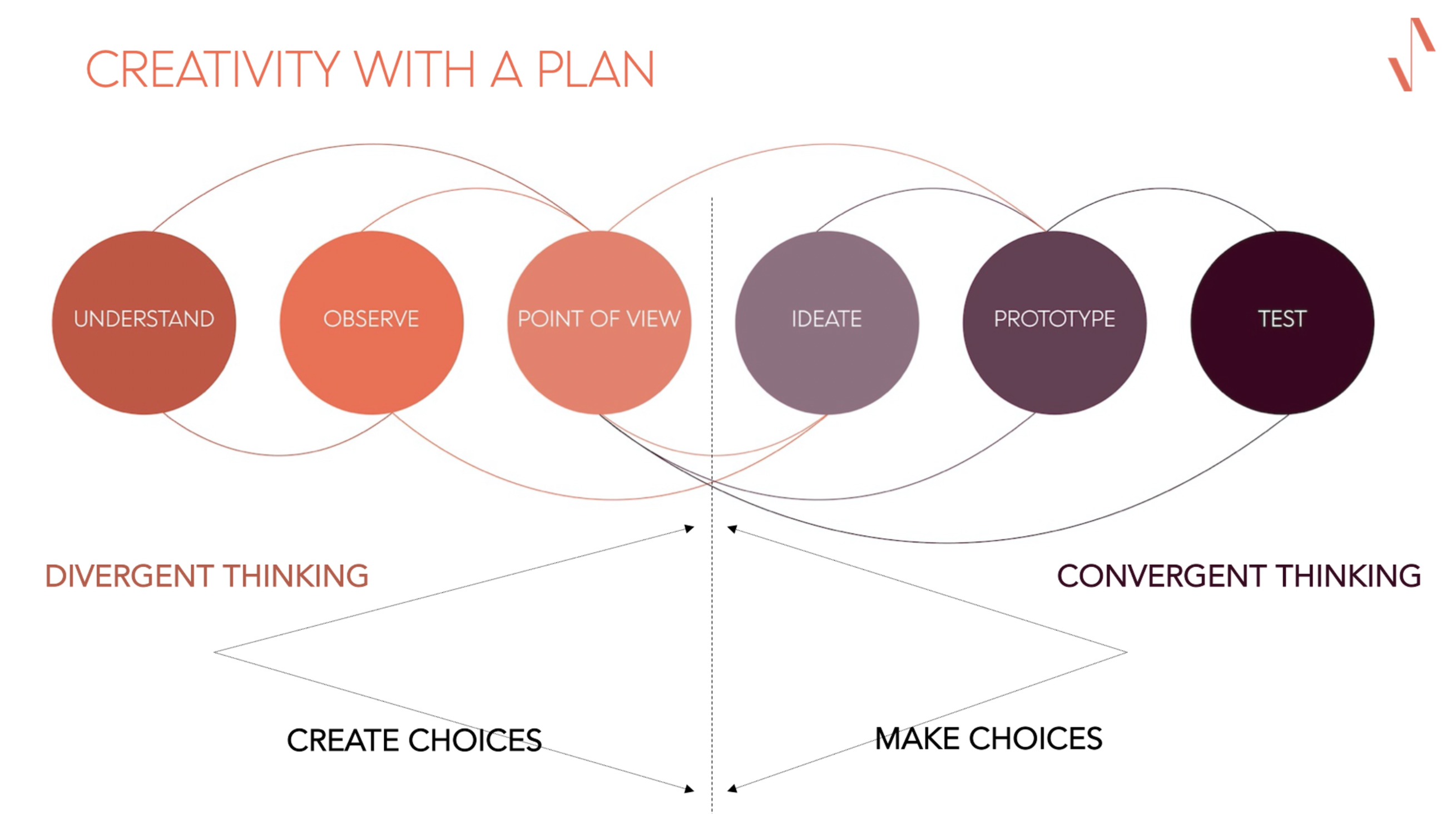
According to Kelley (2013), comprehending human needs and people’s fundamental motivations and beliefs – human factors – should be the starting point as it offers “some of the best opportunities for innovation”. Having a diverse team of people allowed us to have very peculiar insights, and, according to Brown (2009), the most minor perceived details are those that inspire innovation.
Empathy is key
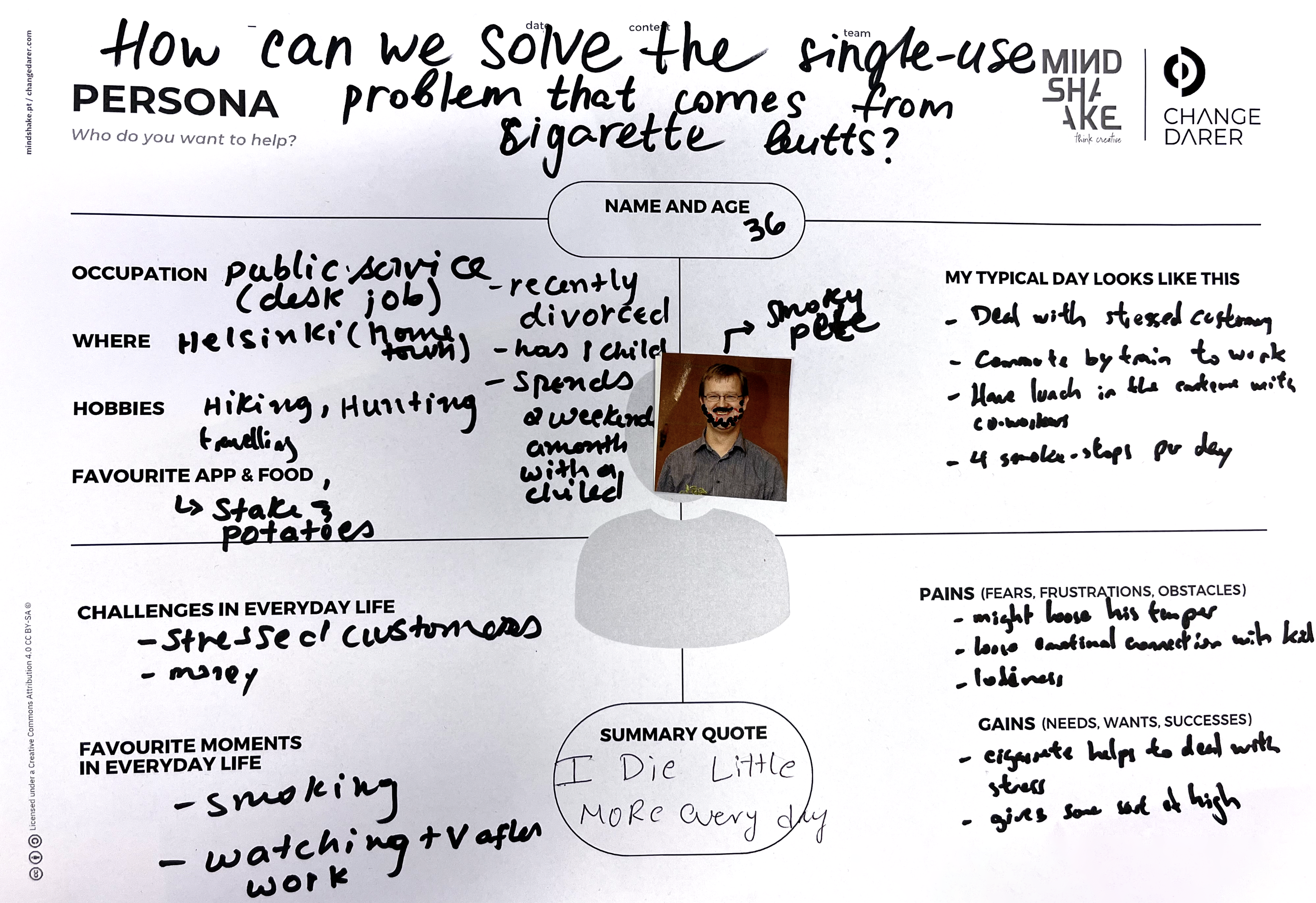
Leaving our comfort zone to interview people can take much work. For example, we realised that people felt judged when we started to talk about smoking with them. So, to be successful in this process, it’s important to create empathy when immersing in someone else’s world.
Merlijn Kouprie and Sleeswijk Visser, in “A Framework for Empathy in Design” (2009), explore the integration of empathy in Design and show its importance. They reiterate the clear difference between empathy and sympathy. Empathy is relating oneself to someone else and seeing the world in their shoes; it doesn’t judge but relates. Everyone has their own empathetic horizon, but some techniques can expand by working through the phases of using empathy in Design – discovery, immersion connection and detachment.
Channelling creativity
Another vital tool in the creative process of Design Thinking is framing the insights and problem into a question using the format “How might we…?”.
“The ‘how’ suggests that improvement is always possible – that the only question remaining is how we will find success. The word ‘might’ temporarily lowers the bar a little. It allows us to consider wild or improbable ideas instead of self-editing from the very beginning, giving us more chance of a breakthrough. And the ‘we’ establishes ownership of the challenge, making it clear that not only will it be a group effort, but it will be our group.”
David & Tom Kelley (2013)
This last point is super important: what can this single group achieve with its capabilities?
Although finding consensus among such a diverse group can be challenging, framing the problem in this way leads to a channelling of creativity to explore solutions in a specific context, helping the team to reach a solution together. This emphasis on collaboration and learning is the most impressive factor in Design Thinking; it encourages people to iterate, learn and pivot, recognising that innovation often emerges from unexpected sources. As Richard Buchanan suggests in “Wicked Problems in Design Thinking” (1992), it’s “a new liberal art of technological culture” that “connects and integrates useful knowledge from the arts and sciences alike, but in ways that are suited to the problems and purposes of the present.”.
According to him, designers work on “indeterminate” and “wicked” problems, being “universal in scope, because Design Thinking may be applied to any area of human experience.”. In other words, it unites disciplines and promotes a constructive mindset. It teaches us to embrace uncertainty and seek inspiration in unexpected places for any wicked – complex, multifaceted and often defying easy solutions – problems.
In the ever-evolving landscape of business and society, Design Thinking is a lighthouse of hope – a way to navigate complex problems, unlock creative potential, and make a positive impact. It’s a way of approaching the world with curiosity, empathy and the belief that we can create a better future.
References
Brown, T. 2009. Change by Design: How Design Thinking Transforms Organizations and Inspires Innovation. New York: HarperCollins Publishers.
Buchanan, R. 1992. Wicked Problems in Design Thinking. In: The MIT Press (ed.) Design Issues Vol. 8.
Kelley, D. & Kelley, T. 2013. Creative Confidence: Unleashing the Creative Potential with us all. London: William Collins.
Kouprie, M. & Sleeswijk Visser, F. 2009. A framework for empathy in design: Stepping into and out of the user’s life. In: Taylor & Francis Group (ed.) Journal of Engineering Design Vol. 20.


Leave a comment