
Constraints foster creativity. In this case, my own limitations. At the core, I am an analyst, a conceptual thinker used to dealing with words rather than images. Most of my best service design work so far has furthermore been done using traditional survey methods rather than the kind of innovative methods promoted by designers like Tim Brown or Katja Tschimmel. And, to be honest, that approach has worked for me really well – so far. The fact is, however, that I am nevertheless utterly fascinated by this new toolkit, as its visual approaches to innovation at first seem so alien to me, yet they work. They work for me, as they do for others.
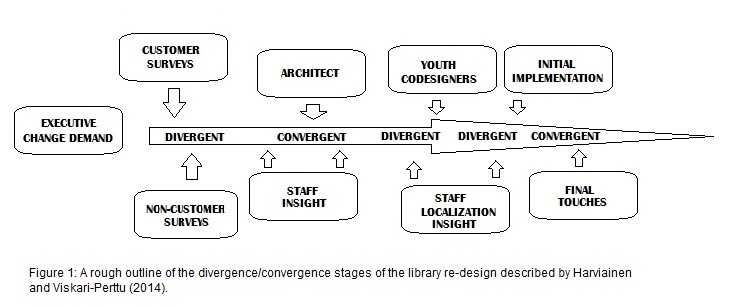
So what is in design thinking for the kind of an academic Brown frequently mentions as his opposite in thinking throughout Change by Design? The easy answer is ”a lot”. The real answer is: even more than that. First and foremost, it is about understanding. Understanding the customers, understanding the organization, understanding one’s own limitations. There is something very effective – and compelling – in the visual approaches that let everyone have their say. This fosters empathy, insight and creativity. As Brown notes, empathy is what sets apart design thinking from an academic approach. The two approaches are not, however, polar opposites, because effective design flows in a diamond-like pattern of divergence and convergence, and at least my experience says that at the convergence stages, the academic, analytic approach may come in rather handy. Especially for an academic who, like me, has been a divergent thinker already.

Figure 2 – A divergent phase
Second, design thinking is about playing with strengths – strengths of the individual, strengths of the group. Here and there in his book, Brown intriguingly shows that some of what he recommends as useful methodology may stem from his own way of thinking rather than the innate efficiency of the methods themselves. In effect, because most influential designers have been of a visually thinking, non-academic bent, the methods of design thinking have become, almost as dogma, explicitly visual. Is this a bad thing? I would argue no, not as long as the dogma does not become exclusivist. I think Brown would agree, as while he mocks academics now and then, he also acknowledges that there is potential in fusing the strengths of design thinking with more traditional research methods. Most importantly, the design thinker’s visual approach works, so what do its origins matter?
At the core, nevertheless, limiting oneself to the tools of just one paradigm may be a good thing – constraints, after all, inspire creativity. Likewise, it fits the duty to experiment and the right to fail: why use a convergent magic bullet, when the results of a bunch of “might work” concepts will almost inevitably turn out to be much more interesting? I may be an academic, but years of divergent co-authoring have taught me to instantly appreciate what visual co-design has to offer.
References:
Brown, T. 2009. Change by design: How design thinking can transform organizations and inspire innovation. New York, United States: HarperCollins.
Jones, M. & Samalionis, F. 2009. From small ideas to radical service innovation. In Lockwood, T. (ed.) Design Thinking. New York, United States: Allworth Press, 185-196.
Tschimmel, K. 2012. Design thinking as an effective toolkit for innovation. In Proceedings of the XXIII ISPIM Conference: Action for Innovation: Innovating from Experience. Barcelona, Spain.
J. Tuomas Harviainen, information systems researcher & first year SID student


Leave a reply to heinikauppinen Cancel reply