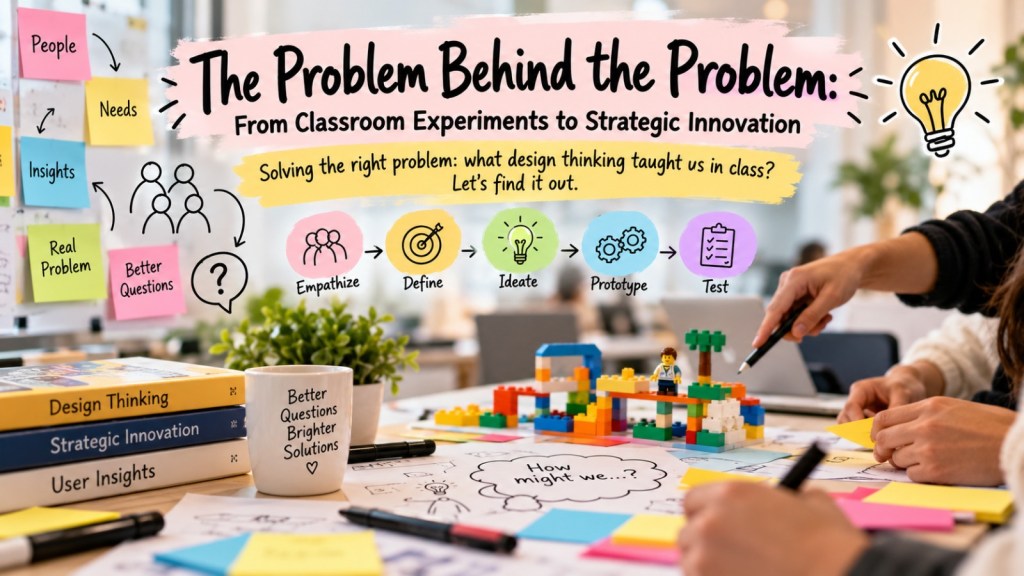
The Problem Behind the Problem: From Classroom Experiments to Strategic Innovation

On October 1 and 2, we had our Design Thinking contact sessions, and it really changed our way of understanding people, questioning assumptions, and making decisions. We also read articles and books. So, putting these together with our class sessions helped us see that these lessons are useful for business strategy too.

Assumptions limit what we try

The nine-dot exercise our teacher gave us was one of the most interesting moments in the session, where we needed to connect nine points with four straight lines without picking up the pencil, and we were like, oh my god! It’s difficult. We found it hard because our own assumptions limited the ideas we tried. Afterwards, I kept thinking about companies. How many of them handle problems with familiar thinking and never ask whether their first assumptions were right?
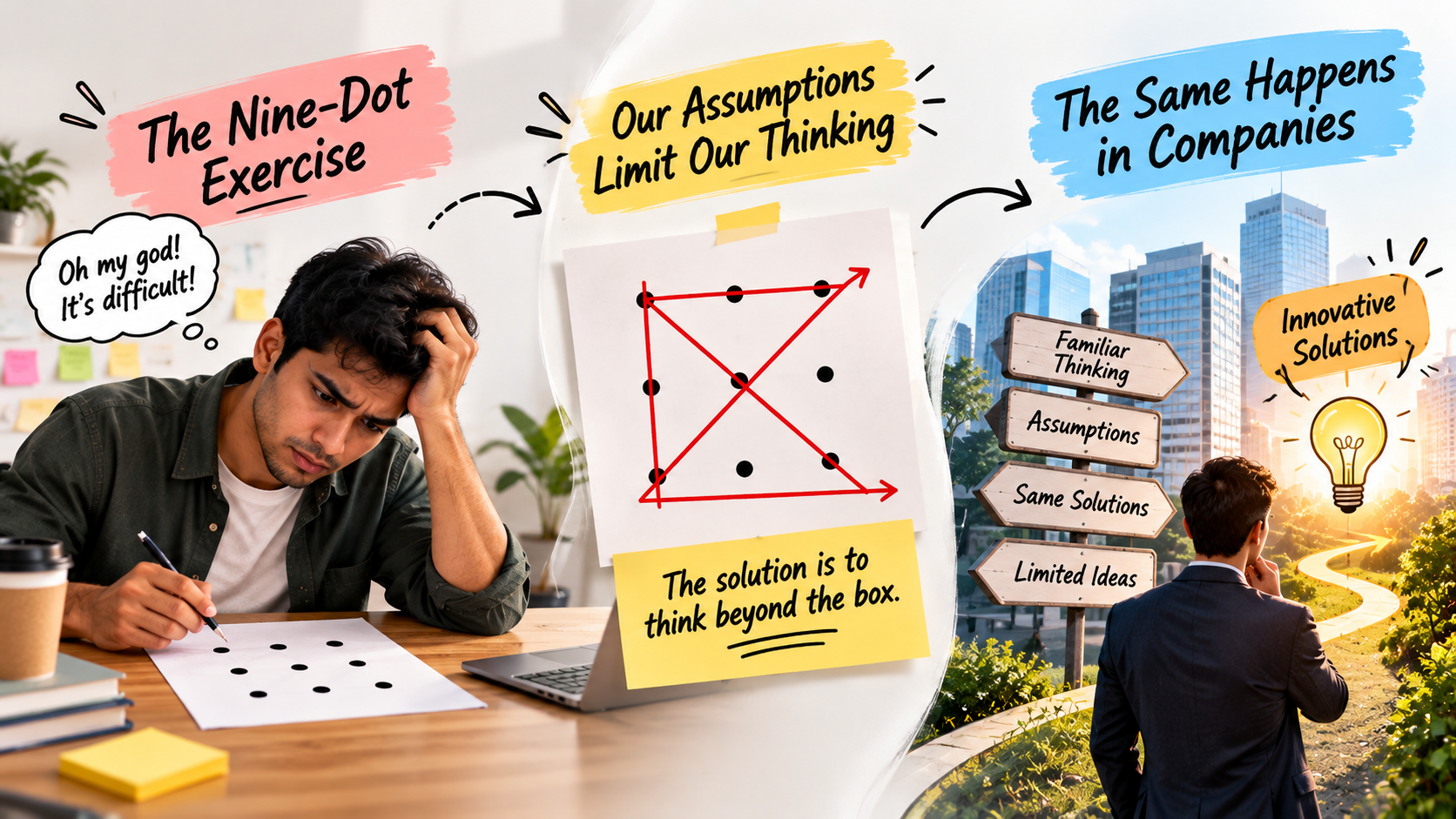
We read a journal article, the Double Diamond framework by Shen et al. (2024), which clearly explains 4 phases: discover, define, develop, and deliver. It moves back and forth, opening up ideas and narrowing them down, so it shows that innovation needs both. Our exercise showed this in a practical way; Sometimes we can make progress just by looking at the problem in a different way.

Empathy shapes which problems we solve

In our group activities, we explored personal preferences, drew portraits, built a persona from a group member’s experience, and wrote a “How might we…?” question. This pushed us to look at people’s actual experiences instead of our assumptions.
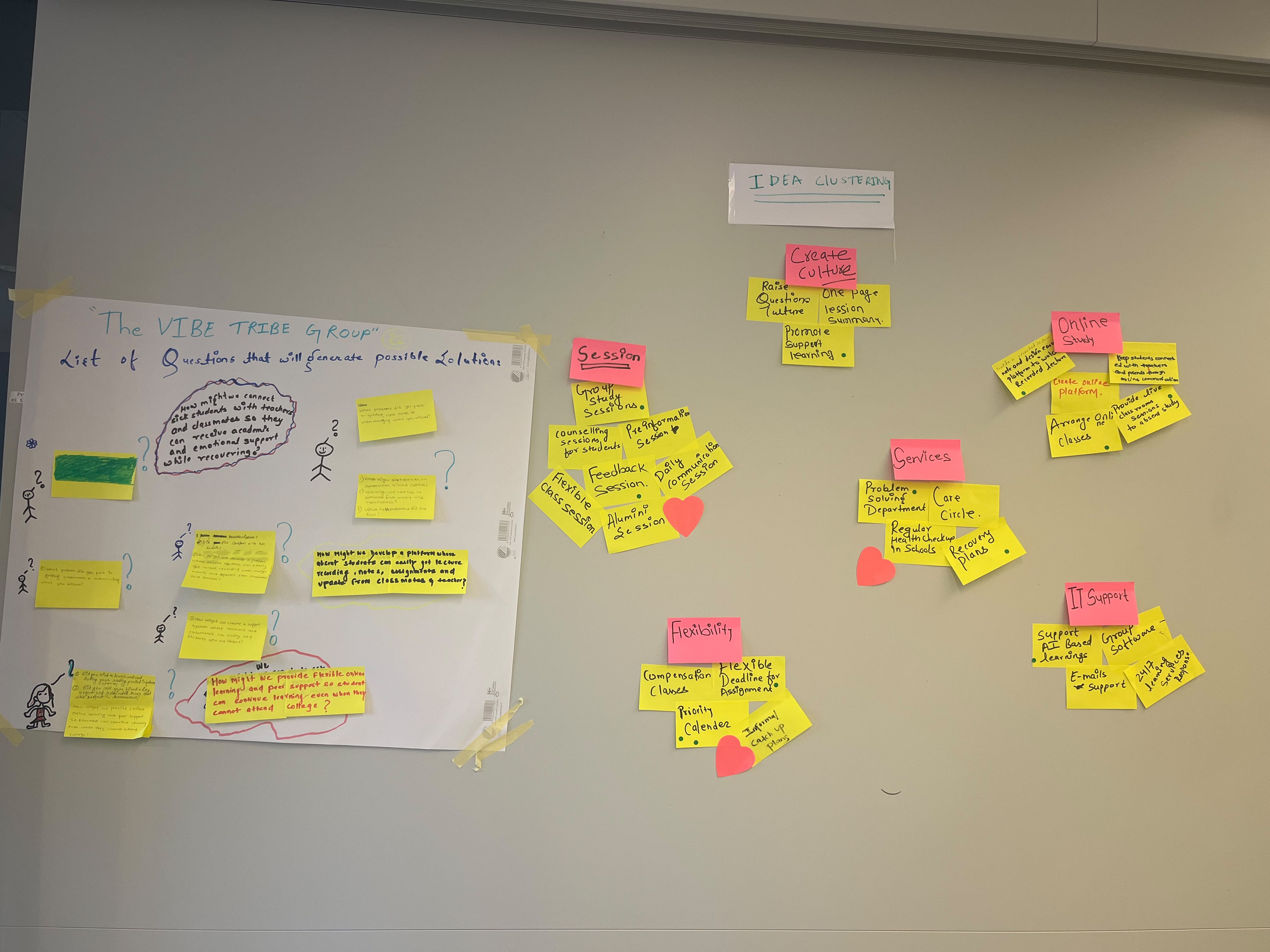
Mootee (2013) connects design thinking to strategic business challenges such as business-model innovation, customer experience, and organisational change. Reading this altered how we thought about empathy. We used to believe that it is just mean being kind to people, but it can also influence which problems a company chooses to address and how it creates value to their customer.

The amazing simple message we learned was that if we genuinely understand customers and question our assumptions, we are less likely to choose the first idea that comes to mind. This is what Liedtka (2015) writes: design thinking can improve innovation by helping decision makers avoid biased thinking.

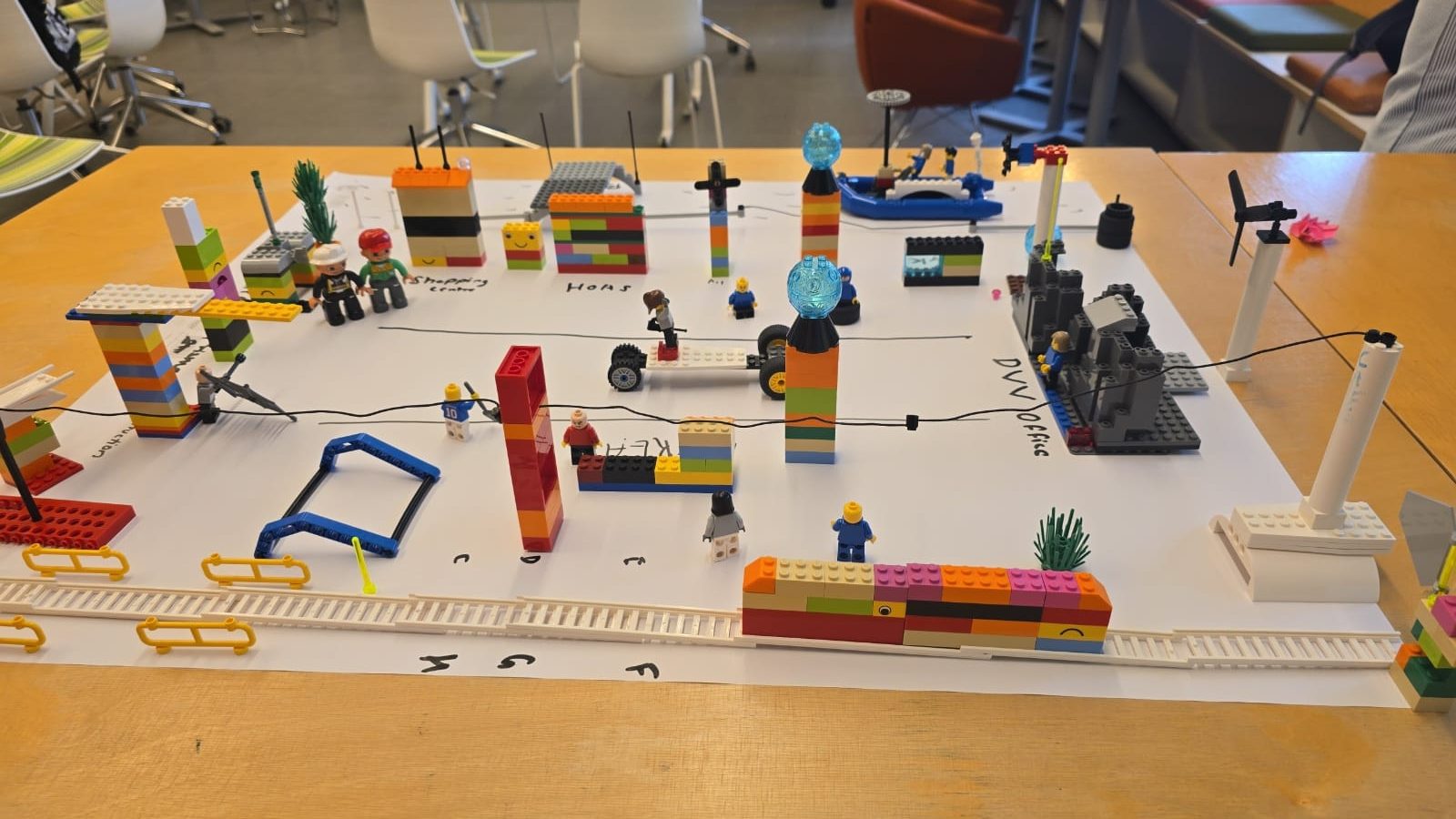
A prototype visualises ideas.

The LEGO prototype helped us to make the idea easier to explain and to examine.
Our biggest takeaway

What really ties our classroom work to the literature most seriously is that innovation starts before the solution exists, with understanding people’s needs, challenging assumptions, and identifying the real problem.

In our upcoming projects, we will ask ourselves two questions before we put forward an idea. Which assumption are we treating as a fact? Whose experience are we overlooking?  We think the real advantage may come from asking better questions early, before everyone commits to the wrong answer.

References

Mootee, I. (2013). Design thinking for strategic innovation: What they can’t teach you at business or design school. John Wiley & Sons.

Shen, Y., Bosch, G., Pino, L., & Gopalan, V. (2024). Use of the ‘double diamond’ design framework to nurture creativity in life sciences research. Trends in Biochemical Sciences, 49(8), 654–657. https://doi.org/10.1016/j.tibs.2024.04.008

Liedtka, J. (2015). Perspective: Linking design thinking with innovation outcomes through cognitive bias reduction. Journal of Product Innovation Management, 32(6), 925–938. https://doi.org/10.1111/jpim.12163

Comments

3 responses to “The Problem Behind the Problem: From Classroom Experiments to Strategic Innovation”

  1. sharmilahamal Avatar
    sharmilahamal

    I would like to thank both of you for your contribution, Sapna and Binu! I found it very interesting how you have related the nine-dot puzzle with the business approach. The idea that the way of thinking we adopt ourselves sets limits on our creativity is a great one since many companies make the same mistake.
    I find it good how you have connected the concept of empathy with the issue of the problems the organization tries to resolve based on Mootee and Liedtka. It was a very useful idea for me.
    The two questions that you gave at the end of your contribution, “Which assumption are we taking for granted?” and “Whose experience do we ignore?”, are practical, and I am going to apply them in my future work.
    I am wondering how a team in a real company can apply your two questions under the pressure of time. Do you think these two questions could become a part of the process of decision making like some kind of checklist before starting the project?

  2. phoolmayadimdungtamang Avatar
    phoolmayadimdungtamang

    Thank you for this post, Sapna and Binu. I preferred it particularly due to your ability to relate a classroom activity to the actual strategic question as opposed to describing events. Nine dots is a relevant choice. The line regarding many firms “handling problems with familiar thinking” seems to be the most valuable part of the post.

    The way you describe how empathy shifts from “being kind” to shaping the decision about what issues a company needs to tackle is impressive. I believe this also influences a way a firm sees its market as well. Empathy studies allow discovering the fact that customers hire the product to perform a different job than one perceived by the company, which opens completely new competitive environment for them. If this piece of information is missing, a company will keep developing a product, which is not the key one for its consumers.

    There is one perspective that can be considered as well. Design Thinking process and the pressures on firms may be incompatible sometimes. Double Diamond requires divergence while business practices tend to favor rapidness and efficiency. As a result, the “define” stage becomes too rushed. This can be one of the reasons why.

    Finally, the LEGO protype that you mentioned makes me wonder if prototyping can be used to test assumption cheaply and not just for explanation of ideas. Thankyou for such an insightful post.

  3. Achut.Neupane Avatar

    Hello Sapna and Binu,

    I found your blog interesting to read, especially when you mentioned the nine dot exercise. This reminded me of how easy it is to put ourselves in a box while basing our thinking process on assumptions unknowingly. In our blog, we talked about how questioning is as important as finding answers.

    Another interesting point you raised was empathy. In our attempt to find answers to our problems, we often fail to put ourselves in the shoes of the person experiencing the problem. I believe this becomes very important in service design where the user experiences a certain service in their own unique way.

    Lastly, your discussion about using LEGO prototyping also made me realize the importance of visualizing ideas and finding issues that could otherwise go unnoticed in discussion. Do you think prototyping could help in identifying hidden assumptions?

Leave a Reply