Step In & Step Out – What We Learnt About Real Problems Using Design Thinking

By Deepesh Khadka, Uma Dhakal Gautam & Rajesh Kumar Shah | Design Thinking Masterclass – 1-2 October 2026 – Lecturer: Elif Öztekin, Laurea University of Applied Sciences.

Have you ever had a perfect plan for your project, only for everything to change? Well we have! But after completing two days of Design Thinking at Laurea we now understand why.
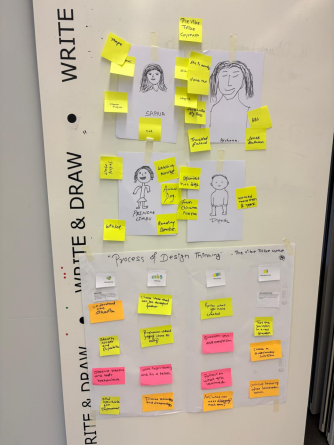
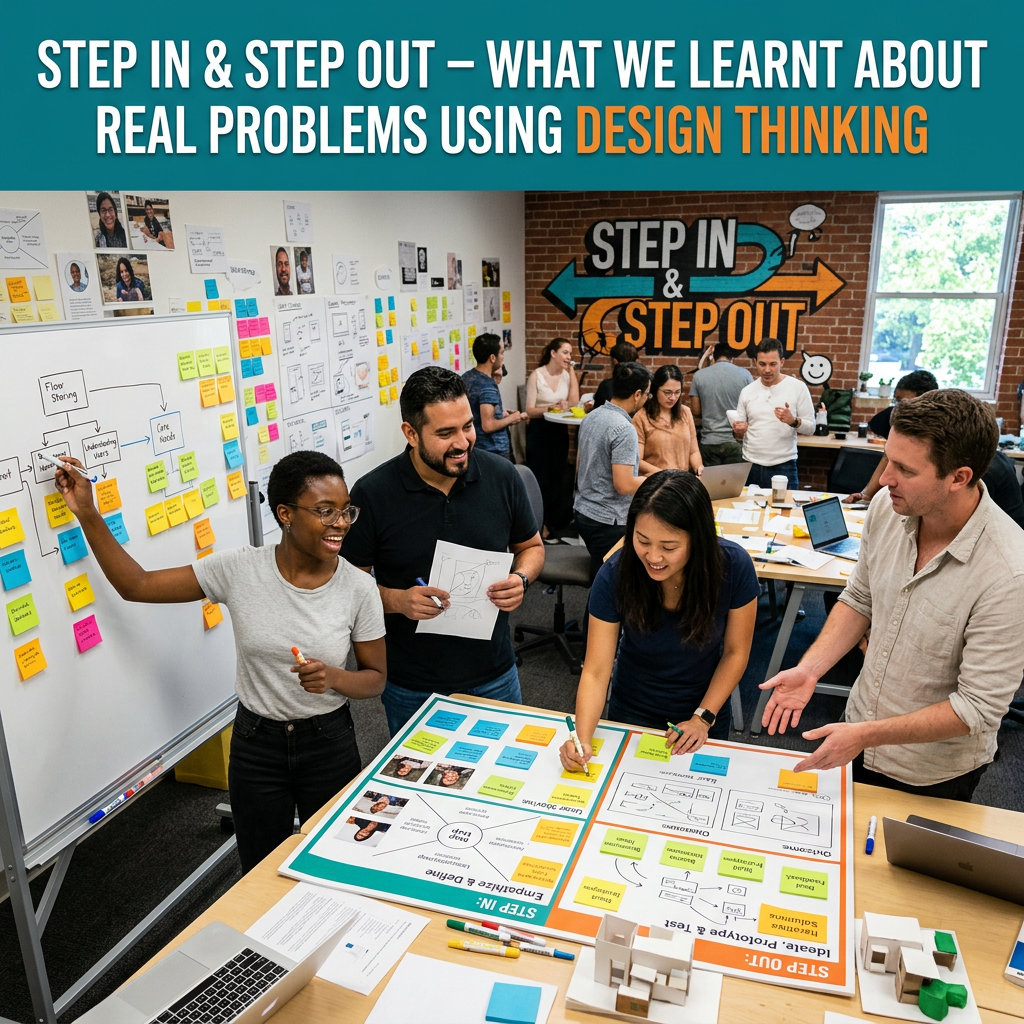
Teamwork at Laurea – 1-2 October 2026. We used notes and posters to develop our ideas.

What We Did In Class

Day 1: We conducted deep interviews in small groups. This consisted of one person telling a story from their student life, one listening and one taking notes. In only 5 minutes we learnt so much more than we would have if we had asked a long list of questions.

Day 2: We developed ‘How Might We’ questions from the knowledge we had gained. We then designed a prototype using LEGO bricks and pitched our design in 2 minutes.

Step In & Step Out

Empathy can be broken down into four stages: discover, immerse, engage and disengage (Kouprie & Sleeswijk Visser, 2009). Basically ‘stepping in’ and ‘stepping out’. During our interview activity we were ‘stepping in’, however without stepping out we would only have empathy for the person. By stepping out we can actually design something.

Wicked Problems

Horst Rittel came up with the idea of ‘wicked problems’ (Buchanan, 1992). These problems are difficult to define and there is no clear end goal. All solutions will impact the problem. Buchanan also explains that the brief isn’t the actual problem, it is just the initial issues to look into. This is why often plans can change once we understand people better.

Think With Your Hands

Innovation involves three stages; inspiration, ideation and implementation (Brown, 2009). We don’t move from one to the next but bounce between them. Prototyping is also central to this process as it involves thinking with your hands.

During our class we created our idea using LEGO bricks on a large piece of paper. We created a model which included an entrance, lobby, session area, playground and problems solving department. We also included some support such as email help and AI based learning. The model wasn’t very detailed but meant we could point to our idea, ask questions and make changes.
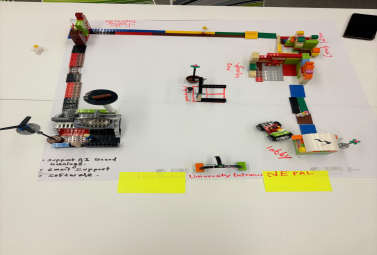
LEGO Prototype – University area using LEGO bricks. Includes session, play and problems solving areas.

Conclusion

The three sources tie in well together. Kouprie & Sleeswijk Visser show us how to identify what is important. Buchanan reminds us that this will constantly change. Brown shows us how to easily test our ideas. Our LEGO model is a good example of this. It was nearly free to create but made our idea easy to talk about. It’s easy to make changes to your idea on a table but once it’s been launched it will cost a lot of money. Overall design thinking is a cycle rather than a linear process. You want to step in early, step out to think and test.

How can teams find time to empathise with people when they are under time pressure?

References

Brown, T. (2009). Change by design: How design thinking can transform organisations and inspire innovation. HarperCollins Publishers.

Buchanan, R. (1992). Wicked problems in design thinking. Design Issues, 8(2), 5-21.

Kouprie, M., & Sleeswijk Visser, F. (2009). A framework for empathy in design: Stepping into and out of the user’s life. Journal of Engineering Design, 20(5), 437-448.

Tschimmel, K. (2026). Design thinking masterclass [Lecture slides]. SID, Laurea University of Applied Sciences.


Comments

7 responses to “Step In & Step Out – What We Learnt About Real Problems Using Design Thinking”

  1. arunkhadka6651fd5044 Avatar
    arunkhadka6651fd5044

    Hi Deepesh, Uma and Rajesh,

    Thanks for sharing your blog post. I really liked the “step in and step out” idea. It’s easy to feel sorry for someone after hearing their story, but you made it clear that real design only starts when you step back and think about what to do with it.

    I was also impressed that you learned so much from a 5-minute interview. It shows that listening well matters more than asking a long list of questions. And the LEGO prototype is a great example of thinking with your hands.

    Well done to all three of you!

  2. limbuprinsha14 Avatar
    limbuprinsha14

    Hello Deepesh, Uma and Rajesh,
    I really enjoyed reading your blog post, especially the way you connected the theoretical concepts of design thinking with your practical experience in the classroom. I found the explanation of “stepping in and stepping out” particularly interesting as it highlights that understanding users’ experiences is not enough; we also need to reflect on those experiences and translate them into meaningful solutions.

    I also agree with your point about prototyping with LEGO bricks. It demonstrates how even simple and low-cost materials can help teams communicate ideas, identify potential challenges and improve solutions before implementation. One additional perspective is that involving users in the testing phase could make these prototypes even more effective, as their feedback may reveal needs that designers have not initially considered.

    Your conclusion that design thinking is a continuous cycle rather than a linear process is very relevant. It reminds us that flexibility and empathy are essential when addressing complex problems. Great work!

  3. limbuprinsha14 Avatar
    limbuprinsha14

    Hello Deepesh, Uma and Rajesh!
    I really enjoyed reading your blog post, especially the way you connected the theoretical concepts of design thinking with your practical experience in classroom . I found the explanation of “stepping in and stepping out” particularly interesting as it highlights that understanding users’ experiences is not enough; we also need to reflect on those experiences and translate them into meaningful solutions.

    I also agree with your point about prototyping with LEGO bricks. It demonstrates how even simple and low-cost materials can help teams communicate ideas, identify potential challenges and improve solutions before implementation. One additional perspective is that involving users in the testing phase could make these prototypes even more effective, as their feedback may reveal needs that designers have not initially considered.

    Your conclusion that design thinking is a continuous cycle rather than a linear process is very relevant. It reminds us that flexibility and empathy are essential when addressing complex problems. Great work!

  4. shojan shrestha Avatar
    shojan shrestha

    Great job of capturing the October sessions Deepesh, Uma and Rajesh! Often the pain point is not in the original brief but when you are actually hearing from people what their experiences are. Taking some time to get an understanding of how they feel in the initial phases of prototyping can ensure users stay engaged without slowing the process down. What made your group decide to combine AI learning with physical spaces (lobby/playground)?

  5. phoolmayadimdungtamang Avatar
    phoolmayadimdungtamang

    Thanks for the insightful post Deepesh , Uma and Rajesh! I really liked the way you’ve framed the post by the phrase “step in and step out.” It helps to easily recall the Kouprie and Sleeswijk Visser approach.

    By pointing out that only stepping in leads us to an empathy toward one person while stepping out is necessary to come up with some design, you’ve touched upon one important thing many designers tend to overlook.

    I also liked your reflection on ways how we can step out wrongly. There is definitely a danger that once we go out of an interview, we might turn a real story of a person into some sort of our own interpretation and use our notes to come up with a design solution for this fictional person. I think that a possible remedy here is to return to the user with some prototype or even a reformulated problem and see whether this prototype reflects reality.

    By referring to wicked problems, you have highlighted that our brief is not the actual problem. But this thought can be elaborated even more. If every solution redefines a problem as Buchanan suggested, then prototypes should not only be used as tools for testing our design. Finally, I am curious to hear if your group changed anything in your concept after the pitch.

  6. archanachudal Avatar
    archanachudal

    Hello Deepesh, Uma and Rajesh

    I enjoyed reading your blog post. I liked how you explained the step in and step out approach and how it helps us understand real problems. It is interesting to see how listening to people’s experiences can help us find better solutions.

    I also liked how you shared your learning from the design thinking activities. I think teamwork and sharing different ideas are important parts of solving problems.

    I have one question: What was the biggest challenge your group faced while using design thinking, and how did you solve it?

    Thank you for sharing your experience. Great work!

  7. partivamadai Avatar
    partivamadai

    Hi Deepesh, Uma and Rajesh,

    I really enjoyed this post! I liked the idea of stepping in and stepping out. Sometimes you’re able to understand others feelings but forget to think about how you can use that knowledge to help solve their problem. This is why I found this interesting.

    I found it surprising how much you were able to learn from the 5 minute interview. Often when creating interviews you can over complicate the questions and end up focusing more on asking the questions rather than listening to the person. Giving them time to talk can help give you a better understanding.

    I also liked the idea of using the Lego bricks. It was a simple and cost-effective way of creating the prototype. This made it easier to give ideas, suggestions and adapt. If they had created the perfect model they may have focussed more on how it looked.

    I think even a quick conversation can help. You don’t always have to ask lengthy questions to understand their problem. Taking a few minutes to listen can help avoid making incorrect decisions.

    Were there any changes you made to your idea after presenting it to the class? Did you get any feedback that made you think differently about your idea?

    Well done all!

Leave a Reply