Listening Before Building

By Chiranjivi Roka & Shojan Shrestha

We walked into lecturer Elif Öztekin’s masterclass on 1 October, we had only a rough idea of design and no clear expectations for the session.. We thought design thinking was mainly about designers and their methods and tools for their product, but we did not fully understand what it meant. Over two days, we learned that real work starts before anything is built by listening to people, understanding their problems, sharing ideas and testing solutions are what lead to meaningful innovation. We left with a new perspective, new ideas, and the confidence to approach problems differently.
.

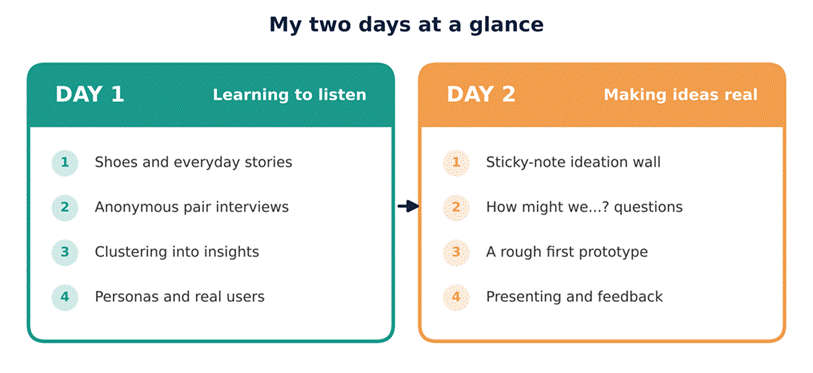
Day one: learning to listen

The first day was all about listening. We got to know each other by pairing up with people and then interviewed each other in pairs. Classmates spoke more openly than expected, and we heard their preferences. Later in the session, we clustered pain point of individual what we had heard into insights and turned them into personas, each built around a specific person’s pain point. Good design begins with human needs, and it felt true as we filled the wall with ideas that started from a real persona (Brown, 2009).

Our Moment: Building a persona and figuring out how we could ease their pain point in that situation.

Before you ask what to build, ask who it is for
Day two: from sticky notes to prototype

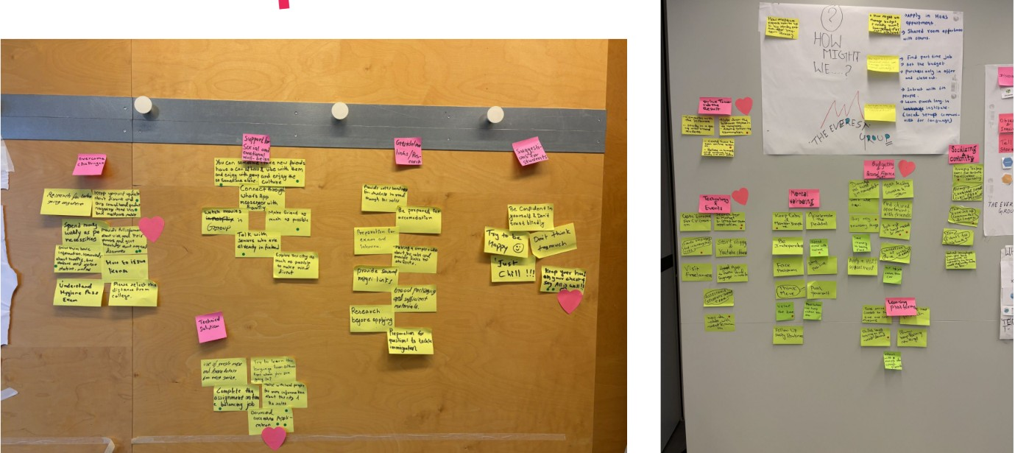
Ideas came next, and the first ones were rarely the best. Our wall filled with sticky notes that we combined, challenged, and refined into persona pain points. We created a technique that combines two unrelated ideas to spark new, unexpected insights through a semantic confrontation process to see what happens. Turning insights into “How might we…?” questions gave our ideas a direction. Our prototype was rough on purpose, because a rough model gave us honest feedback. ( Kelley, 2013), Call the courage to try, fail, and try again ” creative confidence.”
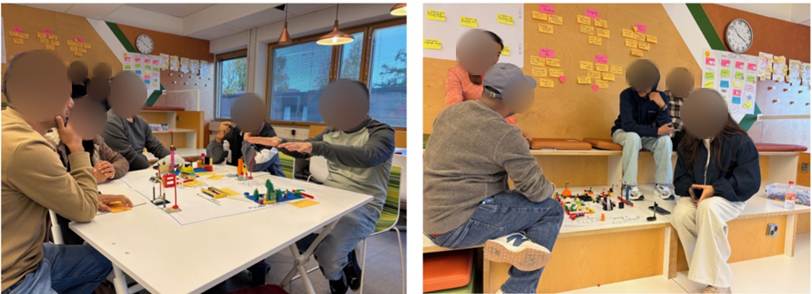
Presenting our idea

Presenting made the process feel real. Explaining our idea to others showed us which parts we truly understood, such as the persona’s situation, what they were dealing with at that moment, and how we could ease their pain point, and which parts we had only assumed.
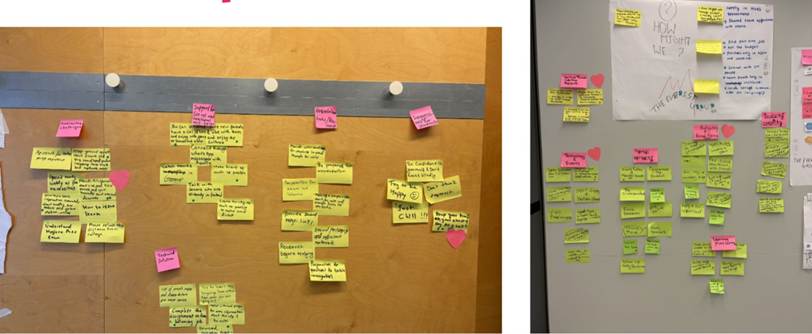
Messy, and that is fine

We draw on (Richard Buchanan’s 1992) idea of wicked problems and accept that progress is a zig-zag line rather than a straight line. A method is a starting point to adapt, not a script. (Mark Stickdorn, 2011) describes service design as co-creation, and our table somehow roughly proved it. The best ideas appeared when different backgrounds read the same problem differently.
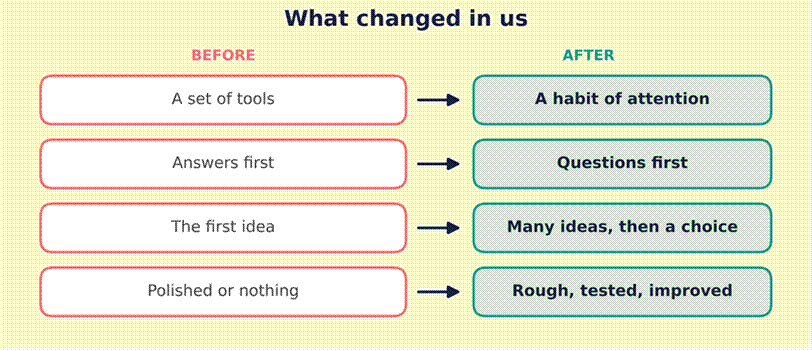
We did not become an expert in two days. We gained something we needed more about the perception of design thinking. the habit of listening before building, and the confidence to ask better questions and to act when the answer is unclear, which will help us in the real working world.

References

Kelley, D. and Kelley, T. (2013) Creative confidence: unleashing the creative potential within us all. New York: Crown Business.

Brown, Tim (2008) Design Thinking. Harvard Business Review

Buchanan, R. (1992) Wicked problems in design thinking. Design Issues.

Norman, D. A. 1. k. 2013. The design of everyday things. Revised and expanded edition. New York, NY: Basic Books.

Mark Stickdorn, (2011) This is service design thinking.

Figures

Some of images were created using ChatGPT, with some based on original photographs and screenshots from our Design Thinking workshop.

Comments

3 responses to “Listening Before Building”

  1. Rupa Kumari Thapa Avatar
    Rupa Kumari Thapa

    Hi Chiranjivi and Shojan, thank you for writing this so clearly. I really enjoyed reading your blog.

    What stayed with me most was your idea from Day 1 – “Before you ask what to build, ask who it is for.” When we did the pair interviews, I also realised listening is not easy. We had to really focus to find the real pain point behind what the person was saying, not just what they said first.

    I also liked your Day 2 part about a rough prototype. I used to think everything has to look perfect before showing it, but you made me understand that a rough model gives more honest feedback. Your Before / After table was very clear for me, especially “Answers first” to “Questions first”.

    One question – when you presented your idea, did you find any part where you had only assumed something? For me, presenting showed me what I had not understood properly yet.

    Thank you again, your blog gave me more confidence to listen first and try, even if it is not perfect.

  2. arunkhadka6651fd5044 Avatar
    arunkhadka6651fd5044

    Hi Chiranjivi and Shojan,

    Really nice post and I enjoyed reading it. I really like the idea of listening before building. It sounds simple, but many people skip it and jump straight to making something.

    The part about building a rough prototype on purpose was my favorite part. It is a good reminder that things don’t have to be perfect to get honest feedback. I also liked what you said about messy progress. It makes the whole process feel less scary.

    Thanks for sharing what you learned from the masterclass. It made me want to try this way of thinking myself. Well done to you both!

  3. sagarshresthae24322893f Avatar
    sagarshresthae24322893f

    Hi Chiranjivi and Shojan,

    I would like to thanks for sharing this reflective post. I liked that you began by admitting that you had a rough idea of design thinking and no clear expectations. That makes the shift, in your understanding and your title, “Listening Before Building” captures the lesson of the two days in a very clear way.

    Interviewing each other in pairs and then turning the main points into personas shows how Brown’s (2009) idea of starting from human needs works in practice. You also clarify that classmates spoke more openly than you expected. So, it clearly shows that to get a quality outcome, you have to listen carefully while interviewing.

    Your reflection on presenting the idea was a strong moment for me. When ideas are explained well, it shows which parts are understood and which are assumed. It also connects to Kelley and Kelley’s (2013) idea of confidence because showing work that isn’t done yet needs bravery.

    In addition, what I liked the most about this blog is that you explain the best ideas came when different backgrounds read the same problem differently. This fits Stickdorn’s (2011) view of service design as co-creation. I wonder if a mixed group could go further. For example, adding someone who’s not a student but who actually faces the pain point might help the group. Their view might challenge your persona in ways your table could not. Finally, your idea that a method is a starting point to adapt, not a script, connects well to Buchanan’s (1992) wicked problems. Thank you again for the post. I wish you the best of luck as you apply the habit of listening before building in your work.

Leave a Reply