
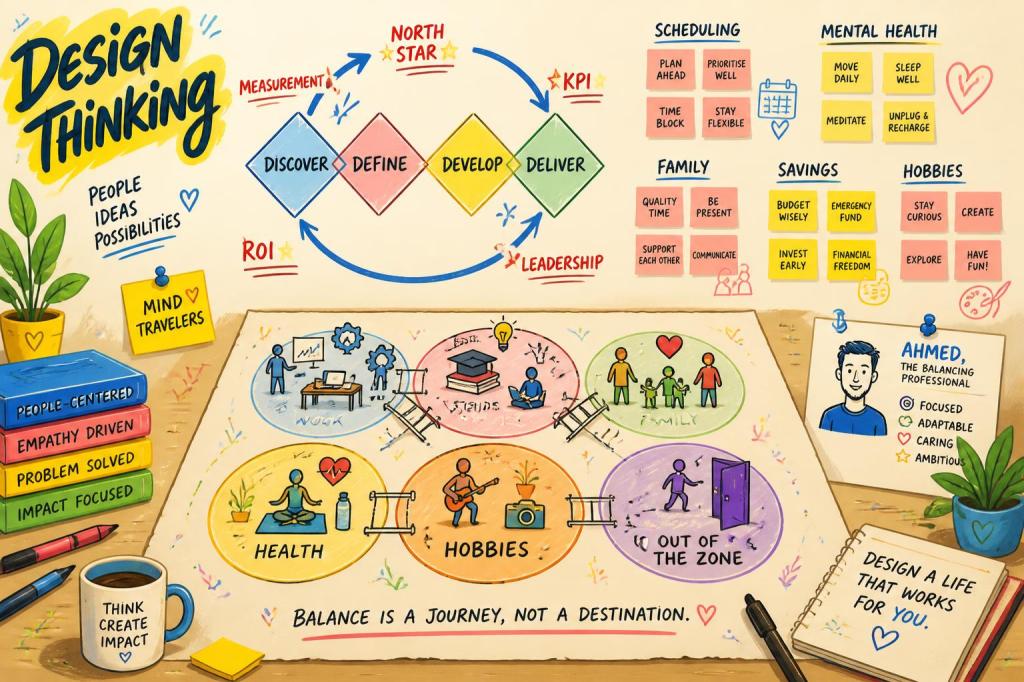
by Asad Hussain & Anu Maharjan
We arrived at Katja Tschimmel’s two-day masterclass expecting a toolkit. We left with a reframed problem, a paper map covered in Lego, and a clearer answer to why design thinking can survive in organisations where other innovation methods quietly die.
Day 1: what a model leaves out
Day 1 moved from Design Thinking 1.0 to 4.0 and through four process models, from IDEO’s 3I to the Double Diamond (Tschimmel 2026). What struck us was that the five principles stayed the same underneath all of them (Tschimmel 2022).
Our group, Mind Travelers, redrew the 2019 Double Diamond (Design Council n.d.) into our own 2026 version. We wrapped the two diamonds in a closed feedback loop and pushed the invisible work to the outside: measurement (KPIs, ROI), leadership and decision-making orientation, and a north star at delivery. Redrawing it forced us to argue about what each model leaves out.
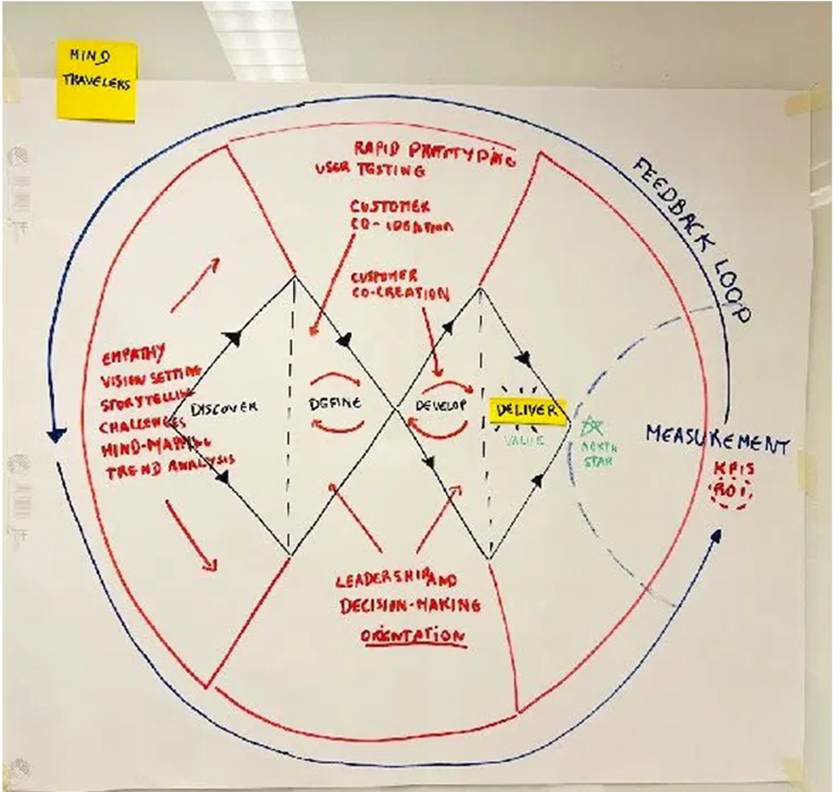
Our redrawn Double Diamond with its feedback loop.
Day 2: the reframe
Our in-class peer interviews produced Ahmed Rahman, the Balancing Professional. Forty, full-time product manager, master’s student, two children, yoga twice a week when the week allows it.
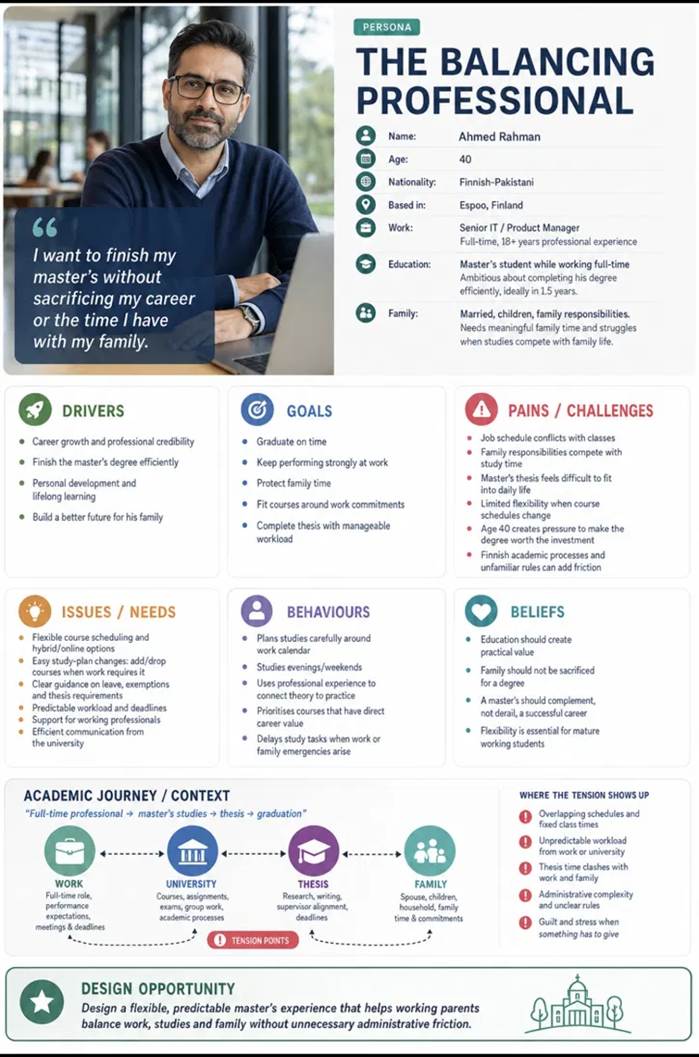
Persona card from our peer interviews.
His problem was not a shortage of hours. Work, studies, family and health each sat in a separate calendar, and nobody else in the household could see any of them. That insight moved our “How might we…?” question away from freeing up time and towards making one life visible in one place, to him and his family.
Cankurtaran and Beverland (2020) describe this kind of first move as disrupt, and warn that organisations under pressure rush past it. Their example is BrewDog, whose first batch of hand sanitiser was rejected for missing the alcohol level hospitals required, and only worked once reformulated with the NHS.
Brainwriting and semantic confrontations, where we collided our challenge with a fintech app, produced around fifty ideas in minutes. Clustering sorted them into themes: scheduling, mental health, family, savings and hobbies.
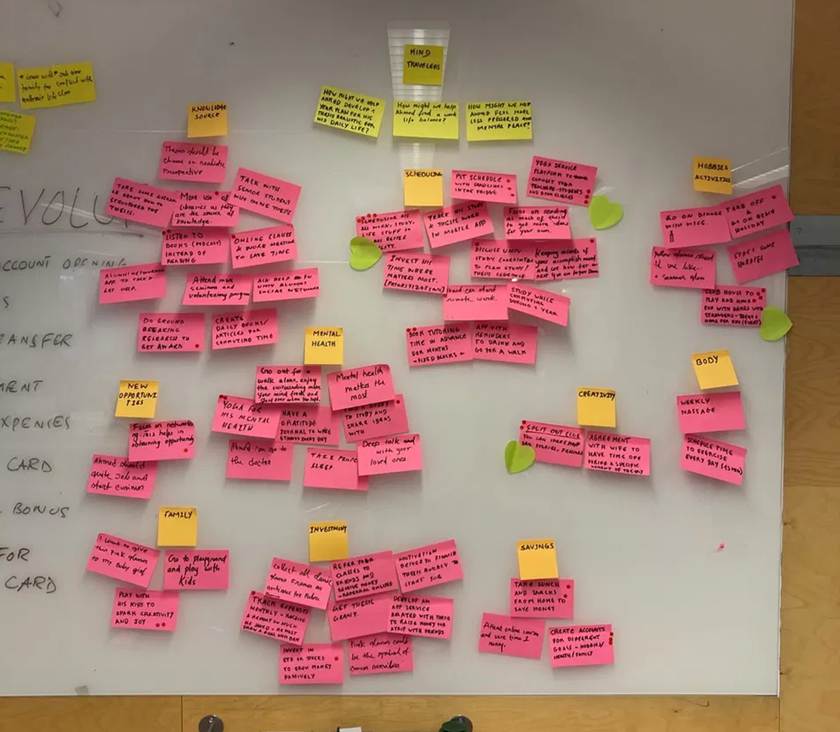
Fifty-odd ideas, clustered into themes.
The concept that took hold was Life Loop, six life spaces in one household view: work, studies, family, health, hobbies and “out of the zone”. We prototyped it as a desktop walkthrough with Lego figures running between the circles. We also had a working app, but with three minutes to pitch we spent them on the problem, value and journey, and showed the paper map.
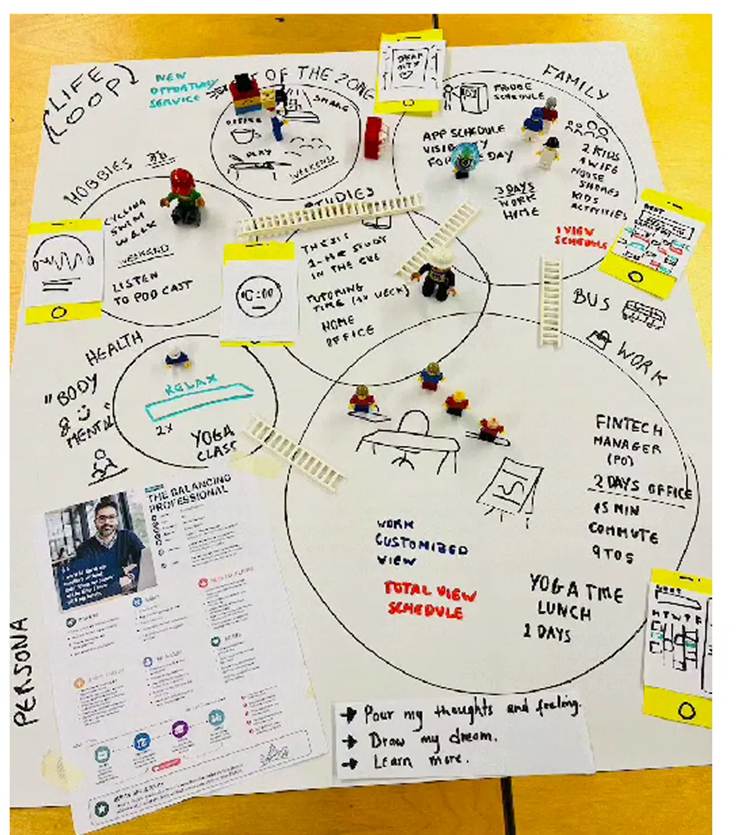
Life Loop: six life spaces, one shared view.
Brown (2009) describes the work as three overlapping spaces, inspiration, ideation and implementation, and calls prototyping building to think rather than a way of confirming an answer. On our table that was literal. Building the map was how we worked out what the concept was.
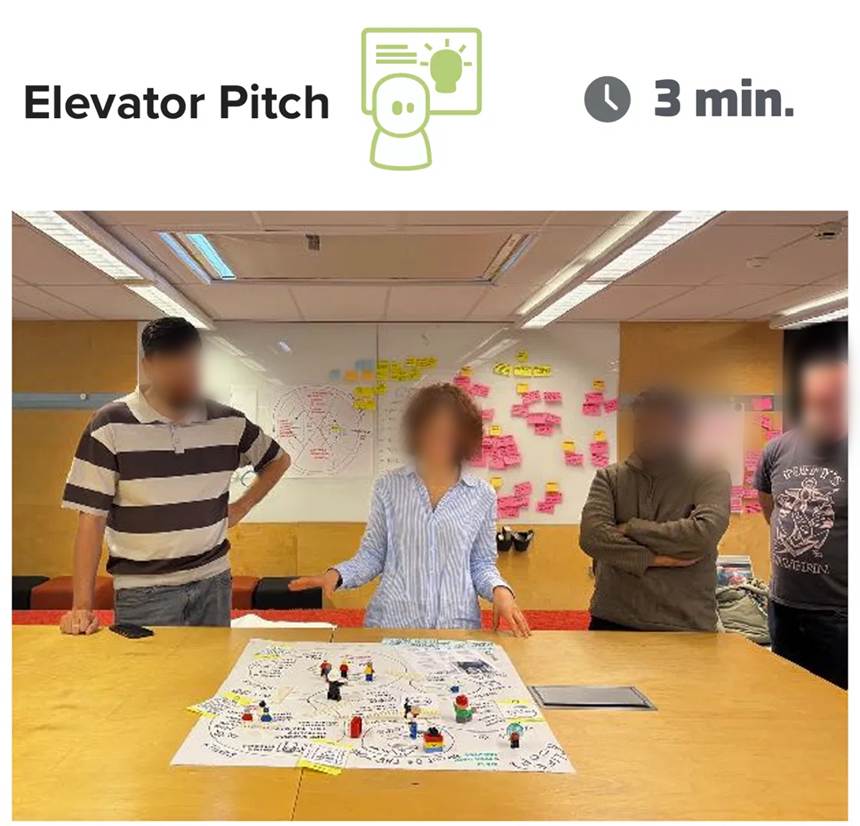
Our three-minute pitch. Faces blurred for privacy.
What we took away
According to Liedtka (2020), design thinking works as a social technology, a set of techniques that make innovation conversations more productive, reduce cognitive bias and align people who frame the problem differently. That is what happened at our table. The Lego map gave four people meeting for the first time something to point at, and kept the focus on the concept rather than on who was talking.
One of us works as a product owner on a regulated B2B product, where the prototype usually arrives after the decision, to validate it. Two days of Lego rearranged that.
Bibliography
Brown, T. 2009. Change by design: how design thinking transforms organizations and inspires innovation. New York: HarperBusiness.
Cankurtaran, P. & Beverland, M. B. 2020. Using design thinking to respond to crises: B2B lessons from the 2020 COVID-19 pandemic. Industrial Marketing Management, 88, 255-260. Accessed 27 September 2026. https://doi.org/10.1016/j.indmarman.2020.05.030
Design Council. n.d. The Double Diamond. Accessed 27 September 2026. https://www.designcouncil.org.uk/resources/the-double-diamond/
Liedtka, J. 2020. Putting technology in its place: design thinking’s social technology at work. California Management Review, 62 (2), 53-83. Accessed 27 September 2026. https://doi.org/10.1177/0008125619897391
Tschimmel, K. (ed.) 2022. Creativity and innovation affairs: are they or are they not…? Porto: Ed. Mindshake.
Tschimmel, K. 2026. Design thinking masterclass at SID. [lecture]. Held on 4-5 September. Laurea University of Applied Sciences.
Images
All photographs and the persona card are our own, taken during the Design Thinking class at Laurea University. The cover graphic was generated with an AI image tool from our workshop material.


Leave a Reply