
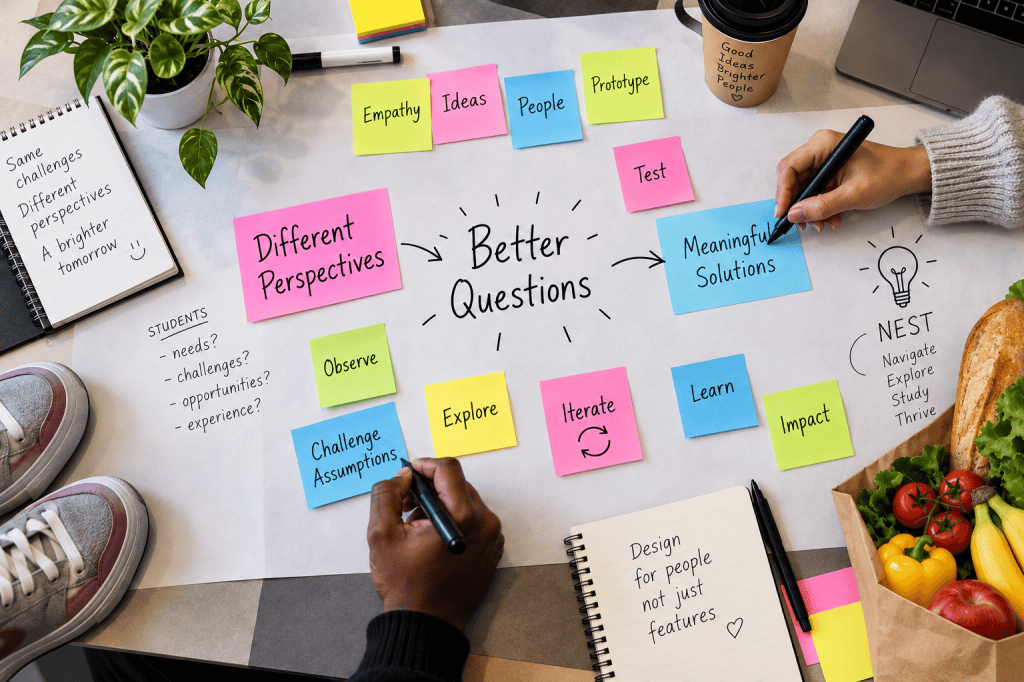
Written by: Olukayode Adebiyi & Kirsti Earl
Our design thinking journey began from different perspectives.
During Laurea’s second-phase admission process, we took part in a group discussion about how artificial intelligence is shaping our world. Kirsti saw many possibilities in AI while also noting that how we use it matters. Olukayode was more cautious about how much personal information and decision-making we are willing to hand over to technology.
Online grocery shopping became our unlikely example. Do we want others to select which tomato looks right or which avocado feels perfect, when these choices are based on personal preference? What one person would choose, another might leave behind. What we discovered was that different perspectives create better questions.
From strangers to Chill Gang 5.0
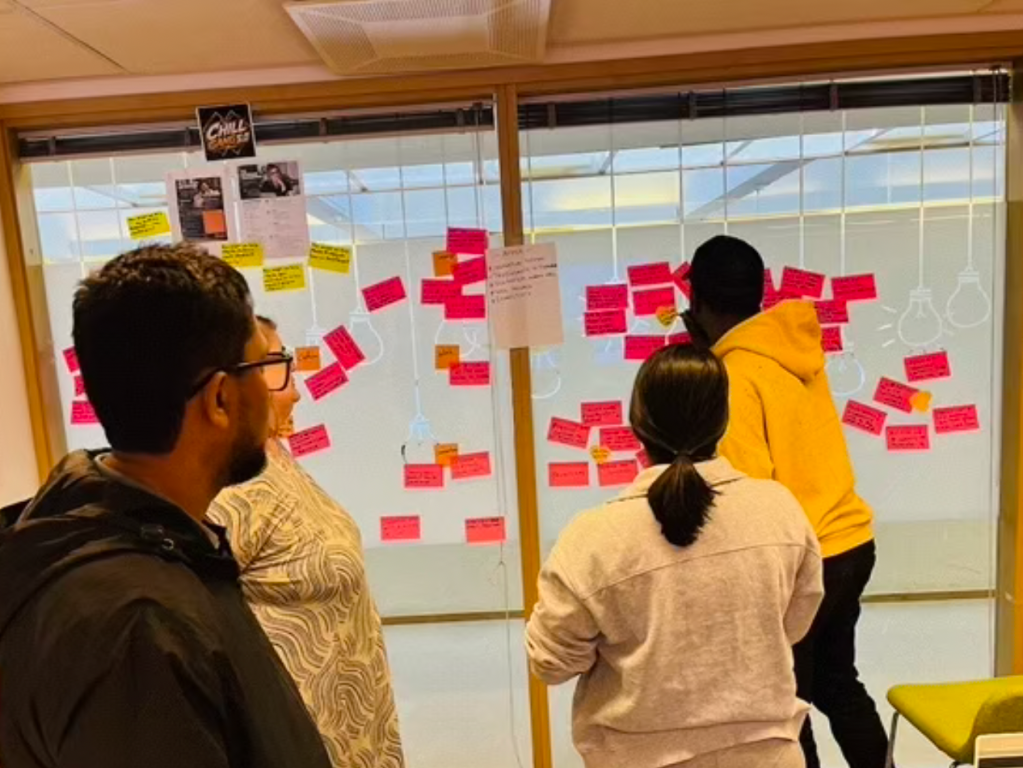
When we met again during orientation, there was already a sense of familiarity. In Tschimmel’s (2026) intensive Design Thinking Masterclass, we were assigned to a group and became part of Chill Gang 5.0.
The two days were fast-paced, visual, and highly collaborative. We interviewed each other, clustered observations, and challenged our assumptions before moving on to generate ideas. Each step pushed us to look at the problem from a different angle rather than jumping straight to a solution. This connected with Buchanan’s (1992) idea of wicked problems. Design problems are not always clearly defined, and how we frame a problem influences the solutions we begin to see. Brown (2008) describes design thinking as a human-centred approach to innovation. We experienced this in practice by learning to ask, “Who are we designing for, and what do they really need?” before asking, “What should we build?”
Empathy can start with shoes
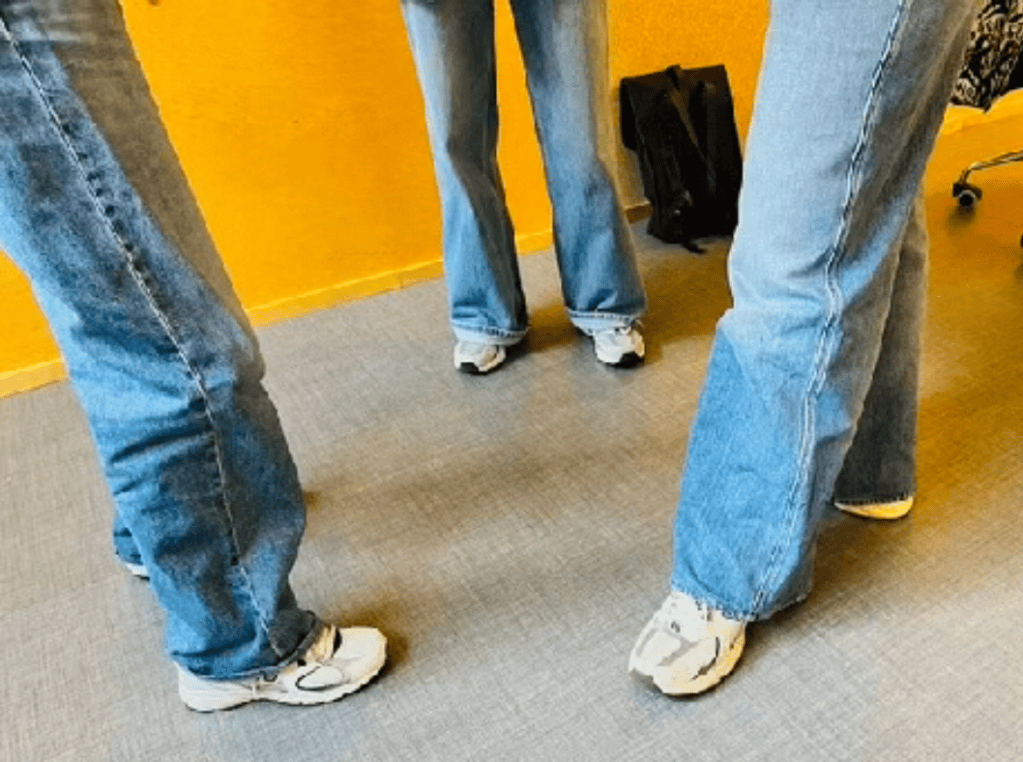
One memorable exercise began with something surprisingly simple: shoes. We found people wearing similar shoes and talked about why we had chosen them, how comfortable they were, and what influenced our choices. An everyday object suddenly revealed personal stories, habits and preferences.
The exercise gave us a simple lesson in empathy. What we see does not necessarily tell us the whole story. Kouprie and Sleeswijk Visser (2009) describe empathy in design as stepping into another person’s world, connecting with their experience and then stepping back to reflect. We carried this mindset into creating personas and exploring the challenges faced by new and international students. These insights then became the starting point for our ideas.
Our first idea was not our final idea
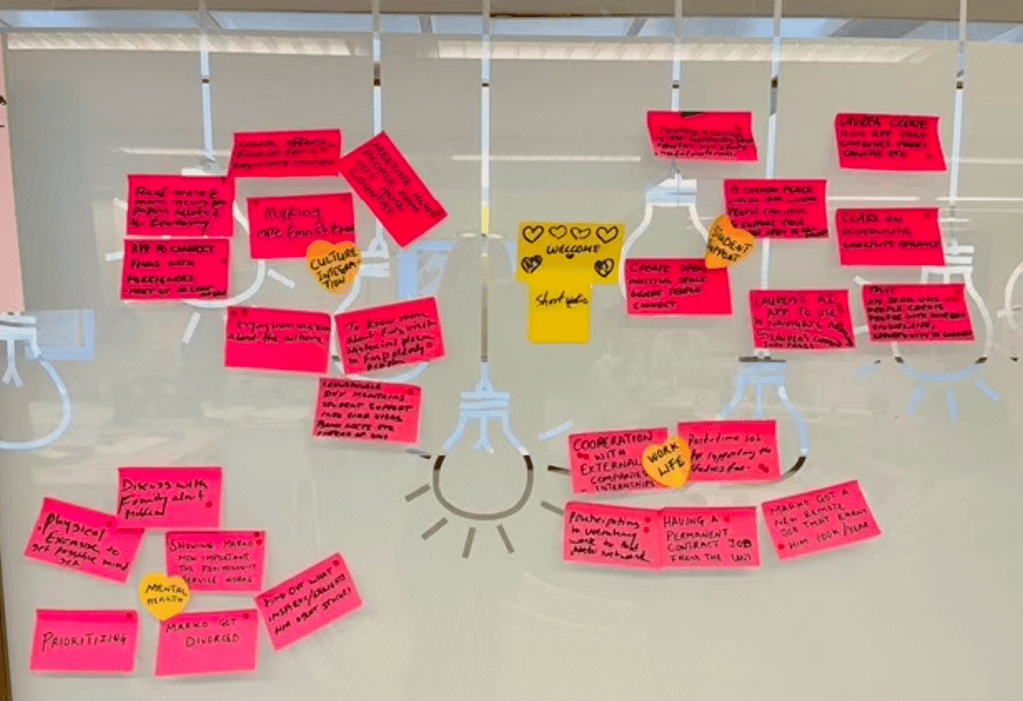
During the ideation exercises, we also learned not to settle too quickly. The goal was first to create possibilities rather than judge them. Our wall filled with sticky notes as we built on each other’s ideas, combined them and explored different directions. Some ideas disappeared while others sparked something new. We began to see that letting go of an idea was not a failure, but part of finding a stronger solution. This experience also connected with Kelley and Kelley’s (2013) idea of creative confidence. It means having the courage to act on ideas, experiment and learn without being afraid of getting things wrong.
From insights to NEST
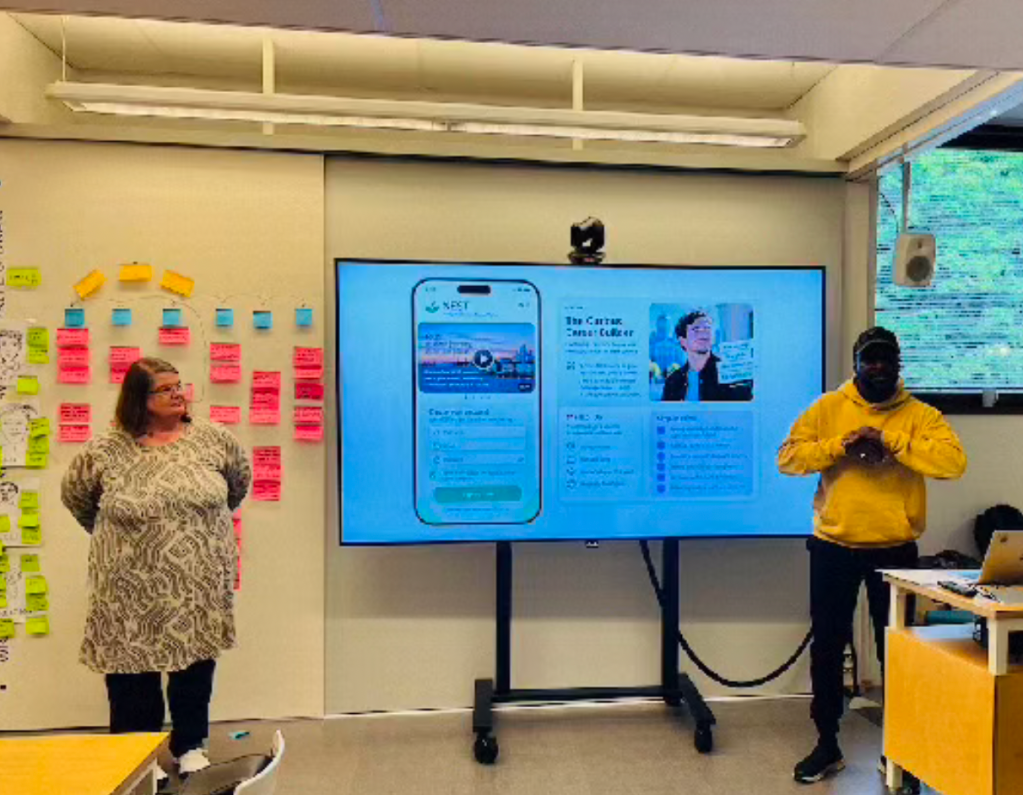
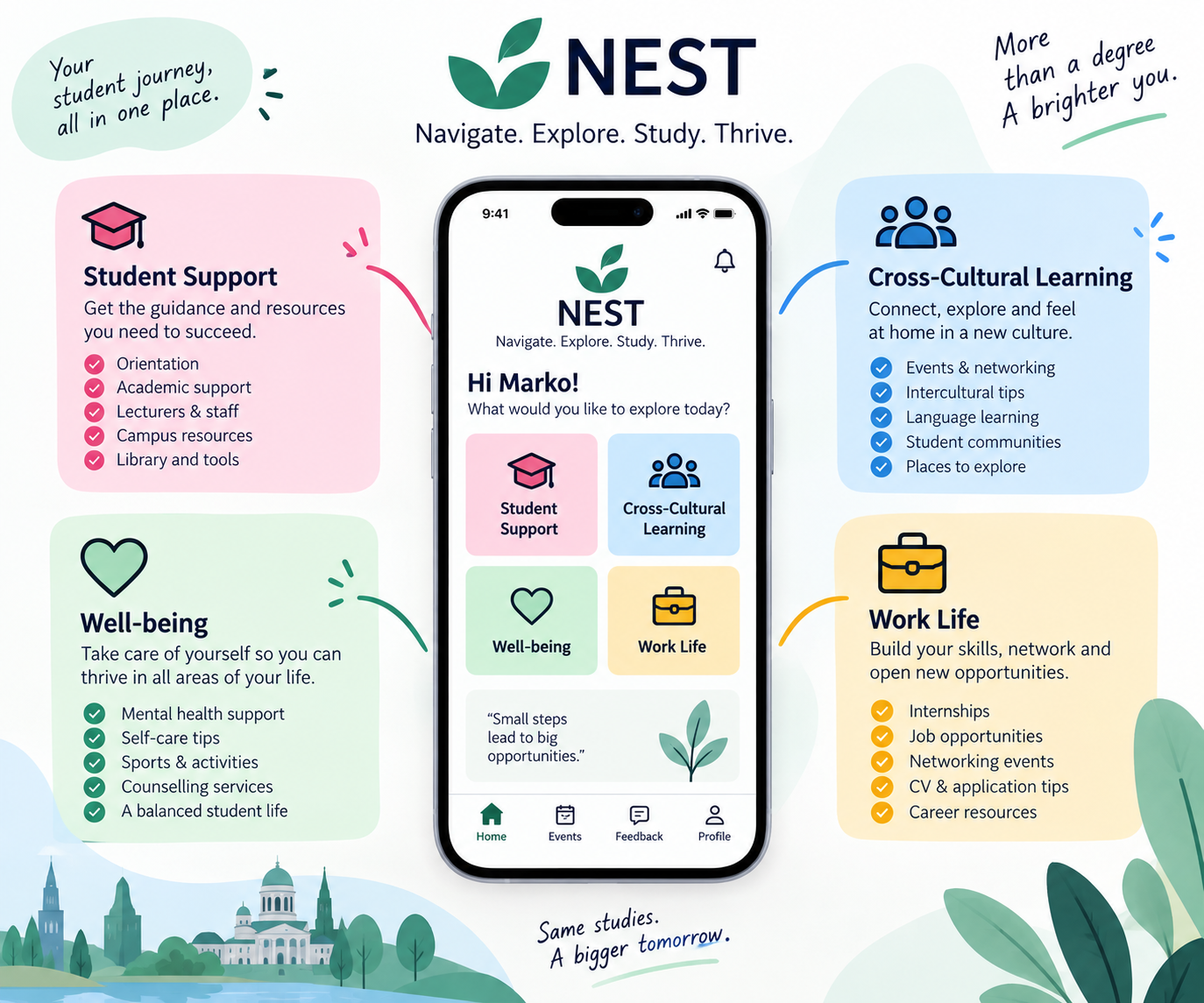
The process eventually led us to NEST – Navigate, Explore, Study, Thrive – an app-based prototype concept designed to support students during orientation and throughout their studies. Kolko (2015) emphasizes the importance of focusing on the user experience and making interactions with systems more intuitive and human. As we developed the concept for NEST, this reinforced the need to design around students’ needs rather than simply focusing on the features of the app. NEST was not one brilliant idea that appeared suddenly. It grew through listening, reframing, discussing, rejecting, combining, and testing.
That may be our biggest takeaway from the Masterclass. Design thinking gave us a way to explore different perspectives rather than trying to find the right answer too quickly. By listening, questioning assumptions and experimenting with ideas, we were able to turn those different perspectives into something meaningful.
Different perspectives + empathy + experimentation = better questions and more meaningful solutions.
References
Brown, T. 2008. Design thinking. Harvard Business Review, 86 (6), 84-95. Accessed 18 September 2026. https://designthinkingmeite.web.unc.edu/wp-content/uploads/sites/22337/2020/02/Tim-Brown-Design-Thinking.pdf
Buchanan, R. 1992. Wicked problems in design thinking. Design Issues, 8 (2), 5-21. Accessed 18 September 2026. https://web.mit.edu/jrankin/www/engin_as_lib_art/Design_thinking.pdf
Kelley, D. & Kelley, T. 2013. Creative confidence: Unleashing the creative potential within us all. New York: Crown Business.
Kolko, J. 2015. Design thinking comes of age. Harvard Business Review, 93 (9), 66-71. Accessed 18 September 2026. https://cdn-assets.fedwebplatform.org/fed-42/2892/design_thinking_comes_of_age.pdf
Kouprie, M. & Sleeswijk Visser, F. 2009. A framework for empathy in design: stepping into and out of the user’s life. Journal of Engineering Design, 20 (5), 437-448. https://doi.org/10.1080/09544820902875033
Tschimmel, K. 2026. Design thinking masterclass at SID. [lecture]. Held on 4–5 September. Laurea University of Applied Sciences.
Images
The featured image was created with the help of ChatGPT. Workshop photographs were provided by the Design Thinking Masterclass instructors, Laurea University of Applied Sciences.


Leave a Reply