
You know the Fazer chocolates, right? You have seen them at the airports at least.
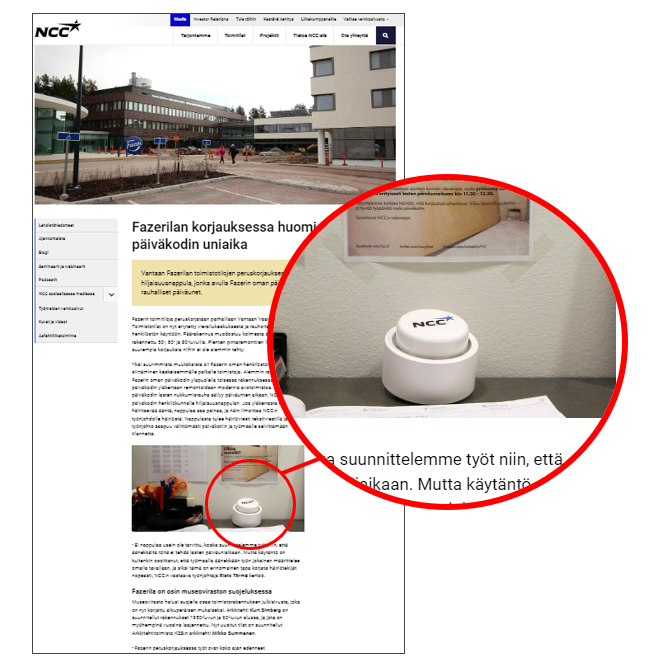
Some years ago, a construction company called NCC in Finland had to renovate an office above a nursery at the Fazer chocolate factory. This created a challenge: how to keep the noisy construction from waking up the toddlers during their daily nap?
The solution was clever yet straightforward. NCC gave a big button to the nursery staff. When pressed, it sent a message to the construction team to stop making noise temporarily. There was a schedule for quiet times, but if a child was still sleeping, they could press the button to extend the peaceful time.
Through deep understanding of the user’s circumstances and experiences, we are able to put ourselves in other people’s shoes. Empathy allows us to relate to the user, understanding the same feelings that the users feel, more than just knowing about the user (Kouprie & Visser, 2009).
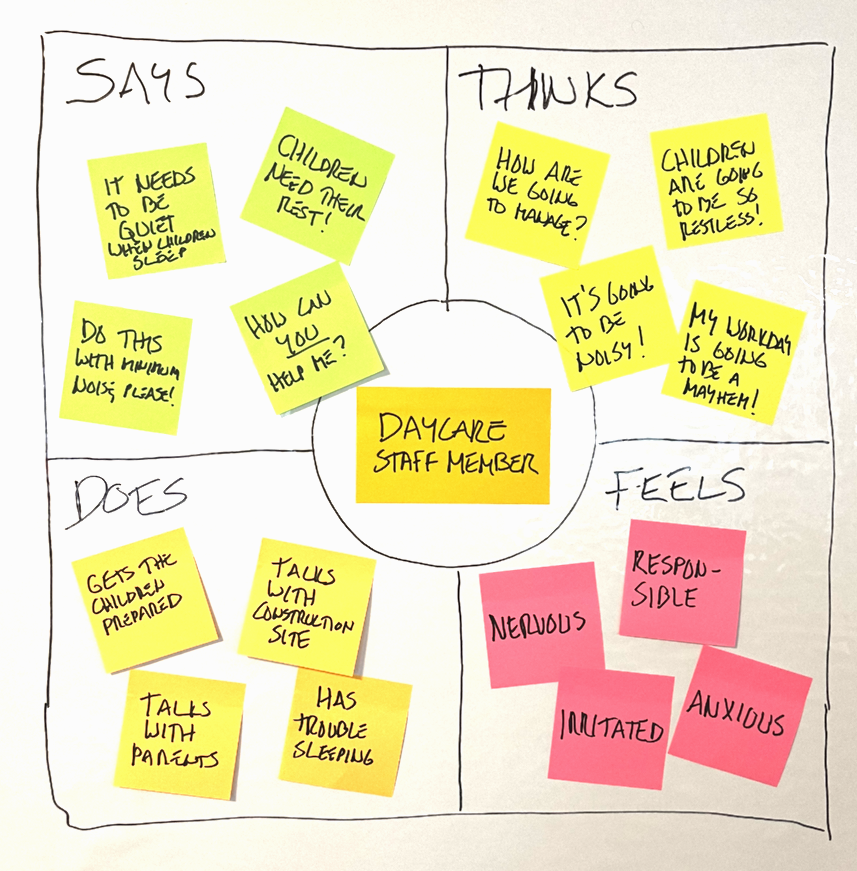
Although Kouprie and Sleeswijk Visser (2009) point out that the definitions of empathy are rather vague, in the example of the construction mute button the impact of empathy is self-evident: A child waking up to loud construction noise would have been scared. It helped the nursery staff, who didn’t have to deal with upset children. And it made the parents happy, knowing their kids were well-rested as they picked them up.
This is where Design Thinking comes into play. It is a human-centered problem-solving approach that keeps the user at the core of the design process. It empowers us to create solutions that resonate to the user’s emotional needs and align with their desires, blending human needs with technology and business feasibility (Brown, 2008).
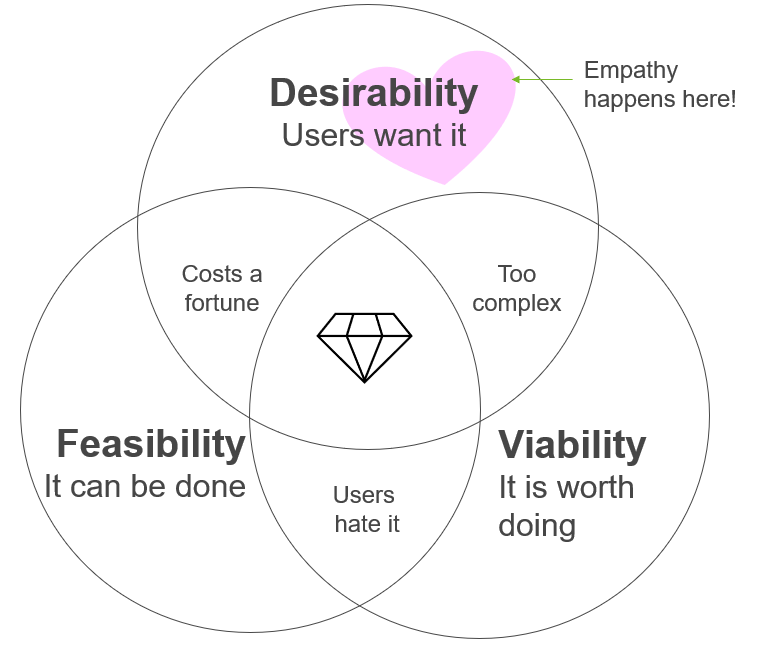
Tim Brown writes in Harvard Business Review (2008): “Contrary to popular opinion, you don’t need weird shoes or a black turtlenext to be a design thinker”. Although the construction site workers most certainly did not think about design thinking theories, they still managed to master the impact of empathy in their service.
Written by Service Innovation and Design MBA students Elisa H. and Pirita V.
References:
Brown, Tim. Change by Design. HarperCollins Publishers. 2009
Brown, Tim. Design Thinking. Harvard Business Review. June 2008.
Fazerilan korjauksessa huomioidaan päiväkodin uniaika. 2017. https://www.ncc.fi/media/ajankohtaista/fazerilan-korjauksessa-huomioidaan-paivakodin-uniaika/
Kouprie, Merlijn & Slleswijk Visse, Froukje. A framework for empathy in design: stepping into and out of the user’s life. Journal of Engineeringn Design Vol 20, No. 5, October 2009, 437-448.
Stickdorn, M., Lawrence, A., Hormess, M. E. & Schneider, J. 2018. This is Service Design Thinking Doing Methods.


Leave a reply to irinatikanvaara Cancel reply