
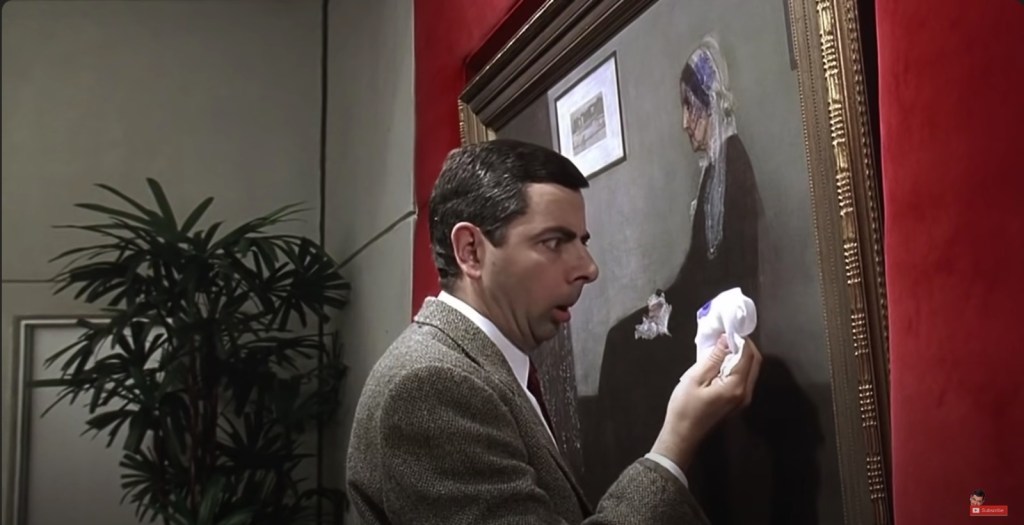
Today we have all kinds of complex problems that need holistic solutions. Sometimes we do not even know what the problem is – so how can we ideate solutions then?
A non-linear and iterative approach, Design Thinking, has offered a choice for solving complex problems – and impacted extensively the modern world’s innovations in business and society. We dove into the world of Design Thinking as fresh Service Innovation and Design students, and this is what we found out.

Mr. Bean tries out different solutions in the movie Bean, 1997.
What is and what if?
There are many parties involved in the Design Thinking creation process. The interdisciplinary team enters the existing situation by researching, observing, interviewing, etc. This is how the team gets insights to be able to picture out the actual needs behind problems: what is the real problem that needs to be solved? (Brown 2009, 39–48).
In addition, to get a response to ”What is?” Design thinkers want to ask ”What if? (Kimbell 2011, 287). To find out different possible solutions to existing problems, Design Thinking offers multiple tools and methods. Here are some examples Professor Daniela Marzavan taught us during the contact lessons in the Design Thinking course at Laurea, University of Applied Sciences.

Drawing by Mr. Bean in the movie Bean, 1997.
Ideation and prototyping – success or failure?
Daniela Marzavan (2023) gave us a challenge: create a wallet for a partner. The initial phase of the project was the interviewing process to comprehend the partner’s requirements. As Tim Brown states in his book Change by Design, “Empathy is the mental habit that moves us beyond thinking of people as laboratory rats or standard deviations” (Brown 2009, 93). Interviewing a partner and collecting insights, might have felt hard because one had to build a connection, so the partner felt comfortable sharing valuable information. After the interviewing, insights were transformed into ideas, and then the ideation and prototyping began.
It’s crucial to understand the user’s circumstances and experiences, which requires more than just knowing about the user (Kouprie & Sleeswijk Visser, 2009). Coming from an intangible into a tangible prototype, it’s easier to test if this prototype works for your customer. The sooner you realize that your prototypes aren’t meeting the needs of your clients, the faster you’ll come up with new concepts. The idea is not to be afraid of making mistakes!
According to Tim Brown (2009, 26–28), to gain the best results, there should be an interdisciplinary, “smart team” with an optimistic mindset and joint trust. This kind of team blurs the line between designers and other professional groups – and Design Thinking also blurs the line between companies and individuals, as well as between creators and customers (Brown 2009, 55-61).
Mr.Bean presents his solution in the movie Bean, 1997.
So what does Mr. Bean have to do with all this?
As an example, Mr. Bean, a beloved character from a British sitcom, would have struggled to find the right solution in the movie Bean. Our journey through Design Thinking, like Mr. Bean's, reminds us not to jump to solutions before thoroughly understanding the problem. Mr. Bean's courage in pursuing innovative concepts emphasizes the importance of accepting failure in the creative process. So, don’t be afraid to be innovative – embrace failing and rethinking!
Written by Iryna Bohun and Susanna Hulkkonen
Pictures and video material from the movie Bean, 1997. Directed by Mel Smith. Working Title Films and Tiger Aspect Films.
References:
Brown, T. 2009. Change by design: how design thinking can transform organizations and inspire innovation. New York: HarperCollins Publishers.
Kimbell, L. 2011. Rethinking Design Thinking: Part 1. Design & Culture, Vol. 3 (3). 285–306.
Kouprie, M., Sleeswijk Visser, F. 2009. A framework for empathy in design: stepping into and out of the user's life. Journal of engineering design Vol.20 (5), 437–448.
Marzavan, D. 2023. Design Thinking [lecture material]. Held on 8 and 9 September 2023. Laurea University of Applied Sciences.
Mr Bean, 31.12.2019. Art DISASTER | Bean Movie | Funny Clips | Mr Bean Official Youtube. https://www.youtube.com/watch?v=QTli1HU9axY


Leave a reply to jennijappinen Cancel reply