From Sticky Notes to Real Understanding: Our First Steps in Design Thinking

By Santosh Lamichhane and Arun Khadka


Starting point: What is design thinking?
Before the course, we thought design thinking was about making things look nice. We also thought it meant sticky notes and brainstorming. On 1–2 October, Elif Öztekin (2026) showed us it is much more. It is a way of thinking and working, and it can be used far beyond traditional design.
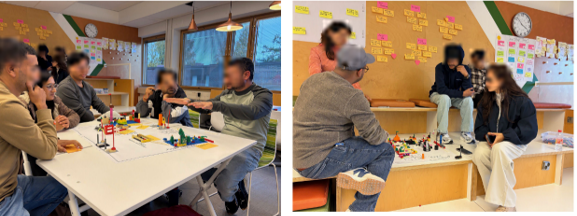
Working in teams with sticky notes and LEGO. Source: our workshop photos.


Learning by doing
On day one, we learned how design thinking has changed over time. At first, it was about how designers think. Later, companies used it to create new products and services. Today it also deals with sustainability and working with AI.
Then we practised. We did deep interviews in pairs and told stories about hard moments in our studies. Listening to others without interruption was harder than we thought. Empathy means understanding how another person experiences a situation.


On day two, we turned our notes into “How might we…?” questions. We used brainwriting to collect many ideas quickly. Then we built rough prototypes. The first idea is rarely the best one, and mistakes are part of the process.
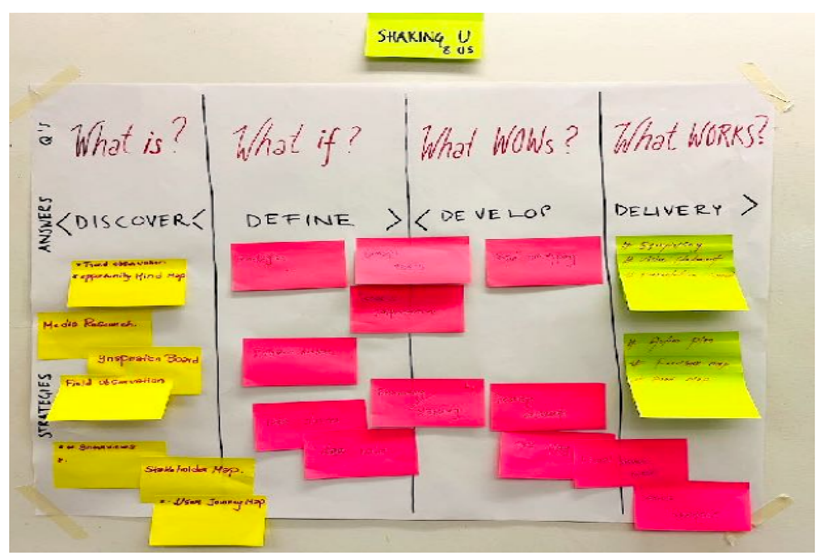
Our workshop framework: Discover, Define, Develop, Deliver. Source: our workshop photo.


A lesson from our work
We have both worked in service jobs, one of us in banking and the other in hospitality. In both, new processes were often planned first. They looked clear on paper. But the plan was not made by understanding how customers and staff go through the process every day.
In banking, customers may find some steps confusing, and employees can make their own shortcuts. In hospitality, a guest’s experience depends on small moments, like check-in or waiting for help. These moments were hard to see from the office.
After this course, we see what was missing. The services were designed for people, not with them. A short deep interview with a few customers or guests would have shown their real problems. A rough first version, tested with a small group, would have saved time.
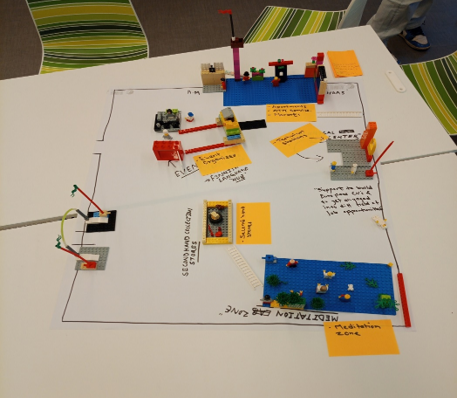
A rough LEGO prototype built on day two. Source: our workshop photo.

What the readings added
Brown (2009) says design thinking starts with people. A good idea must be desirable to users, feasible to build and viable for the business. This is what our banking and hospitality plans missed. He also describes three spaces of innovation: inspiration, ideation and implementation. In his view, everyone, not only designers, can think this way.
Buchanan (1992) explains “wicked problems”. These are unclear and have no single right answer. Customer service is like this. The real need is often vague, and it only appears when you explore it.
Kolko (2015) argues that design thinking works when teams understand users, accept uncertainty and test early. A plan is not enough. We need to learn while we build. This is why we built rough prototypes on day two instead of perfect ones.

Illustration of a team prototyping a service (created with ChatGPT).

Our takeaways
Understand people before designing the process. Treat the first plan as a first guess. Test it small and improve it. We have not mastered design thinking, but we feel more confident to try it.

“What would change in your workplace if you listened to customers before planning?”


References
Brown, T. 2009. Change by design: how design thinking transforms organizations and inspires innovation. New York: HarperCollins Publishers.
Buchanan, R. 1992. Wicked problems in design thinking. Design Issues, 8 (2), 5–21. https://doi.org/10.2307/1511637
Kolko, J. 2015. Design thinking comes of age. Harvard Business Review, 93 (9), September, 66–71. https://hbr.org/2015/09/design-thinking-comes-of-age
Öztekin, E. 2026. Design thinking masterclass at Laurea UAS [lecture]. Held on 1–2 October. Laurea University of Applied Sciences.

Visuals
Image sources: the first and last images were created with ChatGPT, and the other images are our own photographs from the Design Thinking workshop.


Posted

in

by

Comments

6 responses to “From Sticky Notes to Real Understanding: Our First Steps in Design Thinking”

  1. Rupa Kumari Thapa Avatar
    Rupa Kumari Thapa

    Hi Santosh and Arun thank you for sharing this. I really enjoyed reading your blog because it felt very honest.

    I had the thinking before the course – I thought design thinking was just about sticky notes and making things look nice. Your blog made it clear that it is actually a way of thinking. Your line “we thought it was about sticky notes” was exactly my experience too. What I liked most was your example from banking and hospitality. That part made me think a lot. In my work in a restaurant, new rules are also often made in the office. They look clear on paper. When we actually serve customers the small moments like waiting for help or check-in are where the real problem is.Your idea that services were “designed for people not with them” really hit me.

    I also liked how you connected it to the readings. I did not think about “wicked problems” before but now I understand why customer service has no single right answer. The real need only comes out when you explore it like you said.

    One question. After this workshop if you go back, to your workplace what is one thing you would test first with a rough prototype instead of making a full plan? For me I would like to test how we welcome guests in the 2 minutes.

    Thanks your blog helped me see that we need to understand people before we design the process.

  2. chiranjiviroka Avatar
    chiranjiviroka

    Hi Santosh and Arun,

    I really enjoyed your post, and it is well written. I liked how you mention that before the course you thought design thinking was just about sticky notes and making things look nice. It was an honest starting point, and it made your learning feel real.

    Your banking and hospitality example was my favorite part. The idea that services are planned for people instead of them is very true, and it made feel practical not by just a nice word. I also agree that listening without interrupting in the deep interviews was harder than I expected. You really have to try not to jump in between interviews.

    Thanks for sharing about your workshop in design thinking.

  3. sagarshresthae24322893f Avatar
    sagarshresthae24322893f

    Hi Santosh and Arun,

    First of all, I really appreciate this well-structured post. I loved how you admitted you used to think design thinking was just about making things eye-catching or pretty, then explained how your mindset completely changed. It makes your learning easy to follow.

    I found the connection between the workshop and your own work in banking and hospitality before arriving here. After all, the services were designed for people, not with them, which gave me a clear understanding of a complex problem. The blog also links to Brown’s (2009) idea that a good solution must be desirable, feasible, and viable. In your example, it seems the feasibility and business side were planned carefully, but real customer desirability was never tested.

    Taking the step to conduct deep interviews with direct observation helps catch hidden problems that people often forget to mention. This multi-angle approach is essential for solving “wicked problems,” where you actually get clarity regarding the customer’s real needs once you analyze their actual behavior from different perspectives. I also liked your point that the first plan should be treated as a first guess. Kolko (2015) stresses testing early, and in a bank or hotel, a small pilot is a realistic way to do that, for example, trying a new check-in step with one shift or one branch before changing the whole process. I would be curious to hear how you would convince a manager to allow such a pilot when the organization is used to detailed plans.

    Your closing question about listening to customers before planning is a great way to end. Thanks for sharing, and good luck with the rest of the course!

  4. Achut.Neupane Avatar

    Hi Santosh Lamichhane and Arun Khadka, enjoyed your blog, particularly the bits on banking and hospitality. The bit about services being designed for people rather than with them really stuck in my mind. I can easily imagine a process that looks perfectly good on paper but is a right pain for the person who has to use it on a daily basis.

    We’ve actually written about something very much along those lines in the blog before (you need to understand the problem and ask the right questions before you even think about solutions). Your examples are spot on. A single short chat with a customer can sometimes reveal something that the organisation simply can’t see from the inside.

    As for your last question I think listening to the customer first would save organisations from making changes they didn’t need to make and the service would be one that actually matched what the customer wanted. The one thing I’m not sure about is what happens when the customer wants something different. How would you deal with that?

  5. partivamadai Avatar
    partivamadai

    Hi Santosh and Arun, I really enjoyed reading your blog post. I especially liked how to connected the design thinking workshop to your previous work experiences in banking and hospitality. Your examples is clearly show why understanding customer and employees is important before creating new process.

    I found your review on empathy and deep interviews interesting. I agree that listening to people’s experience can reveal problem that are not always visible from an office or through written plans. The LEGO prototyping example also highlights the important of testing idea and learning from mistake.

    One thing I learned from your post is that design thinking is not just about creativity or making things look attractive. It is about knowing the real human need and developing solutions together with the people affected.

    Thank you for sharing your experiences and learning!

  6. umadhakalgautam Avatar
    umadhakalgautam

    Hello Santosh and Arun,

    Thank you for this blog post so that we know what actually Design Thinking is. I like the way you mentioned that making things look nice is not design thinking but it is  a way of thinking and working. You shared your experiences about day one and two which emphasized on learning by doing and about empathy was wonderful. The key points about design thinking which you mentions discover, define, develop, deliver was notable.

    While reading I got a line that, ‘services were designed for people, not with them’. Here service design helps close the gap between service and people. Brown’s (2009) three spaces of innovation: inspiration, ideation and implementation. According to his view, everyone, not only designers, can think this way. Buchanan’s (1992) “wicked problems”. Kolko’s (2015) early test theory means prototyping a service before we go to the field. According to you, people should understand before design the process. I agree on it.

    I would like to thank you both for wonderful blog post so that we can understand what design thinking is.

    Thank you.

Leave a Reply