
Written by: Saroj Shrestha Mengyun Xu
Our first two days of Design Thinking were intensive, practical, and sometimes surprising. Before the sessions, we mainly understood innovation as creating something new. By the end of the second day, we realized that our understanding had already started to change. Innovation is also about understanding people, finding the right problem, exploring possibilities, testing ideas, and learning along the way.
Learning from Teamwork
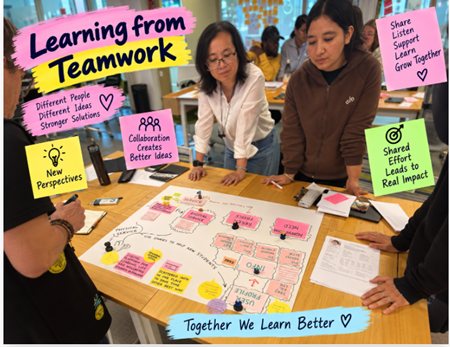
The bridge-building challenge was one of the moments when Design Thinking started to make sense to us. We had to communicate, make decisions, test our ideas, and change them when something did not work. It was a simple exercise, but it brought an “aha” moment: our first idea did not need to be the best one. Trying, learning, and improving were already part of the process.
The activity also made us think about teamwork differently. Working together does not always mean that everyone has the same chance to be heard. Sometimes, people who speak faster or more confidently can easily shape the discussion. Tschimmel (2025) connects Design Thinking with democratic collaboration, which made us think about what this could mean in a small team. How can we make space for different voices? Writing down ideas individually before discussing them together may give everyone more room to think and contribute.
Seeing Through Someone Else’s Eyes
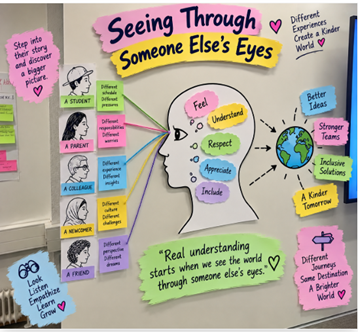
Several activities helped us practise looking at people more carefully. In one exercise, we used simple drawings to describe a person’s life and let others guess who that person might be. It was playful, but it also made us notice how much we try to understand people through small details and how easily we make assumptions about them.
The persona activity took this one step further. Instead of thinking about what we would do, we had to consider another person’s needs, challenges, and feelings. This made empathy feel much more practical. Tschimmel (2012) describes Design Thinking as a practical toolkit for innovation, and during the workshop we experienced how visualisation and other simple tools could help us move away from our own perspective and see a situation through someone else’s eyes.
Learning by Exploring
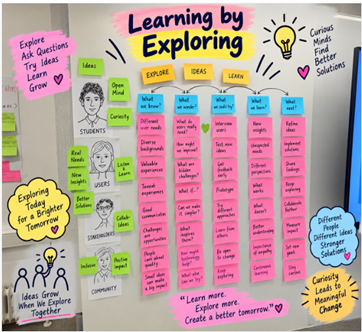
The Business Model Canvas and rapid prototyping showed us that Design Thinking does not always follow a straight line. The Evolution 6² approach (Tschimmel, 2018) helped us understand that the design process is iterative, with moments of exploration and evaluation rather than a simple straight line. A prototype does not need to be perfect; it helps us see what works and what we can change.
Boden’s The Creative Mind (2004) also gave us a useful way to understand creativity. She describes three ways creative ideas can develop: combining familiar ideas in new ways, exploring possibilities within an existing space, and transforming the space by changing its rules or boundaries. This helped us better understand the different ways creativity can happen.
From Tools to a Way of Thinking
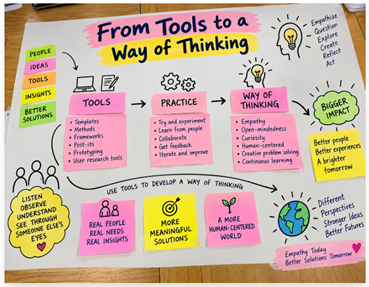
Looking back, perhaps our biggest learning was that Design Thinking is more than a collection of tools. Models and methods give us a structure, but we do not need to follow them mechanically. With practice, understanding people, questioning our first assumptions, exploring alternatives, testing ideas, and learning from mistakes can gradually become part of the way we approach problems.
This way of thinking can be useful beyond the classroom, including in hospitality, service development, and management.
Figures
All images are original photos taken during the course and edited using ChatGPT.
References
Boden, M. A. (2004). The Creative Mind: Myths and Mechanisms (2nd ed.). Routledge.
Tschimmel, K. (2012). Design Thinking as an effective toolkit for innovation. In Proceedings of the XXIII ISPIM Conference: Action for Innovation: Innovating from Experience. Barcelona.
Tschimmel, K. (2018). Toolkit Evolution 6²: An E-handbook for practical Design Thinking for Innovation. Mindshake.
Tschimmel, K. (2025). Design Thinking – A catalyst for democratic collaboration and transdisciplinarity. In E. Duarte & J. B. Ferreira (Eds.), Design and Democracy: Essays Towards Democratic Imagination (pp. 215–221). IADE Press.


Leave a Reply