
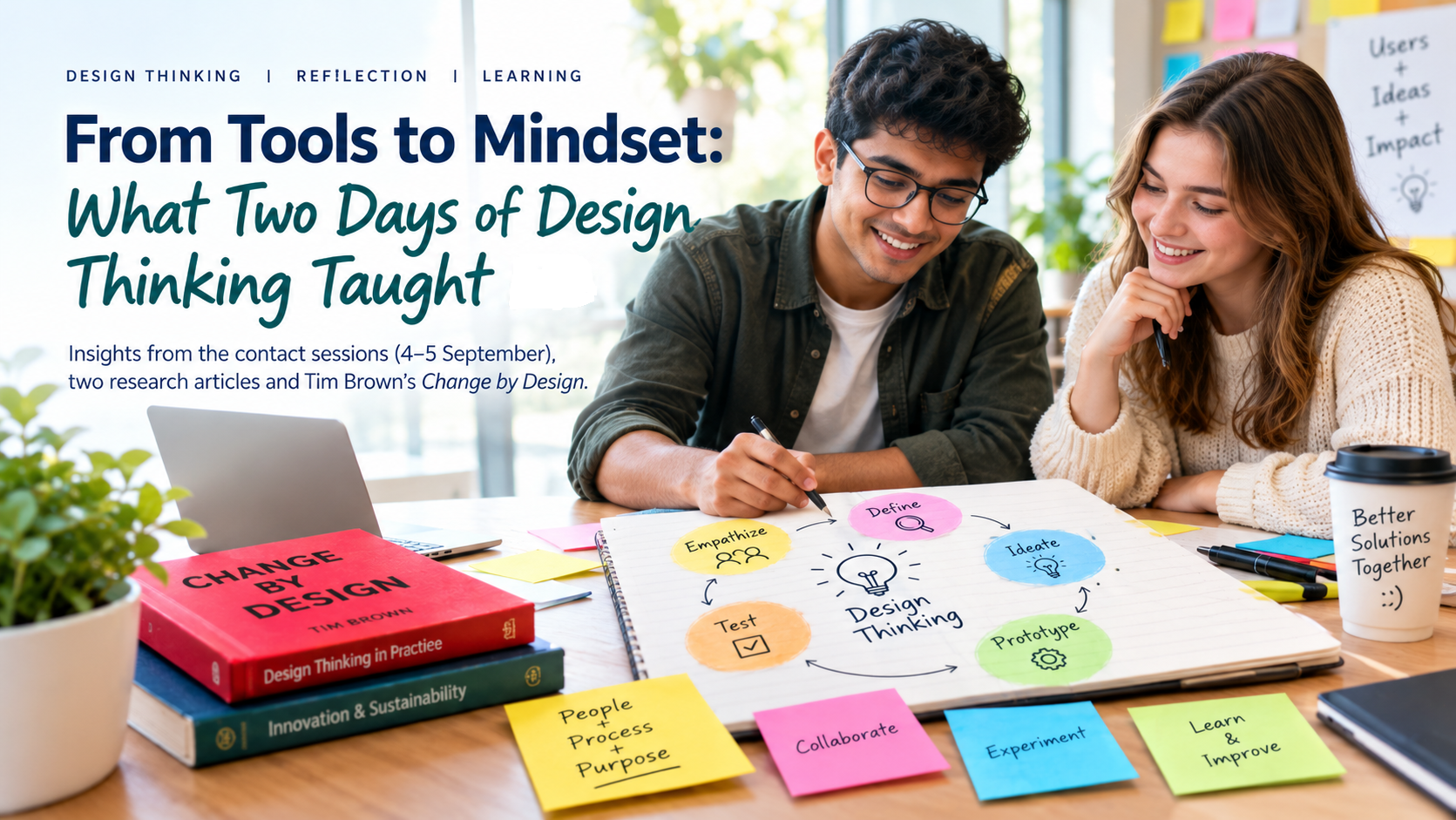
Written by: Md Shanaullah Shihab & Pratiksha Ghimire
Design Thinking | Reflection | Learning
The contact sessions on 4–5 September gave us an opportunity to look at Design Thinking (DT) not simply as a collection of tools, but as a different way of understanding and approaching challenges. The discussions, learning activities, and reflections helped us recognize that effective innovation begins with understanding people, their needs, and the context of a problem before moving towards solutions.
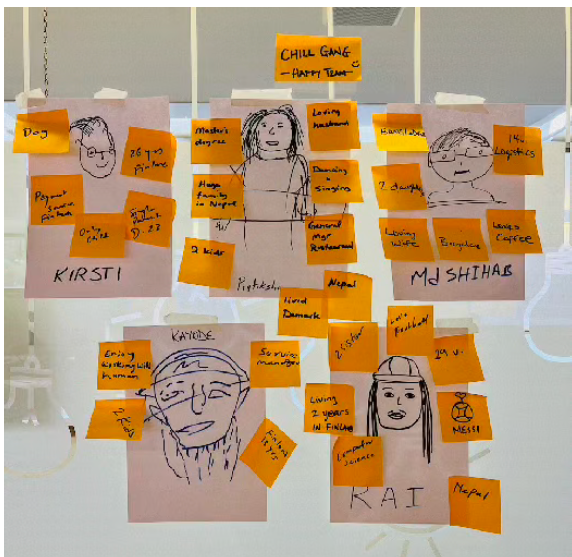
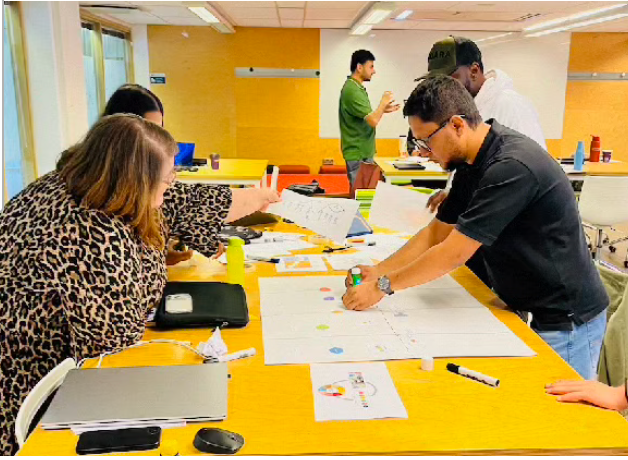
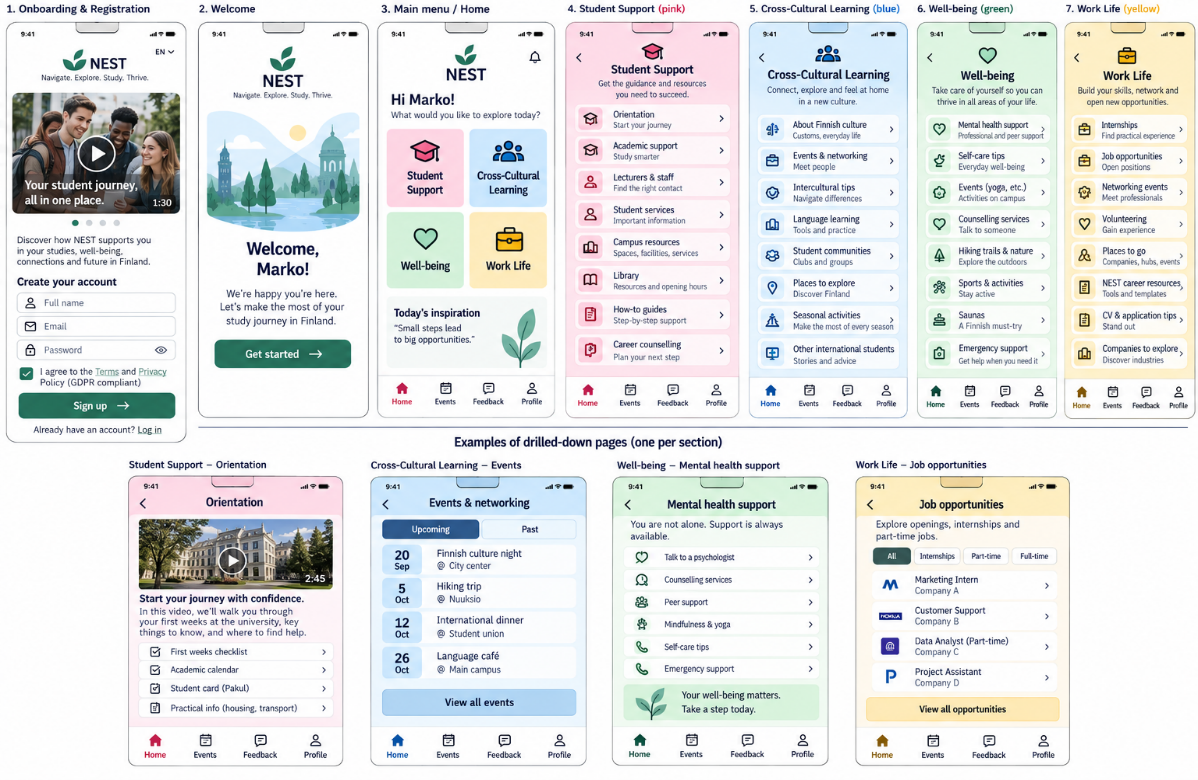
During the two contact days of the Design Thinking course, we learned new ways of learning and engaged in group discussions. We also discovered that the first few ideas are often similar and not very creative, so we need to push ourselves to look at things differently and combine two different approaches for new ideas. These two days were very interesting, and learning felt easy and fresh rather than boring, thanks to the variety of tasks, group work, and examples. In the classroom, students are divided into different groups, and we started by sharing personal thoughts and experiences, which revealed that many students struggled to adjust to the Laurea system. This phase helps us to find the real problem of the student and empathize with them. We started brainstorming diverse ideas that were generated by each member of the group, and collaborating on them provided a prototype solution to create an app called NEST. We also realized that design and innovation are driven by people’s needs and problems.
Learning from the Articles
The article by Cankurtaran and Beverland (2020), Using Design Thinking to Respond to Crises: B2B Lessons from the 2020 COVID-19 Pandemic, particularly highlighted the importance of DT when dealing with uncertainty. The authors describe crises as “wicked problems” because they are complex, interconnected, and constantly changing. Their three-stage process—disrupt, define and develop, and transform—shows how organizations can question existing assumptions, understand problems in context, develop possible solutions, and continuously learn through experimentation.
One important lesson for us was the value of not rushing to a solution. Contextual understanding, questioning, and iteration can lead to better responses, especially when circumstances are uncertain.
The second article, Augsten and Marzavan (2017), Achieving Sustainable Innovation for Organisations through the Practice of Design Thinking, takes the discussion further. Their case study of the German automotive industry argues that design thinking should not be treated merely as a set of methods, workshops or templates. Instead, it can become a “strategic art” that supports organizational transformation and sustainable innovation. This requires collaboration across functions, openness to different perspectives and organizational support for experimentation.
The Book: Change by Design
Tim Brown’s Change by Design provided another valuable perspective. Brown presents Design Thinking as a human-centered approach to innovation that connects people’s needs with technological possibilities and business objectives. The relationship between desirability, feasibility and viability helped us understand why successful innovation needs to balance the human experience with practical and organizational realities.
Together, the book and articles show that Design Thinking is more than a process. It is a mindset built around empathy, curiosity, collaboration, experimentation, visualization and learning from uncertainty.
What we Take Forward
As a Supply Chain Management professional, I can see strong opportunities to apply this mindset to customs experience, process improvement, supply chain resilience, and service innovation “Md Shanaullah Shihab“. Instead of asking only, “How can we improve the existing process?”, Design Thinking encourages us to ask, “What do our users really need, and how might we create a better experience?”
Our biggest takeaway from these two days is simple: do not rush to the answer. Understand the problem, involve people, experiment, learn, and redesign. Design thinking is more than just a method; it’s a mindset focused on putting people first. By truly understanding user needs and solving problems creatively, we have learned that the best solutions come from empathy, simple models, and a willingness to adapt through feedback. This mindset can help transform complex challenges into meaningful opportunities for innovation.
References:
Augsten, A., & Marzavan, D. (2017). Achieving sustainable innovation for organisations through the practice of Design Thinking: A case study in the German automotive industry. https://canvas.laurea.fi/courses/15059/files/3954660?wrap=1
Cankurtaran, P., & Beverland, M. B. (2020). Using design thinking to respond to crises: B2B lessons from the 2020 COVID-19 pandemic. https://canvas.laurea.fi/courses/15059/files/3954664?wrap=1
Brown, T. (2009/2019). Change by Design: How Design Thinking Transforms Organizations and Inspires Innovation. https://laurea.finna.fi/Record/3amk.254850/Details?sid=5528690527&imgid=1
Figures
All images were created from original photographs taken during the course and subsequently edited using ChatGPT.


Leave a Reply