
“From Mess to Precision: How Design Thinking matters to reach to an End”

Note by Bijaya Tamang & Rachana Poudel

Everything which we try to create, starts from a crap and enlighten us that we are learning.

Trust the Process

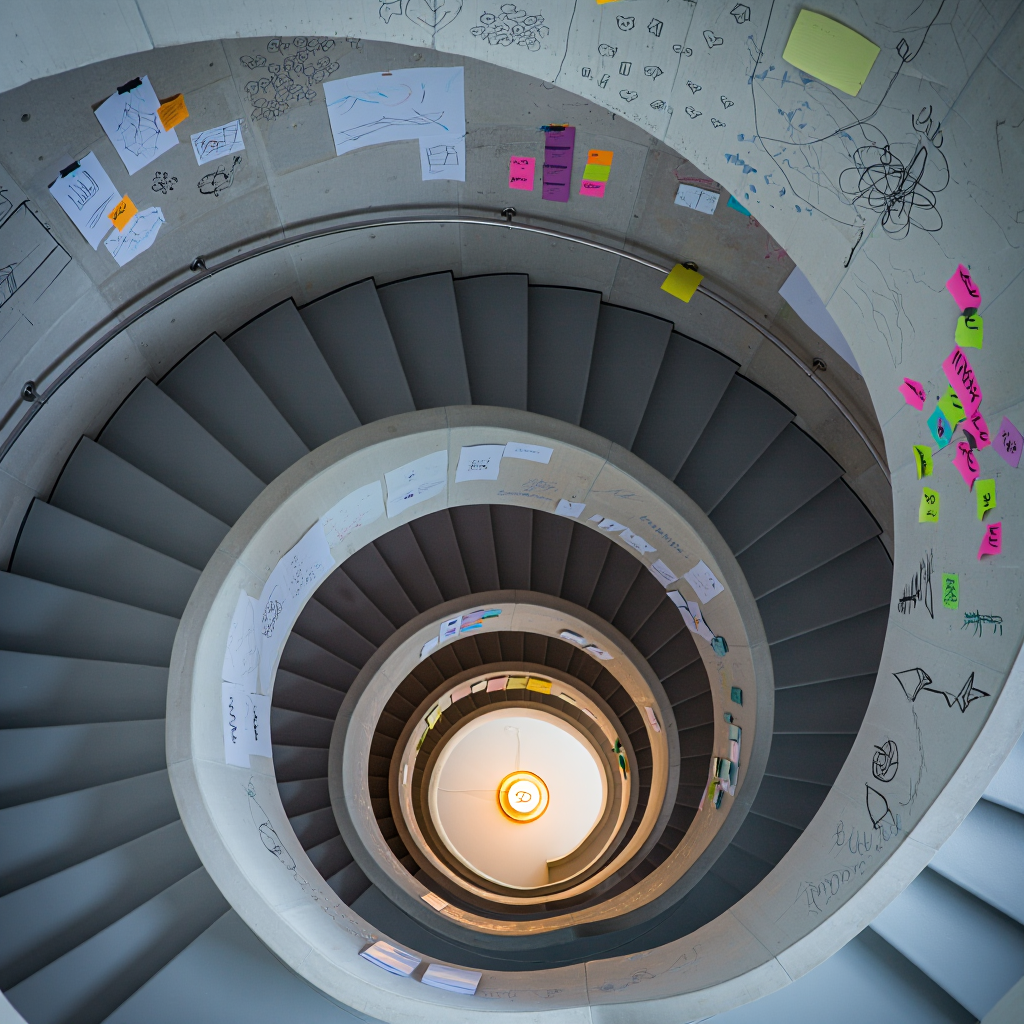
All tasks have a start and an end. It means, from the beginning till the end or completion of the task or project there should be a lot of process. Every effort and every step matter to give a shape to the handful information. The reason for the iterative, nonlinear nature of the journey is not that design thinkers are disorganized or undisciplined but that design thinking is fundamentally an exploratory process; done right, it will invariably make unexpected discoveries along the way, and it would be foolish not to find out where they lead (Brown, 2009). There are useful starting points and helpful landmarks along the way, but the continuum of innovation is best thought of as a system of overlapping spaces rather than a sequence of orderly steps. We can think of them as inspiration, the problem or opportunity that motivates the search for solutions; ideation, the process of generating, developing, and testing ideas; and implementation, the path that leads from the project room to the market (Brown, 2009).
Inspiration

Inspiration is always lead by a motivation. Then only a disordered raw knowledge takes a first lead towards a perfection. An inspired design thinker doesn’t care about the uncertainty. A crucial part of DT entails gaining a thorough understanding of users and their needs, even of those they are unaware of (Lisa Carlgren I. R., 2016). We think designers should gain understanding of the user (cognitive), by feeling the user’s emotional state (affective) (Visser, 2009).

Ideation

DT is perceived as an innovation process that uses a variety of techniques to develop and test innovative solutions by means of prototypes (Lisa Carlgren I. R., 2016). Prototypes become the pathway between brain and a hand. It helps a thinker to show what S/he wants to deliver. It turns insights into possibilities with the help of continuous development.

Implementation

This is the most crucial and important part of the design thinking process. In DT process every imagination or prototypes must have to come into a valid form or solution. Which is carries the weight of entire DT process. Empathy serves to inform and to inspire designers to create products that fit the user’s needs (Visser, 2009). A sensitive design thinker every time tries to deliver a product which actually fits according to the need, want and demand of a user or a consumer.

Reasoning

In the beginning we always start from a crap. Same situation comes at the moment of design and creating some services or products. Organizing each steps thoughtfully and believing the procedure leads a imagination up to a proper reality. Design thinking helps each individuals who are willing to deliver something in the field of problem identification, idea generation, decision making and utilization of the actual and required solution.

References:

Brown, T. (2009). How Design Thinking Transforms Organizations and Inspires Innovation, Change By Design. California.

Lisa Carlgren, I. R. (2016). Framing Desing Thinking: The Concept in Idea and Enactment.

Visser, M. K. (2009). A framework for empathy in design: stepping into and out of the user’s life. Journal of Engineering Design.


Posted

in

by

Comments

4 responses to ““From Mess to Precision: How Design Thinking matters to reach to an End””

  1. mih00322 Avatar
    mih00322

    I really enjoyed reading your blog post! It provides a thoughtful and engaging explanation of how design thinking transforms unclear, messy beginnings into structured and meaningful outcomes. I found the situations you described very relatable. The emphasis on ”trusting the process” is particularly impactful, as it highlights the importance of iteration and exploration rather than expecting immediate perfection.

    The way you structured the content around inspiration, ideation, and implementation makes it easy to follow and reflects a strong understanding of the design thinking process. I also appreciate how you connected empathy to each stage—especially regarding the understanding of user needs—which is a critical aspect of successful design.

    Overall, your post is very insightful and clearly communicates the value of design thinking in problem-solving and innovation. Thank you for sharing!”

  2. Kiran.Timalsina Avatar
    Kiran.Timalsina

    This note provides an intelligent and detailed discussion of the way design thinking can be used to bring messy concepts to a specific and actionable solution. I really like that the authors also stress on the iterative and nonlinear nature of the process and demonstrate that exploration, experimentation, and unexpected discoveries are not indicators of disorganization but are key to innovation. The fact that they put an emphasis on empathy and the desire to understand the cognitive and emotional requirements of users supports the human nature of design thinking.

    The disintegration of inspiration, ideation and implementation is an example of how raw ideas are slowly refined into meaningful solutions. I especially appreciate the manner in which they emphasize prototypes as a form of transitional point between imagination and reality and how they enable designers to test, pinch, and convey their concepts.

    In general, this reflection confirms that it is important to trust the process, be comfortable with failure, and plan all these steps in order to present solutions that truly meet the requirements of the user and encourage creativity and learning.

  3. durgathapa533adc6832 Avatar
    durgathapa533adc6832

    I value the way your approach fosters trust and guides thoughtful business decision-making through design thinking. Inspiration, ideation ,implementation, and reasoning form the core design thinking , and you’ve shown them in a way that makes everything easy to understand.

    By moving through four structured stages , it enables an impartial assessment of situations, encourages assumption-free ideation ,and promotes ongoing cycles of experimentation , testing ,and iteration to enhance results. It moves from understanding user needs to defining the main issue, creating solutions, and testing prototypes to reach the final outcome.

    Overall ,Design Thinking may appear extensive , yet it remains an accessible and adaptable approach for anyone who values user-centric , solution-driven innovation.

  4. nikeshthapa91e50c80d5 Avatar
    nikeshthapa91e50c80d5

    Hello friends,
    I enjoyed your blog post and gained more information about design thinking in a short format. I enjoyed reading about the stages of design thinking: inspiration, ideation, and implementation.

    Firstly, I liked the way you linked inspiration and motivation, showing how they work mutually to secure a common goal, which is solving a problem. You explained well how a problem itself motivates individuals to find a solution.

    Secondly, I liked how you explained ideation and prototyping as a connection from the brain to the hands. Ideation represents the brain, and the prototype reflects the ideas generated by the brain.

    Lastly, implementation was clearly linked to customers and their feedback. Without them, the whole process would be worthless, so including them in this section adds more meaning and aligns with my thoughts.

    In conclusion, your blog was able to deliver its intended message. However, as a small suggestion, since a single blog post cannot cover the entire process in detail, including specific examples would attract more readers and make the post more concrete.

Leave a comment