
by Andre Vicentini and Juliet Leal-Ruokonen
In our course Design Thinking we understood the wide range context meaning of design that is becoming increasingly relevant in innovation management (Mauroner and Warnke 2020, p. 924) as compared to the business’ traditional understanding of design that is only applied to creation and development of products and services, limiting the business in its response to changes and uncertainties. It was an interesting reflection from the course lectures and recommended readings, the ways of thinking and ways of working together and with lots of learning we decided to emphasize in this post how Design Thinking can expand and contribute further to resolve unexpected challenges.
Innovation to whom?
Developing innovative solutions to meet users’ needs is not solely the responsibility of design experts, rather it’s a collaborative, diverse, holistic approach involving multiple functions across the organization. When design strategy mindset is anchored in the business, its implementation generates measurable economic value (Mauroner and Warnke 2020, p. 925).

Integrating design thinking
The first aspect is the integration of design thinking into the company’s business strategy adds economic value through collaboration, creativity, empathy, leading to higher customer satisfaction, when implemented (Mauroner, and Warnke 2020, p. 925).
Insights and deep understanding of customers are the starting point of each problem-solving process (Mauroner, and Warnke 2020, p. 933). How you think and what do you do with the available information and then transform it into an innovative valuable solution to meet customer´s needs thus, positioning the company competitively.
Design Thinking for unexpected times
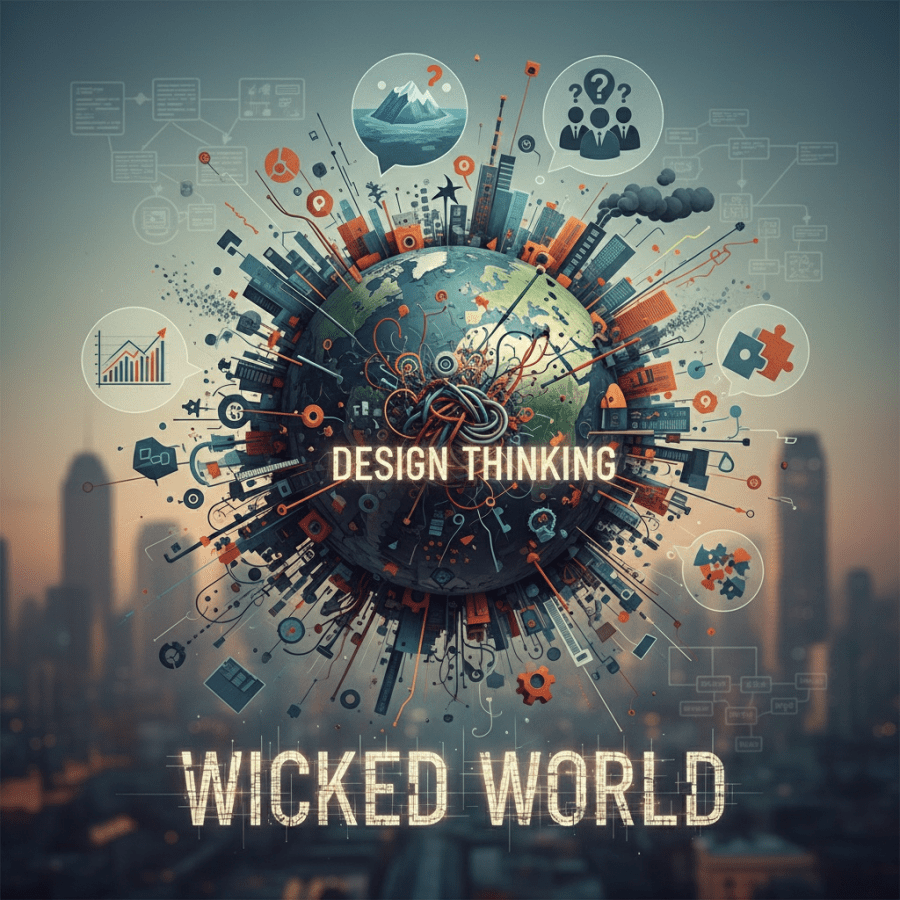
In the article “Using design thinking to respond to crises: B2B lessons from the 2020 – COVID-19 pandemic” by Cankurtaran & Beverland, 2020 the text reflects further on the design thinking importance as it shows how design can tackle complex or “wicked” problems. Utilizing the example of the pandemic, that represented an unpredictable scenario, where maintaining a business operation became very stressful.
The authors underlined that “maintaining the continuity of business activities amidst the disruption caused by the epidemic represents a ‘wicked problem’” (Cankurtaran & Beverland, 2020, p. 256), so they build upon the known stages of design thinking defined by Brown (2009) outlined by the three core spaces of design thinking as inspiration, ideation, and implementation, and introducing another three stage framework that breaks down into Disrupt, Define and Develop and Transform phases.
Wicked Problem three stages framework

Furthermore “Design thinking, with its emphasis on disruption, abductive thinking, and reframing, offers insights for the necessary pivot that many B2B firms will have to undergo to survive, and potentially, emerge stronger” (Cankurtaran & Beverland, 2020, p. 255) which highlights the importance of service design.
Conclusion – Naive Thinking
The fact that we are living a digital transformation makes us rely on a lot of it’s digital infrastructure but ultimately the idea is that naive questioning can highlight key stakes of our way of thinking like for example EMPATHY as seen here: “What we’ve had to pivot towards is more like, ‘what do you need?’ … we are now forced to think in terms of what is your peculiar need, right now” (Prothero, cited in Cankurtaran & Beverland, 2020, p. 257). to address more emergency solutions and a mindset of thinking outside the box, a “naïve questioning involves asking seemingly simple questions to uncover existing assumptions, and help generate ideas for new alternatives” (Cankurtaran & Beverland, 2020, p. 257).
It is inherent for humans to think, imagine, and create. Design thinking harnesses these abilities, shaped by evolution, environment, and experiences, to solve problems and drive innovations that are essential to our survival and success and with the work we did during our Design Thinking course we could tiptoe on the pool of possibilities that a designer mindset can contribute.
References:
Brown, T. (2009). Change by design: How design thinking transforms organizations and inspires innovation. Harper Business.
Cankurtaran, P., & Beverland, M. B. (2020). Using design thinking to respond to crises: B2B lessons from the 2020 COVID-19 pandemic. Industrial Marketing Management, 88, 255–260. https://doi.org/10.1016/j.indmarman.2020.05.030
Mauroner, Oliver & Warnke, Franziska. (2020). Strategic Design. A Study on the Value Added by Design in an Economic Context. https://www.researchgate.net/publication/348871243_Strategic_Design_A_Study_on_the_Value_Added_by_Design_in_an_Economic_Context


Leave a reply to mallika.kauppinen Cancel reply