Design Thinking: from discomfort and failure to intriguingness and success 

We think that we had inspiring and pragmatic teaching on design thinking during the contact days in Leppävaara campus. As we heard from Marzavan (2024) design thinking is slowly starting to be integrated in major corporations, institutions, organizations and even some governments such as the German government has at least one person with design thinking background in their ministries. Design is not in the center of organizations because of aesthetics, but rather to be able to response to the complexity of the market (Kolko 2015). This is valuable information because we didn’t know how important design thinking is and how widespread it is.  

Observation and research skills are needed to deeply understand the user and its needs, behavior, and motivations (Dunne and Martin 2006, 514; Brown 2009, 52-54). After being challenged, one should start working iteratively by questioning the assumptions and the problem and discovering the project’s constraints to refine and reframe them (Brown 2009, 18, 23, 25).  

We started learning research and observation skills in practice during the contact days by first doing some desk research, like identifying context, trends, and stakeholders related to the given design challenge, and then interviewed some people in Leppävaara park to find out if our hypothesis is correct. The classes left a clear imprint on our memory about the importance of asking why multiple times to uncover the underlying needs and motivations behind user behavior and Brown (2009, 236-237) also states its importance. It became apparent that formulating a good design challenge in the form of “How might I/we help …” is not that straightforward and one needs to be careful not to limit the solution with it.   

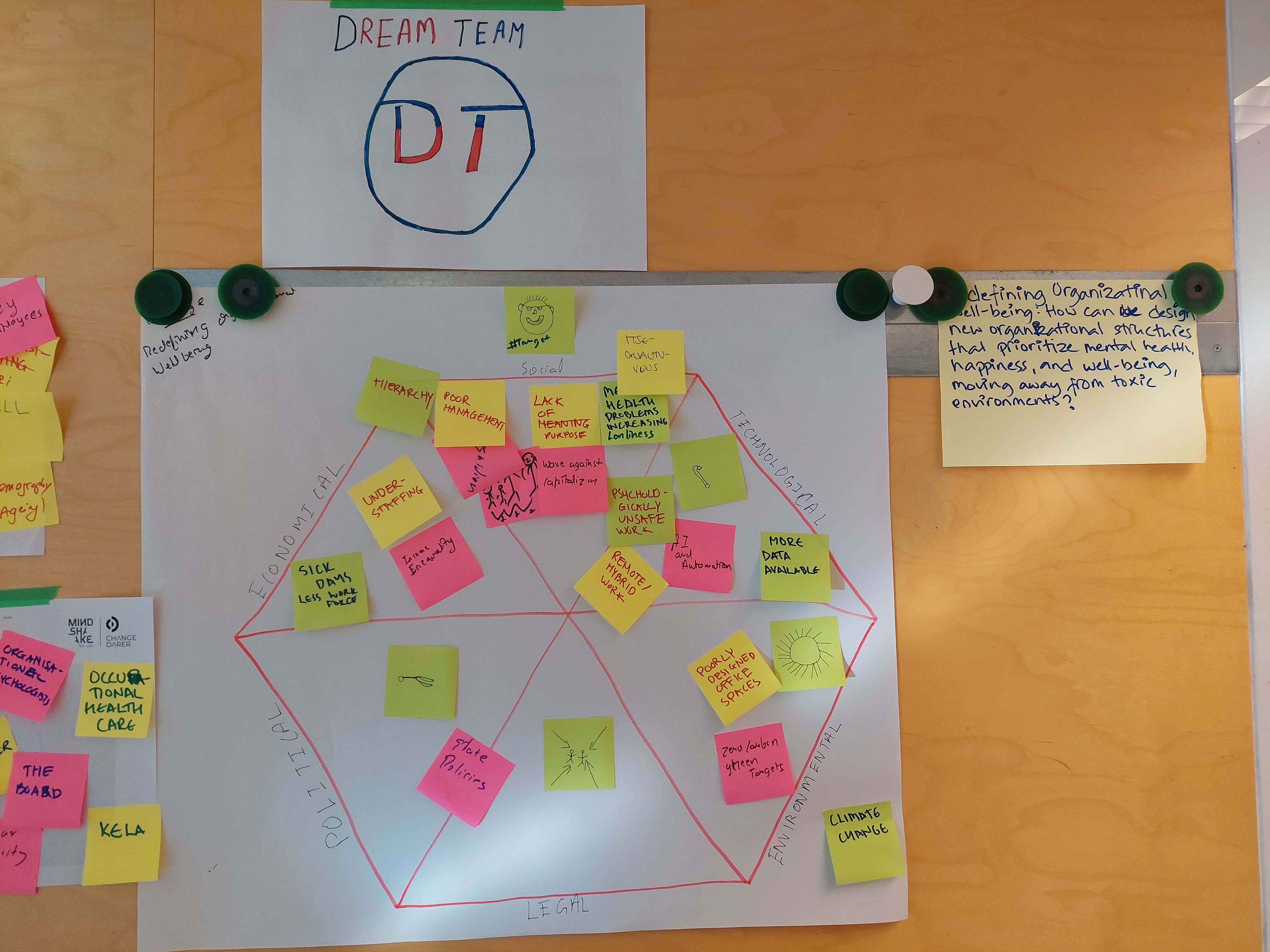
According to Brown (2009, 35) simultaneous visibility of the gathered materials allow us to find patterns and encourage creative synthesis. Synthesis supplemented with abductive thinking allows us to create ideas (Dunne and Martin 2006, 518; Brown 2009, 69-70). We learned that it is important to document ideas, for example using sticky notes, so that you can easily share them with the team.  

Imagining, visualizing and validating with users to improve iteratively are also skills that should be taught (Dunne and Martin 2006, 514). Visualization simultaneously reveals both functional characteristics and emotional content (Brown 2009, 80-81). Kolko (2015) states ”A design culture is nurturing. It doesn’t encourage failure, but the iterative nature of the design process recognizes that it’s rare to get things right the first time.” Also Brown states that (2009, 230) ”Fail early, fail often”. In the wallet challenge we practiced our sketching and physical prototyping skills to get feedback and validate our ideas so that we could pivot or improve existing ideas further and finally into success. Even interviewing and visualizing turned out to be intriguing after the initial discomfort. 

Our team’s name was” Dream Team” and our teacher suggested changing the first draft of our team’s logo. For the second draft we looked for inspiration in magazines and the internet. And the second draft was much better. As you can see below:
Reflections by Atlas Riatson and Satu Muratte

References 

Brown, Tim. 2009. Change by design: how design thinking transforms organizations and inspires innovation. 1st Edition. New York: HarperCollins Publishers. 

Dunne, D. & Martin, R. 2006. Design Thinking and How It Will Change Management Education: An Interview and Discussion. Academy of Management Learning and Education, Vol. 5, No 4, 512-523. Article from EBSCOhost Business Source Elite. Accessed 9 September 2024. https://www.ebsco.com/ 

Kolko, J. 2015. Design thinking comes of age: The approach, once used primarily in product design, is now infusing corporate culture. Harvard Business Review, September, 66-71. Accessed 20 September 2024. https://hbr.org/2015/09/design-thinking-comes-of-age

Marzavan, D. 2024. Design Thinking. [lecture]. Held on 6-7 September. Laurea University of Applied Sciences. 

Comments

5 responses to “Design Thinking: from discomfort and failure to intriguingness and success ”

  1. terokauppinen Avatar
    terokauppinen

    Atlas and Satu, thank you for your blog post! I think your post captured our group assignment well through describing what you learned and by adding useful references. Now that it has been over a month since our workshop days, this was a good refresher on some of the key learnings. After all, learning needs repetitions for the information to stick in our minds (Bruner, 2001).

    I think questioning assumptions is a very important aspect that will require some practice! That’s why our workshop with Daniela was so invaluable. I think our Deep Customer Insights interview and observation assignments will be another chance to practice this. Especially being curious and questioning our assumptions (Brown 2009, 18, 23, 25).  

    I believe the point about simultaneous visibility helping with patterns and creative synthesis is such an interesting concept. I am actually rearranging my home office to have an entire wall available to do this with my assignments Brown (2009, 35).

    What did each of you find the most important lesson from the Design Thinking course?

  2. sahanasanka1978 Avatar
    sahanasanka1978

    Great blog Atlas and Satu,

    Reflection on the Design Thinking ( DT ) learning experience at the class is well structured and informative. It duly highlights how DT, pointed out by Marzavan (2024),is reaching beyond creative industries even in to large organizations and eventually into governments. In this respect, the course particularly valuable for developing research and observation skills needed to understand user needs and showing the value of empathy in the process.

    I also appreciate the iterative learning process, especially the ”failing early, failing often” concept that is so crucial to refining ideas towards success. To this effect, As Tero mentioned, I find that the post does a great job of reminding one of desk research, interviews, and prototyping during the wallet challenge in explaining how theoretical concepts are practically implemented and helped in fostering creativity and problem solving skills. Besides the visualization and documentation of ideas with sticky notes is an important takeaway for team collaboration.

  3. maritaruotsalainen Avatar
    maritaruotsalainen

    Hi Satu and Atlas, thank you for the great refresher of the core themes and learnings in our class with Daniela Marzavan (2024). It was such a fast deepdive that I personally would’ve loved to take several more contact days to really fall into design thinking and the iterative process of it. Like you said, it’s important to make sure you have the right problem and overtime one iteration at-a-time continue to develop your solution.

    I wanted to also share a personal experience of being part of such a design thinking process that was a negative experience for me. My work got changed heavily in an iterative way, and while the end result is good, the process there left many people close to burnout. When designers make changes or new products that someone has to use while they are still in development, it requires a lot of cognitive effort from the user. The mental models you had about the product or how things are done, are now useless, you do not know what will change and when due to the iterative process that is outside of your influence.

    Based from my experience, the designers need to put a lot of extra care, communication and empathy in those cases, than let’s say in the process of launching a completely new product to the market for the user’s to adopt.

  4. hek00192 Avatar
    hek00192

    Atlas and Satu, I loved your blog post. You did an awesome job of breaking down those two days with Daniela. I totally agree, it would be amazing to keep this journey going with her; she was so inspiring as a professor.

    I also liked how you captured the ups and downs of design thinking, the challenges, but also the excitement of figuring things out. The way you talked about observation, asking “why,” and connecting with users really resonated with me. It felt like you were living the process, not just learning about it.

  5. rosayang02e92df4f7 Avatar
    rosayang02e92df4f7

    Great insights Satu and Atlas! This blog post structured well the learning process we had with Daniela. While reading, it took me back to the exercises and reminded me about the importance of asking why. Even though, this should be fairly basic thing to do, I keep finding myself in situations where I realise –  now I should ask why! I see it does not come as automatically as I thought. This might be evident in a job where you are seen as an expert of certain area.  Rather than asking questions, you are making assumptions. Perhaps because you do not want your credibility to be questioned – I should know the answer to this. Or should you?

    As you nicely put it here, that the class left a clear imprint that we need to uncover the underlying needs and motives behind the behaviour, not make assumptions. I fully agree. What we see as the first layer of an issue is commonly the tip of an iceberg. That is why asking questions is so important. Mootee (2013, 112) talks about sense making as a process by which a design thinker understands the experience. To put it shortly here, it is a process of analysing inputs like business objectives and consumer insights by going back and forth between simple and complex ideas. Key is to go back and challenge the assumptions and discover new insights. In line what you wrote – the iterative process where you question the assumptions and try to fail early, is very useful way of working. In my opinion, it requires practice, at least for a person who likes to be in control, but once you are familiar with the process, it helps you to experiment and encourages you to a creative play.

    Reference – Moote, I. 2013. Design Thinking for Strategic Innovation : What They Can’t Teach You at Business or Design School. John Wiley & Sons, Incorporated. 

Leave a reply to hek00192 Cancel reply