
We think that we had inspiring and pragmatic teaching on design thinking during the contact days in Leppävaara campus. As we heard from Marzavan (2024) design thinking is slowly starting to be integrated in major corporations, institutions, organizations and even some governments such as the German government has at least one person with design thinking background in their ministries. Design is not in the center of organizations because of aesthetics, but rather to be able to response to the complexity of the market (Kolko 2015). This is valuable information because we didn’t know how important design thinking is and how widespread it is.
Observation and research skills are needed to deeply understand the user and its needs, behavior, and motivations (Dunne and Martin 2006, 514; Brown 2009, 52-54). After being challenged, one should start working iteratively by questioning the assumptions and the problem and discovering the project’s constraints to refine and reframe them (Brown 2009, 18, 23, 25).
We started learning research and observation skills in practice during the contact days by first doing some desk research, like identifying context, trends, and stakeholders related to the given design challenge, and then interviewed some people in Leppävaara park to find out if our hypothesis is correct. The classes left a clear imprint on our memory about the importance of asking why multiple times to uncover the underlying needs and motivations behind user behavior and Brown (2009, 236-237) also states its importance. It became apparent that formulating a good design challenge in the form of “How might I/we help …” is not that straightforward and one needs to be careful not to limit the solution with it.
According to Brown (2009, 35) simultaneous visibility of the gathered materials allow us to find patterns and encourage creative synthesis. Synthesis supplemented with abductive thinking allows us to create ideas (Dunne and Martin 2006, 518; Brown 2009, 69-70). We learned that it is important to document ideas, for example using sticky notes, so that you can easily share them with the team.

Imagining, visualizing and validating with users to improve iteratively are also skills that should be taught (Dunne and Martin 2006, 514). Visualization simultaneously reveals both functional characteristics and emotional content (Brown 2009, 80-81). Kolko (2015) states ”A design culture is nurturing. It doesn’t encourage failure, but the iterative nature of the design process recognizes that it’s rare to get things right the first time.” Also Brown states that (2009, 230) ”Fail early, fail often”. In the wallet challenge we practiced our sketching and physical prototyping skills to get feedback and validate our ideas so that we could pivot or improve existing ideas further and finally into success. Even interviewing and visualizing turned out to be intriguing after the initial discomfort.
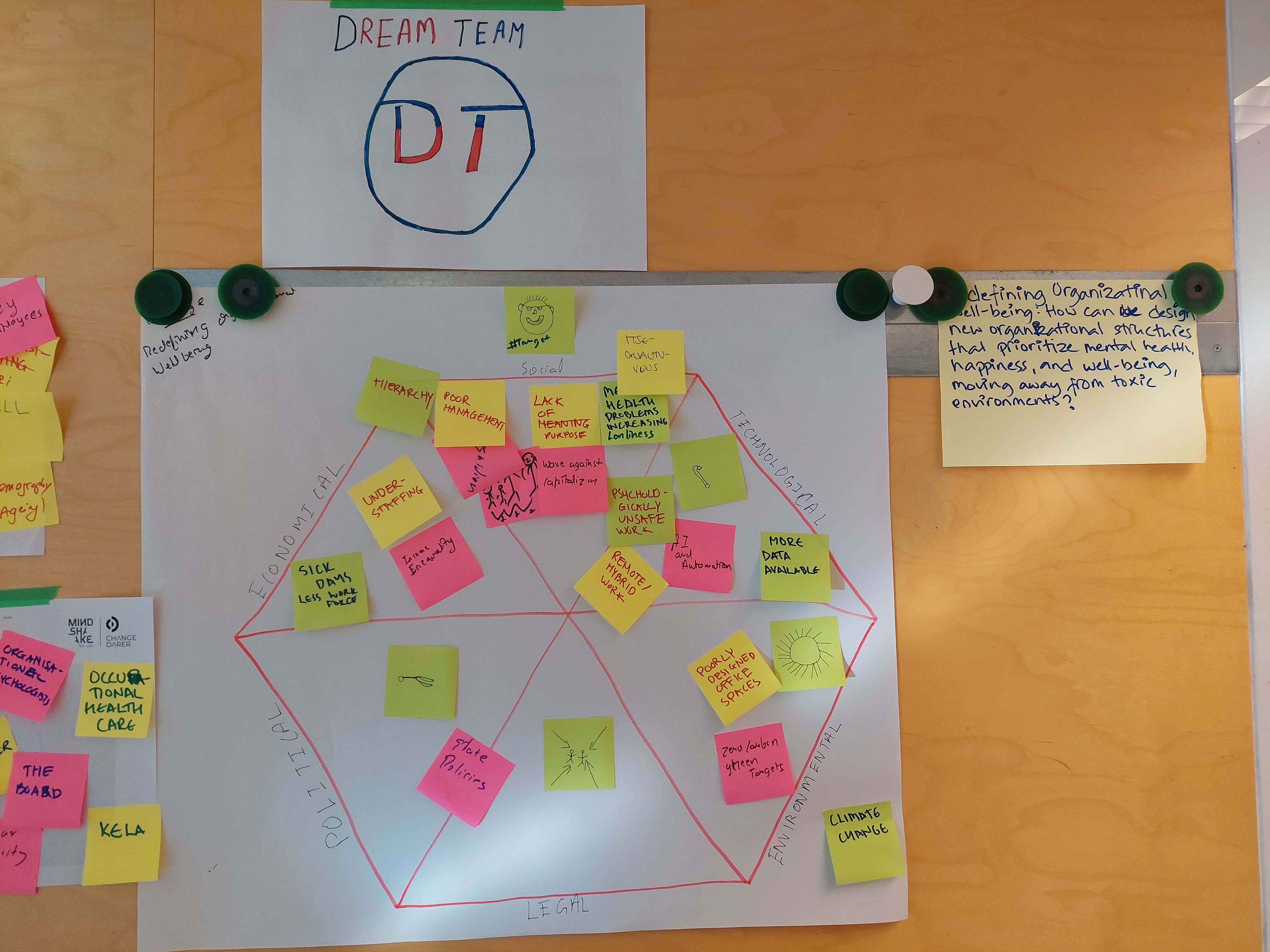
Our team’s name was” Dream Team” and our teacher suggested changing the first draft of our team’s logo. For the second draft we looked for inspiration in magazines and the internet. And the second draft was much better. As you can see below:
Reflections by Atlas Riatson and Satu Muratte
References
Brown, Tim. 2009. Change by design: how design thinking transforms organizations and inspires innovation. 1st Edition. New York: HarperCollins Publishers.
Dunne, D. & Martin, R. 2006. Design Thinking and How It Will Change Management Education: An Interview and Discussion. Academy of Management Learning and Education, Vol. 5, No 4, 512-523. Article from EBSCOhost Business Source Elite. Accessed 9 September 2024. https://www.ebsco.com/
Kolko, J. 2015. Design thinking comes of age: The approach, once used primarily in product design, is now infusing corporate culture. Harvard Business Review, September, 66-71. Accessed 20 September 2024. https://hbr.org/2015/09/design-thinking-comes-of-age.
Marzavan, D. 2024. Design Thinking. [lecture]. Held on 6-7 September. Laurea University of Applied Sciences.


Leave a reply to terokauppinen Cancel reply