
Design Thinking refers to a human-centered, iterative approach for solving complex problems, often leading to innovation. The process involves empathy, creativity, and experimentation, helping teams come up with solutions that may not emerge from traditional methods. Over a weekend learning experience, we delved into the nuances of Design Thinking, gaining insights into both its potential and its limitations.
Design Thinking in Practice
On the first day, Professor Daniela Marzavan introduced us to the six steps of Design Thinking, which can be summarized as: Understand, Observe, Point of View, Ideate, Prototype, and Test. This framework is designed to provide a systematic way of tackling challenges.

Next, we were tasked with creating an innovative wallet. The “Understand” phase focused on deep diving into the problem, analyzing stakeholders, and conducting primary research. The goal was to challenge the initial assumptions and gain a comprehensive understanding of the problem.
Later we observed users’ behaviors, reframed the problem to focus on hidden needs, and brainstormed creative solutions. The final stages, prototyping and testing, involved making a tangible version of our idea to receive feedback and refine it.
A big part of design thinking is design doing. It’s getting your hands dirty and experimenting instead of being an armchair strategist
Design thinking is action-oriented (Mootee 2013, 64), so on the second day, we immediately put what we had learned into practice. “A big part of design thinking is design doing. It’s getting your hands dirty and experimenting instead of being an armchair strategist”, writes Mootee (2013, 64).
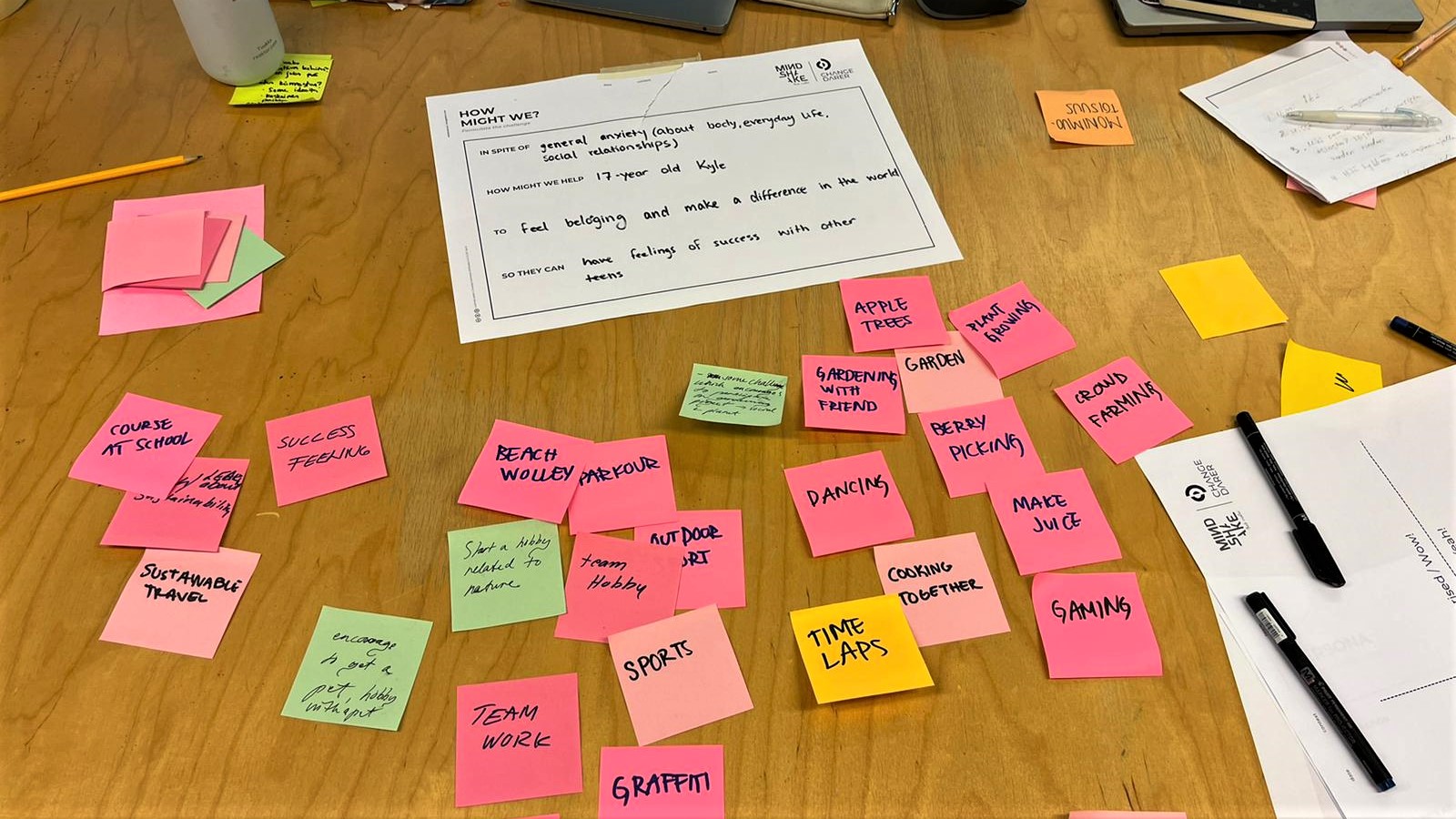
The challenge was to develop a sustainable urban garden for teenagers. The most instructive task was the interviews to understand the lives, thinking, and needs of the target group. We conducted short interviews in a nearby outdoor area and gained a lot of valuable information about the needs of the target group in a very short time.
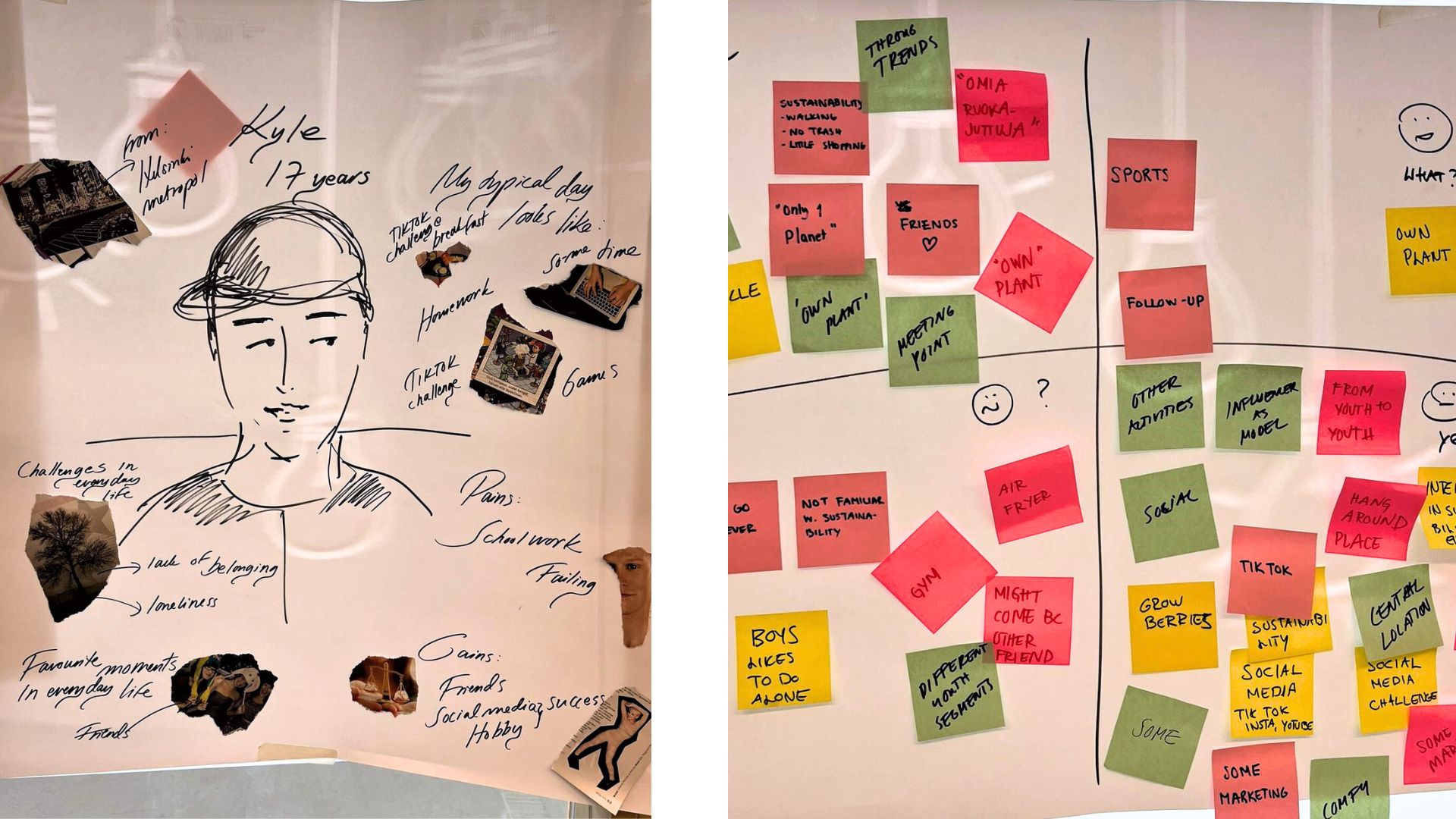
In the afternoon, we reformulated the problem statement and used the insight data to build a visualized persona. With the new information, the focus of the challenge changed, and we discovered in practice how design thinking is a dynamic, constructive process (Mootee, 2013, 68). “It is a continuous learning experience arising out of a need to obtain and apply insights to shifting goals”, Mootee (2013, 68) argues.
Shifting Business Perspectives
Organizations are increasingly turning to design thinking to solve complex issues involving technology, customer experience, and service design. It demonstrates how design thinking has evolved from a niche methodology to a core business function in large companies. However, this shift requires companies to embrace a new way of thinking—one that prioritizes user experience, iterative prototyping, and even failure (Kolko, 2015).
The success of companies like IBM and GE, which have embraced design thinking, shows how this approach helps simplify complex systems and create intuitive solutions. However, adopting design thinking is more than just changing processes; it involves a cultural shift. Employees must feel empowered to experiment, take risks, and focus on user needs, which can be a significant departure from traditional corporate structures (Kolko, 2015).

Wicked Problems in Design Thinking
Designer Richard Buchanan (1992) has suggested that design thinking is a new liberal art. By this, he means that design thinking is a key skill that creates development and innovations in all areas of life. After the publication of the article, design thinking has been expanded and used for many purposes such as communication, interaction, experience, and service design (Marzavan slides, 9).
He also writes about wicked problems (1992, 15), referring to Horst Rittel (1960). “Wicked problems are social system problems which are ill-formulated, confusing, agents with conflicting values, and where the ramifications of the whole system are thoroughly confusing.”
Buchanan doesn’t address the climate crisis, but it is interesting that he wrote about wicked problems and design already in 1990s. Today, the planetary limits of the Earth have already been exceeded in many places (Stockholm Resilience Center), so Buchanan’s words are more important than ever. We need to focus on designing a sustainable life and society.
Not a Cure-All for Problems
Design Thinking offers a structured yet flexible framework for solving ambiguous and complex problems, particularly those that involve user experience, rapid iteration, and creativity. It thrives in dynamic environments, helping organizations navigate the uncertainties of modern business (Mootee, 2013).
Although design thinking is a powerful tool for innovation, it’s not a panacea for every challenge. For well-defined, stable systems, other methodologies may be more effective. Over-reliance on Design Thinking can lead to frustration if applied inappropriately. Organizations must recognize its limitations and integrate it with other strategic tools to remain innovative. Companies that wish to succeed with Design Thinking must shift their culture, adopting a user-centered approach that embraces failure and continuous learning (Mootee, 2013).
Text Henna Kaarlela & Mari Karjalainen
References
- Buchanan, R. (1992). “Wicked Problems in Design Thinking.” Design Issues, 8(2), 5-21.
- Kolko, J. (2015). “Design Thinking Comes of Age.” Harvard Business Review.
- Mootee, I. (2013). Design Thinking for Strategic Innovation: What They Can’t Teach You at Business or Design School. Wiley.
- Stockholm Resilience Center. https://www.stockholmresilience.org/research/planetary-boundaries.html
- Marzavan slides. Daniela Marzavan´s lecture at Laurea University of Applied Sciences 6.-7.8.2024


Leave a comment