

Current State and Recent Challenges of the Concept
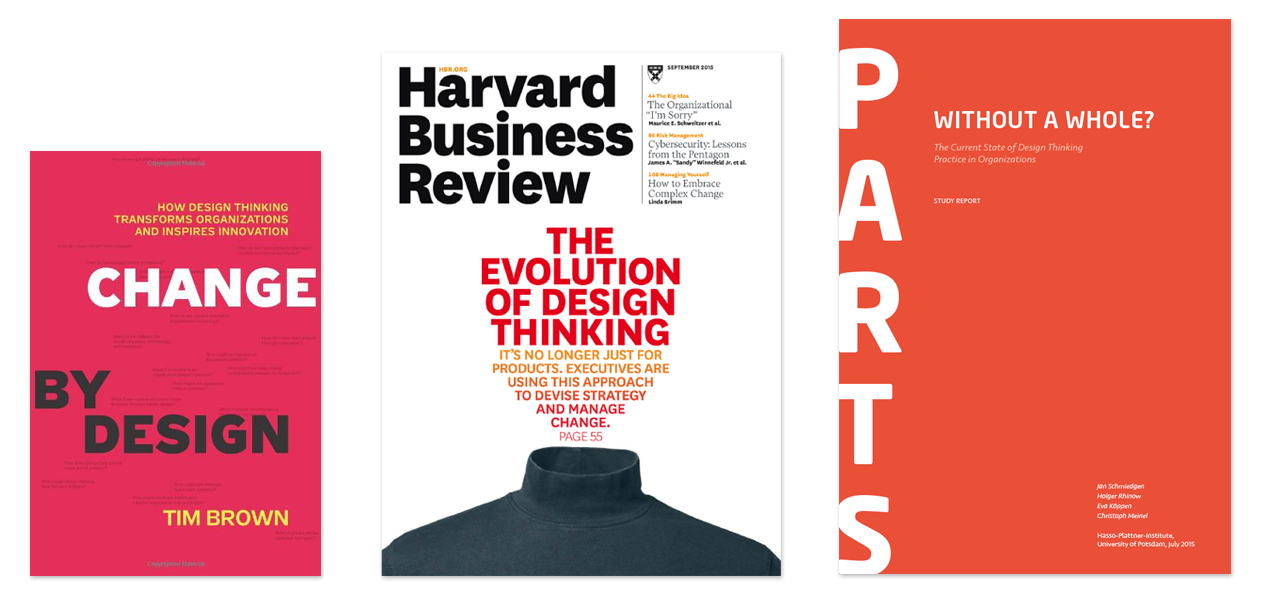
In autumn 2009 Tim Brown published his influential book ‘Change by Design’, an introduction to Design Thinking for business leaders. Shortly thereafter, in early 2010, I read it for the first time while studying in a post-graduate course at the HPI School of Design Thinking. Now, five years later, I am studying Design Thinking again as part of Laurea’s MBA programme, while Brown shares an update in HBR’s latest edition and — simultaneously — the HPI publishes a large study on the current state of the concept. Time for a review of the concept and its application.
The Many Meanings of Design Thinking
In 2009, Brown described Design Thinking as a set of principles, as an exploratory, human-centred process and systematic approach to innovation that can be applied for problem solving. He argued that it balances the perspectives of users, technology, and business. Throughout the book he named its ingredients, ideal organisational setup-up, its divergent and convergent phases. Eventually he pitched the idea that the presented techniques, originated in design studios, should spread inside of organisations and be integrated by other disciplines. Brown suggested to use Design Thinking within interdisciplinary teams to manage innovation portfolios and transform organisations.
The Practitioner’s Point of View
According to a recently published study Brown’s hopes became realities — at least partly. Yet, as diverse as Brown described the concept of Design Thinking (principles, techniques, process) in 2009 as much ambiguity did a group of HPI researchers find now when questioning international practitioners through a survey and qualitative interviews. While almost all survey respondents described it as an ‘iterative process’, only about 60% named it a ‘method or methodology’. Only a tenth of the participants referred to it as a ‘culture’.
In Brown’s vision the entire organisation would commit itself to this human-centred practise. What might start off in an innovation cell would then branch out and be applied to bigger projects. Eventually Design Thinking would become integrated into all of the organisation’s processes and be holistically embedded. The study findings, however, show that in practise such deep cultural integration is far from being the norm. For 3/4 of the organisations which apply Design Thinking it is located ‘somewhere in the organisation’, predominantly in a dedicated department. For about 1/6 Design Thinking is being used for strategic management and decision making. Only a little more than a quarter of the participants stated that it is intrinsic to the overall culture. Most likely Design Thinking is currently localised in a special function instead of being widely embraced, the researchers conclude. 10% of the respondents even stated that they abandoned the concept in the meantime.
To Design Thinking through Design Thinking
While Brown highlighted the broad application of Design Thinking, the researchers were surprised to find it being often used as a programme for internal change-making. This theme was identified as an even stronger aspect than its application for the development of new product and service offerings.
In his autumn 2015 article Brown argues that an introduction of design thinking to the organisation through Design Thinking is critical for its success. More important than the design of products, strategies or complex systems is the acceptance of the new process by key stakeholders, he claims. Executives can feel threatened as the introduction of new working practises and consequently new business models or organisational set-ups might challenge their current position or the prevailing power structure. Brown suggests an ‘intervention design’ with iterative rapid prototyping. Such “iterative interaction with the decision maker” would allow a senior management team to be constantly involved in the development of the new system and get familiar with a relative revolution step by step.
The practitioners of Design Thinking might be on the right track by applying the concept to the organisation in parallel to the development of new offerings. Thereby they can establish a common understanding of its capabilities and spread the mindset without overruling anyone. Such an approach might have been the missing recipe for the 10% of companies which have already abandoned Design Thinking. Using Design Thinking truly holistically can help paving the way to a broader understanding and acceptance of the concept.
Written by Martin Jordan
—


Leave a comment