
In our first contact session with Gijs van Wulfen and Katja Tschimmel, we experienced a lightning version of an innovation process with Design Thinking: 2 days, not even 14 hours of work. And I’ve been wondering… What about real-life innovation? Can you expect to find a great brand new solution in just a couple of days? If not, how much time and effort does the process require? I hope to draft an answer to this question by gathering information from The Innovation Expedition.
Note: don’t get me wrong! I loved the approach. We could live the whole process and understand what we are supposed to do as service designers in a flash. That’s a great guidance for the rest of our studies and beyond. But I really need some perspective…
So, what did we do in class?
We solved an innovation assignment by applying a short version of the Forth innovation method structure, developed by Gijs. And completed each step with design tools —very visual and intuitive—, provided and clearly explained by Katja.

And the long version…
The structure of the method remains, but a little more time is used… About 20 weeks per project! Let’s see how much bigger this looks.
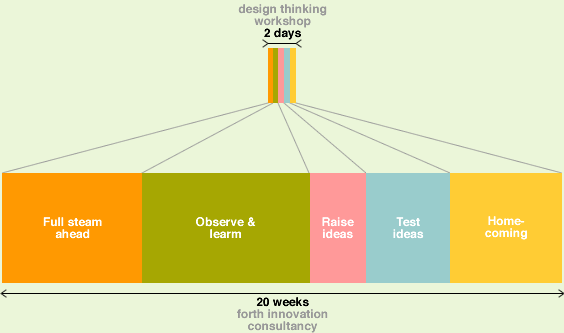
What do they do with so much time? (And what did we do with so little?)
Full steam ahead – 5 weeks

At the beginning of a real innovation assignment, many sensitive issues have to be decided:
- Establish the innovation assignment and evaluation criteria.
- Form the innovation team.
- Plan the approach.
- Set the total costs.
Once all of those are decided, you can:
- Introduce the team members to each other.
- Make the team familiar with the innovation assignment.
Those are basically the two parts we did. Only the real workshops are longer than ours.
Observe and learn – 6 weeks
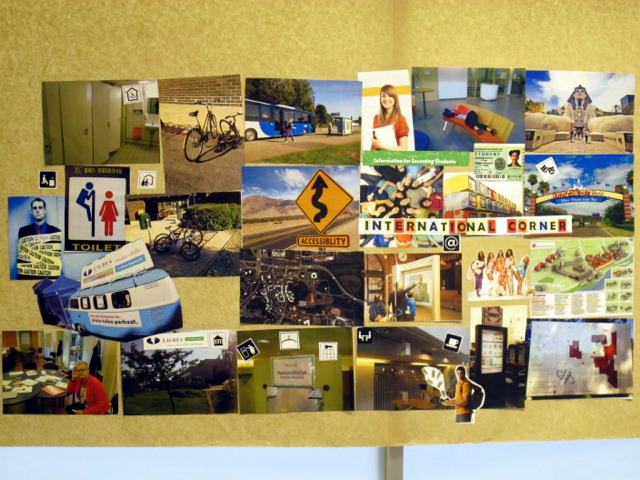
Key activities in this phase are somehow similar to ours, but much deeper. Individuals:
- Explore trends and technology by gathering secondary information and visiting outside sources of inspiration.
- Discover customer frictions with qualitative research.
Note one key difference: to research on customer frictions, they meet real users and talk to them.
At several stages the whole team meets to share all those findings and chooses the most promising opportunities.
Raise ideas – 2 weeks

On the basis of the opportunities spotted in the previous phase, the team gathers in small groups to brainstorm new product or service ideas. In total, they:
- Produce 500-750 ideas.
- Cluster them into 30-40 idea directions.
- Form 12 concepts.
- And improve them with feedback from other groups.
Our process for this was similar, but we only produced about 10 times less ideas, didn’t cluster them and simply chose or formed one concept.
Test ideas – 3 weeks

The 12 concepts are then tested with real users through qualitative concept research. And improved according to the results. We didn’t test our one concept with users. We simple received input from another group. That is, we simplified concept improvement to just one round (in fact, equivalent to the raise ideas concept improvement round in the extended method).
Homecoming – 4 weeks

Last step is all about building a case for each concept and present it to decision makers within the organisation. In pairs, the teams produce a mini new business case that includes:
- The customer friction or need.
- The new concept.
- The benefit for the customer.
- The feasibility for the company.
- The potential costs and profits.
- How to continue with the project.
In our case, we did a very rough estimation of the business model and presented some of those themes, too. Only we didn’t have access to real data and hadn’t worked the concept or its validation as much! Another important activity in this phase —that we didn’t do at all— is the transfer of the project to the development team. It’s hard to remember it by the end of the process, but all you have is still a concept. And there’s a lot of work to do before it reaches the market!
Fuzzy front-end and sticky back-end
Did 20 weeks seem very long? According to Gijs, to put a new product or service to market usually takes between 36 and 18 months, for products and services, respectively. Then, what about the 20 weeks? They correspond only to fuzzy front-end of innovation. The fuzzy what? The start phase of innovation, nicknamed as fuzzy front-end, because it’s the vague process during which the new product or service concepts are crafted. Once the concepts are approved for development, the sticky back-end starts. That’s when the ideas are delivered by designing, communicating, building or producing them. So, some more perspective to add!
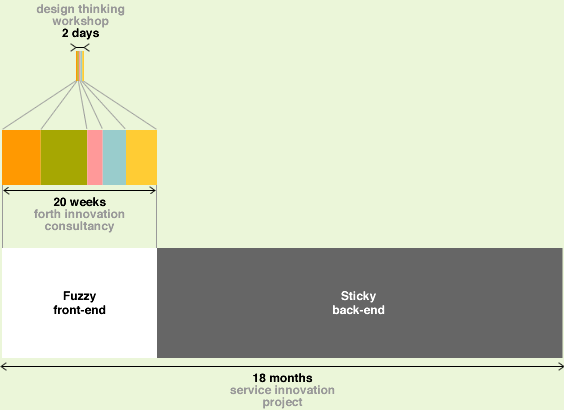
Perspective acquired?
Hum! Not sure I can really grasp what an innovation project really involves yet. But this exercise has made me wonder another key issue: how do you keep up the spirits, energy and playfulness that everyone valued in the longer term?
Post by Itziar Pobes, first-year SID student


Leave a reply to Antti Kytö Cancel reply