
The simplest things we do and all everyday items we use are made as they are by design. We all contribute – sometimes unconsciously – to the outcome which is designed. Hands up, if you have thought about decorating your home or if you have done it to some point? Yes, at least some of you have done it. Therefore, you have designed the interior look and function based on your personal preferences. We all understand (well, more or less we do) stated objects differently, especially, if we need to interpret them based on a drawing. This was freedom of interpretation and freedom to do your own version. But when going deeper into the design process, there is usually a problem triggering or we are simply facing nonexistence. This was the situation we met in our Design Thinking course.
We were pushed to be something we didn’t realize to be until it was already time to finish the course. It was obvious throughout the classes that interaction, co-creation and identified needs were the key to basic design understanding.
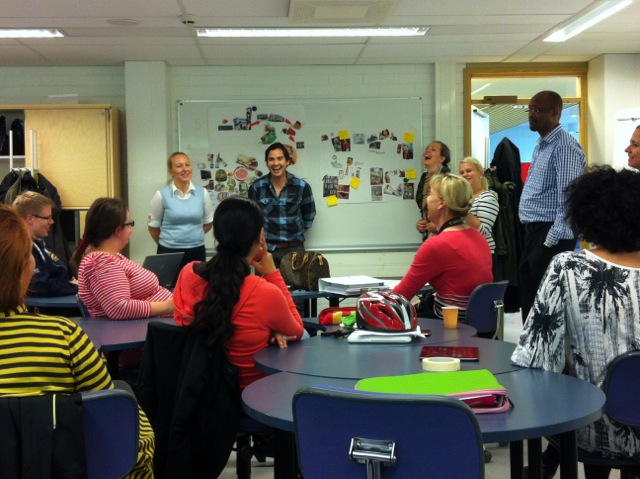
Figure 1: First design thinking class
Exploring the museum challenge
Design Thinking starts with identifying a gap. In the real world, the problems usually are not explicitly defined. One of the methods to identify a problem is through ethnography. Designers put themselves into the problem situations in order to understand the hidden aspects of the problem. They closely work together with the user groups for which the solution will be designed. For instance, in our Design Thinking course at Laurea, we chose the task to identify the problems of a museum service and to design a new solution. We started out with a basic Design Thinking lecture and a workshop providing insights and surprises on ourselves as designers, followed by teambuilding/leadership exercises. Then, gathering in groups of 5 people, we were brainstorming the first ideas on the new assignment. The best ones from the outcome of that session were presented, discussed and taken into the next phase.
We started working with the concepts and put everything together in order to understand how it would fit the existing offering of experiences in the museums. After identifying the problems, we went into the ideation phase. During this phase of the process, designers need the right attitude to think horizontally and spread out in all directions without jumping towards a particular solution or going too much into depth. It is like creating a chaos of solutions and including also radically wild ones. Designers need this kind of attitude to provoke and allow for novel solutions, which are not necessarily based on past experiences but on something which was probably not thinkable before. It is kind of moving away from the incremental approach to a novel solution finding process.
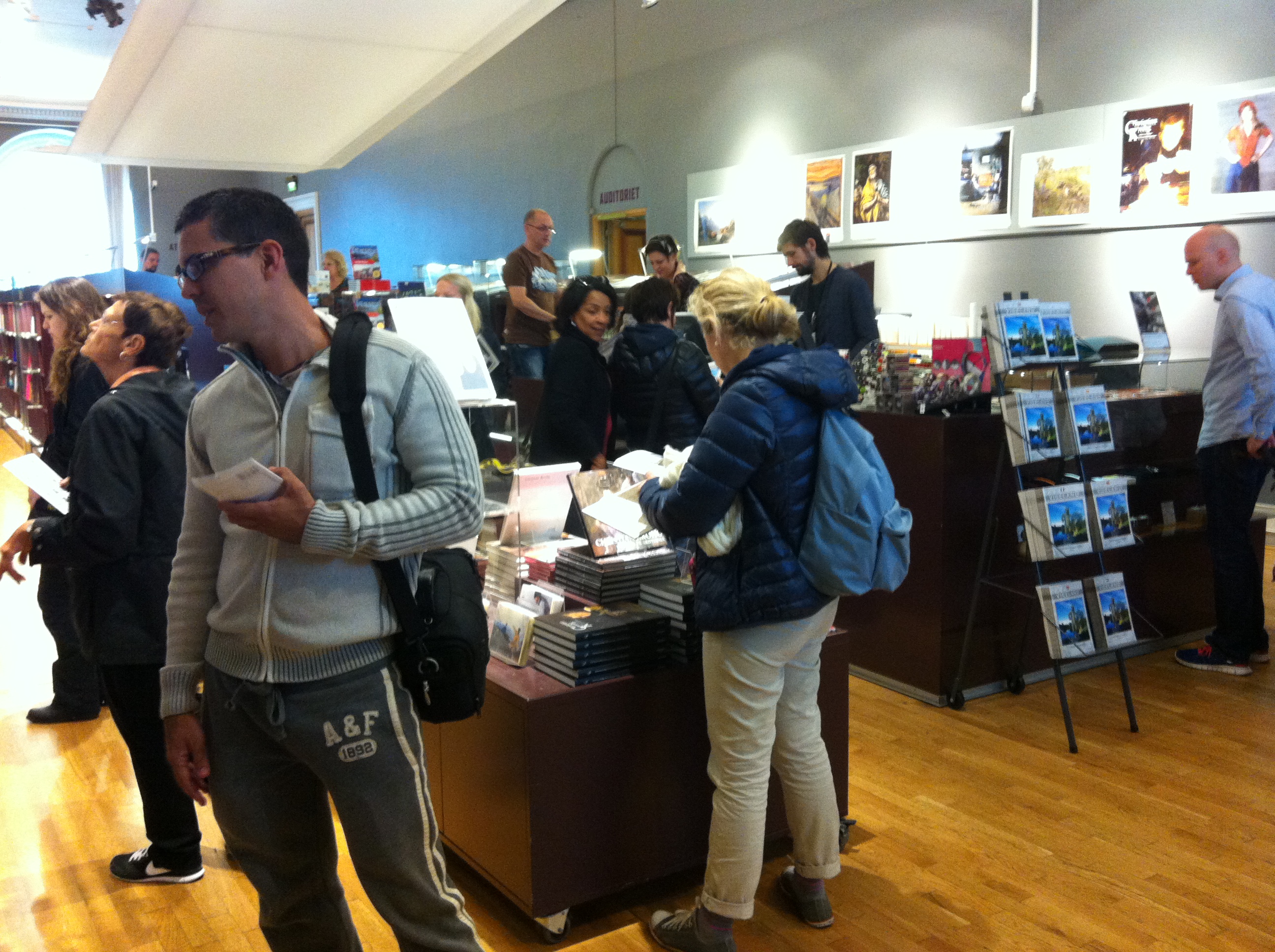
Figure 2: Oslo National Gallery
We had to decide on actual museums, which would provide us with insights on how museums work and help us to gain tacit knowledge. Our journey into ethnography began with visiting EMMA, Espoo Museum of Modern Art and Oslo National Gallery. We were observing, visitors and interviewing users as well as employees. And, last not least, we were acting like visitors and critically observing the services while consuming them. By in-situ observations, we were introduced to many hidden problems in only a short period of time. Having first-hand information on the problem is the first step towards sustainable improvement. And after all this input, we were again facing plenty of potential solutions and had to focus, narrow in and decide on the ones that were most suitable to our approach and had the biggest impact on the given situation.
Which tools to use?
Out of the various approaches to reach a novel solution, these are the ones we applied:
Prototyping: The purpose of prototyping is to get feedback from the users and to evolve the idea. The parameters for deciding on how elaborate the prototype will be: how much time and effort to put in and which materials to choose will be defined by the minimum that is necessary to achieve valuable user feedback. A prototype is tangible but it may not be real. A user interface prototype, for example, can be made out of paper and the entire user interaction can be simulated with a couple of hand drawn pictures simulating the computer screen with various buttons, menu items, dash boards etc. In our design thinking course we used a role playing technique to prototype a future service of the museum and gathered feedback from the audience. Furthermore, we learned how to reveal sensitive tacit knowledge within problem situations which can be most valuable to the designer.
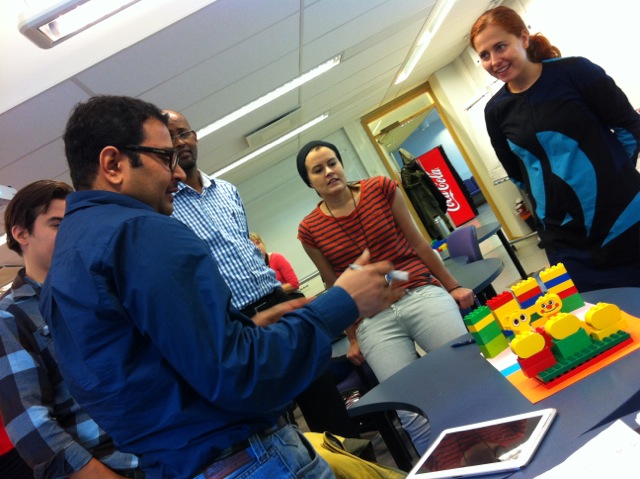
Figure 3: Lego challenge
Scenarios: The advantages of creating scenarios are multilayered. First of all, they function as a tool to communicate a single problem or sequential problems to various stake holders. It is like presenting a visual, life document with tremendous potential for shared impact. Second, scenarios can function as a tool to address problems in a broader perspective. They help to articulate the complexity of the problem and ease the process of breaking it down into linked but manageable sub-problems. Third, scenarios, like prototypes, can help the designer to uncover some of the tacit knowledge of the stakeholders.
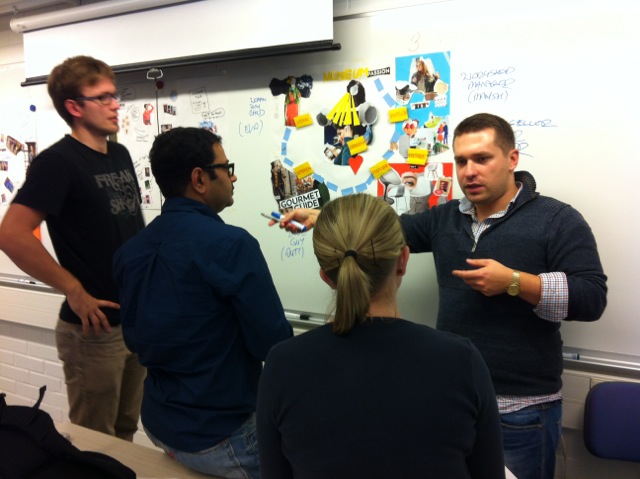
Figure 4: Museum by night scenario
The Scenarios Report “Museum by Night”
Critical Artifact: Like prototypes, critical artifacts are also tangible but with a different purpose. They are useful during the ideation phase in order to specify the problem generate extreme solutions. Stakeholders and designers may imagine such a solution based on prior experiences with the existing services/products. Critical artifacts are not a practical solution to an obvious user need, but its sole purpose is to ignite critiques about the usage of the service or product. When potential user groups start to question and discuss the solutions stated by the critical artifact, novel design ideas are likely to emerge.
At the end of the day
It was an awakening course on Design Thinking. It was exciting to notice, how The 100 lines Exercise in the beginning of the course showed how other contributors express themselves and foremost, how oneself as a designer met the challenge to continue until 100 lines was achieved. Lego block building in small groups without talking at all definitely showed and taught us about subtle communication and understanding the flow made by someone else. The positivity and good energy in this class was stunning and we learned that design is meant to be an inspiring, fun activity. By lacking the fun factor, designers can fear failure which is against the design principal of “fail early” and learn from the mistakes in order to reach an optimal solution.
Design in our eyes
Design is a collaborative activity and communication is the back bone of it. Designers are smart to co-create in almost each phase of the design process in order to head for a user centered, sustainable solution.
Design is subject to constraints – designers will always need to balance imagination, feasibility needs and costs. But most of all, design is about handling this in a creative way. Only imagination is the limit.
We would like to thank you Mariana Salgado and Sanna Marttila for the course in its whole depth. You have enlightened the sparkle inside of us for designing.
Credits
We are expressing our special thanks for the time and effort for helping us to understand more about museums to EMMA‘s museum personnel, Espoo, Finland and Anna Carin Hedberg, Curator Education at Oslo National Gallery, Norway.
The authors: Daniel Augustyn, Eva Hugenschmidt, Manish Singh, Tero Byman & Outi Lassi
Photos by Eva Hugenschmidt
References
The articles:
Tim Brown: Design Thinking
Segelström, Raijmakers and Holmlid: Thinking and Doing Ethnography in Service Design
Simon Bowens: Critical artifacts
Book by Jon Kolko: Exposing the Magic of Design. A practitioner’s guide to the methods and theory of synthesis. Chapter 4. The value of Synthesis in Driving Innovation
Slideshare links:
http://www.slideshare.net/danielaugustyn/storyboarddesignthinkingmuseumbynightgroup3


Leave a reply to abdallaelbadawy Cancel reply