

Written by; Durga Shahi Thapa, Sabita Shrestha & Vijay Pulami Magar
Why do some products do really well when others fail? How do you find what is needed in the market? What makes a product sellable? Are you sure the “idea” currently in your mind is the best you can do? How will you implement those ideas to design a service or a product? When do you test it? These are the questions we explored during our Design Thinking masterclass at Laurea with Prof. Katja Tschimmel.
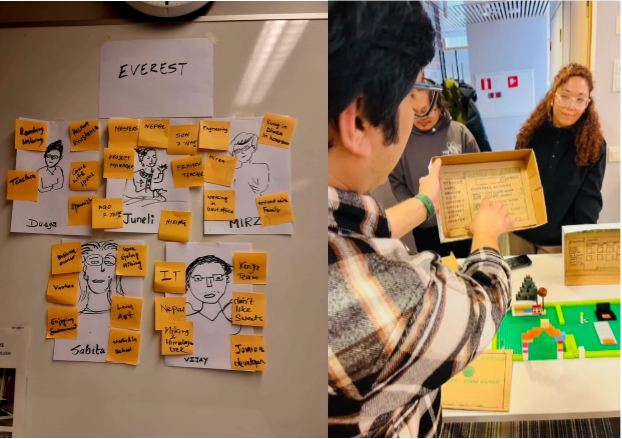
One of the things we learned was that good ideas are not achieved solely due to creativity, but due to the knowledge of human beings. Design thinking is a human-centered and applied philosophy that places real needs, real experiences and real solutions at the forefront. It renders imagination a fact, and the concepts devised by it add value to our lives. Brown (2008) believes, design thinking completes three fundamental things – human needs, technological possibilities, and business value. Innovation involves not just coming up with ideas but also creating them so as to make them usable, viable, and sustainable solution. This is to say that even brilliant ideas will not help unless it works in a real-life scenario.
Lesson of the past: Edison’s Method
Thomas Edison was not only a genius to invent but also the one who foresaw how these devices would be used by people in their daily life (Brown 2008). He observed human practices, found out what was required by people, and developed solutions that suited them; another principle that is mainstream in design thinking: it takes human wisdom to invent innovation, not technology. Similar to this, our group conducted a couple of interviews, gathered insights and worked on creating a service that would solve the problem faced by the interviewees (who were new students facing cultural adjustment issues in Finland). By doing this, we understood that the product should solve an existing problem to succeed.
Problem Framing: The Solution to the Right Problems
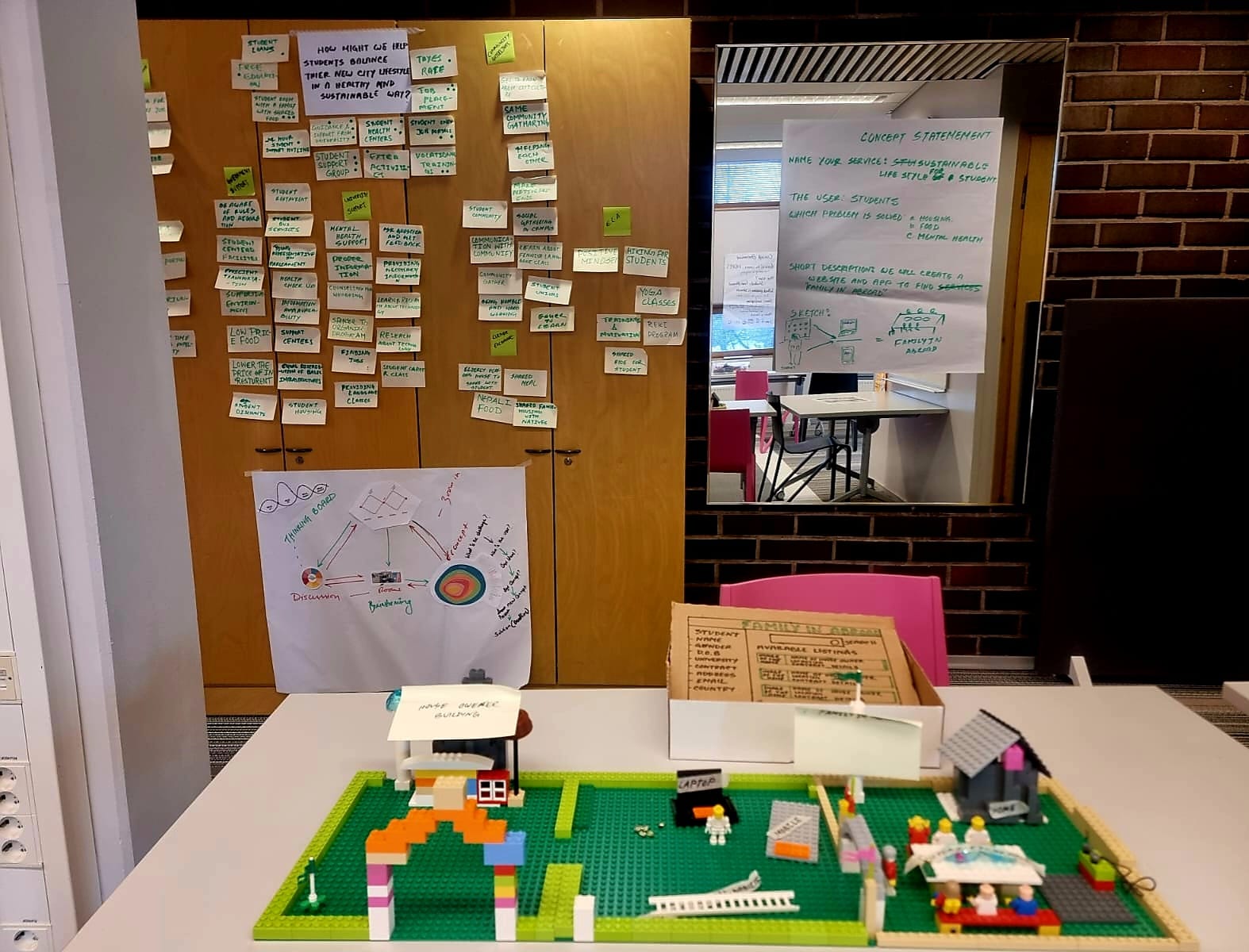
Design thinking prevents us from rushing to make a judgement. It is also significant because a clear definition of the problem will allow us to address the right issue (Carlgren et al. 2016). The approach has a tendency of isolating mediocre ideas and breakthrough innovation. In our case also, we did not rush to design a solution without reviewing all the problems first. we used the “How can we?’ method and listed out few questions to all the problems that we gathered from the interviewees. Then we finalized on one of the problems and only then created a concept statement.
Empathy: The Design Thinking Pillar
Designers will need to look at the world in the multi-faceted lens of the user, customer, and stakeholder to assist in meeting the explicit and implicit needs (Brown 2008). This is as Carlgren, Rauth and Elmquist (2016) discover, through observation, interviews, and life experience. Even the tiniest things, like stalking someone throughout the day can reveal something that will alter solutions.
Action Learning: Prototyping and iterating
After creating the concept statement, team Everest tried to come up with as many solutions as we could individually using the “Divergent thinking” method and later combined them to narrow down on a singular solution with “Convergent thinking” to come up with a service. It is not a perfect product that is being designed, the idea of prototyping is rather about learning quickly (Brown 2008). It is created and nurtured by doing things fast through trial and error, learning by trial & error, and iterating constantly (Carlgren et al. 2016). We then created an initial prototype and pitched it to the fellow classmates. We received feedbacks on the service and improved accordingly.
Conclusion
The overall lesson is that design thinking is an endless process; know people – make the problem clear – brainstorm – prototype – experiment – refine. It is a technique and a manner of thinking founded on empathy, trial and error, learning and curiosity. Design thinking is not merely about the generation of ideas, but transforming them into the real-life solution that works, as it is people-oriented, tolerant of experimentation and continuous learning.
References
- Brown, T. (2008). Design thinking. Harvard Business Review, 86(6), 84-92.
- Carlgren, L., Rauth, I., & Elmquist, M. (2016). Design thinking: The concept and reality notion. Creativity and Innovation Management, 25 (1), 38-57


Leave a comment