
You might have heard of design thinking in business context and its possible perks. A design thinking approach is usually chosen when there’s a need for new inventions, growth or increasing satisfaction. Design thinking is the way designers think – putting human needs in the centre of development and creating engaging and inspiring solutions. Design means an invention or a solution to a problem. Without inventions, there’s no growth. That is why you should get involved.
Design thinking can be taught and learned, it’s not a personality trait
In Dunne & Martins (2006) article they refer to the problem that the word design withholds. Usually the word design is associated with product development or fashion and it is seen as unrelated to the business world. Contentwise design thinkers use the same business tools, like KPI´s and ROI´s, but they always add the question “In service of what?”.
Another reason experts do not embrace design thinking is the idea that design means creativity. We, as a society, tend to categorise people as talented or untalented in different areas, ourselves included. But people are not born leaders, analysts, designers or rockstars – you need to learn the competences! Creativity and design thinking can be taught, and you can learn them.
The human-centric way to solve problems
First you need to understand the why and then you can learn the how.
According to Liedtka & Ogilvie (2011) the whole point of design thinking is to learn a new, systematic approach to problem solving. If you want to compete in the same market in few years, you need to grow and build resilience – you need to innovate. If the innovations are made internally, inside an organisation, a team, or even worse, inside someone’s head, you are heading to trouble.
Most experts know the straightforward way of problem solving: define the problem, identify various solutions, analyse each and pick the best one (Liedtka & Ogilvie, 2011). Traditional problem solving can be seen as a linear process. It follows a process of build-measure-learn, focusing on the building.
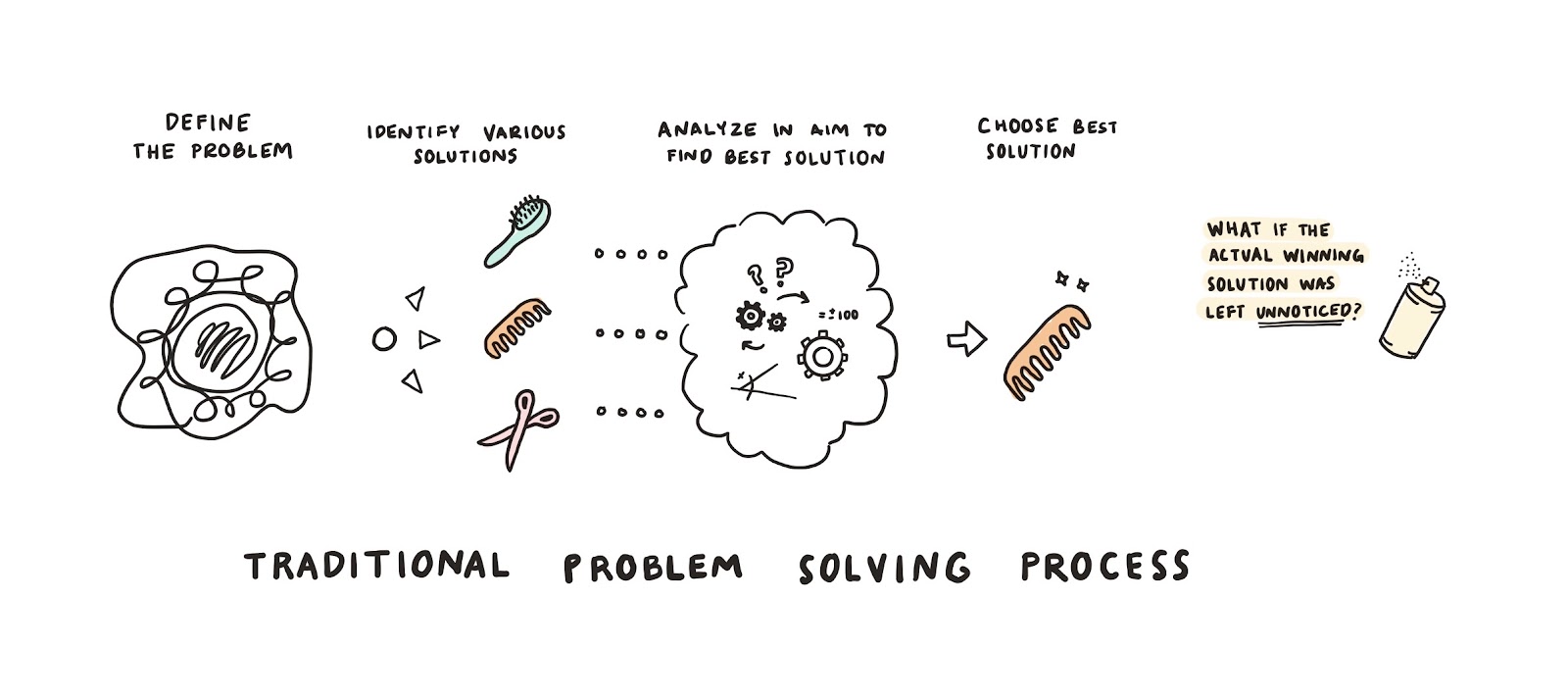
The traditional approach is problematic. It’s optimistic with no proof of the solution delivering great value. The process is cold and clean and all the learning about the solution comes afterwards (Liedtka & Oglivie, 2011).
In a design process you turn the roles other way around, learn-build-measure, focusing on the learning. A design process is never linear and it consists of multiple failures and iterations (Brown, 2018).
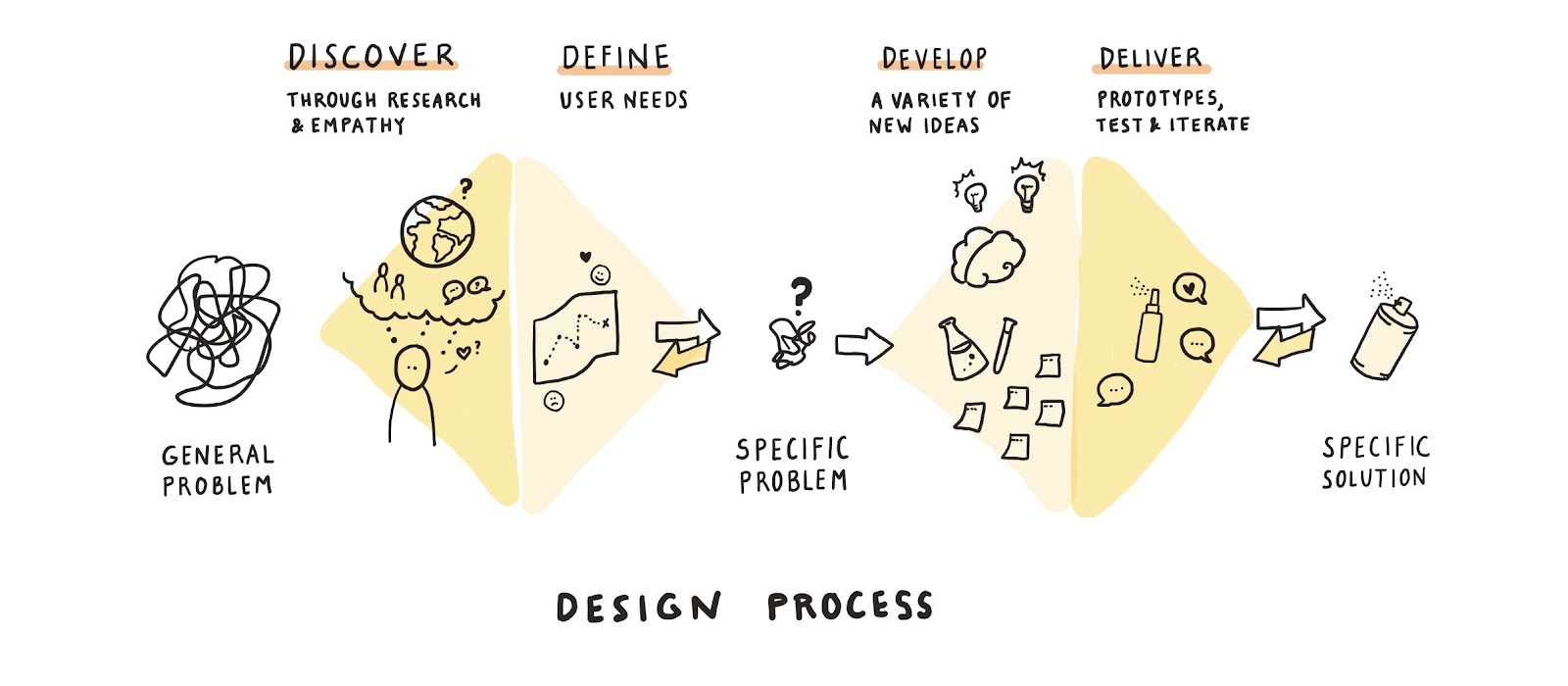
The process aims in discovering genuine human needs and developing specific solutions. It all starts from empathy – trying to imagine what others think (Liedkta & Oglivie, 2011). Others meaning your customers, team members, users or partners. As they say, they are not numbers! They are always real people with real emotions, problems and personal targets. A design process creates solutions that inspire through true engagement and emotional connection.
Learning design thinking doesn’t just mean learning a new set of tools. It also means learning to collect and analyse large quantities of data, learning to think what might be instead of is, learning to manage the feeling of uncertainty and collaborating with many new parties (Liedtka & Oglivie, 2011).
Why haven’t all organisations embraced design thinking?
Organisations with new innovations and best customer and employee experiences recruit the best experts and dominate the market. Still human-centricity is fairly rare.
Comparing the two approaches presented, design process can seem slower. When the emphasis is in the beginning of the project, where all the learning and value creation systems are mapped, the project will not provide solutions as fast as the traditional approach. This is why I’ve seen multiple projects crumble under the feeling uncertainty and change to the traditional approach.
Where next?
Now that you have some understanding of the why, you can start expanding your personal tool kit with new, collaborative tools.
Written by: Elina
References:
Brown, Tim (2008) Design Thinking. Harvard Business Review, June, 84-95.
Dunne, D. & Martin, R. (2006) Design Thinking and How It Will Change Management Education: An Interview and Discussion. Academy of Management Learning & Education, 2006, Vol. 5, No. 4, 512–52.
Liedtka, Jeanne & Ogilvie, Tim (2011). Designing for growth: a design thinking tool kit for managers, New York: Columbia University Press.
Tschimmel, K. (2020). Design Thinking Masterclass, Laurea.


Leave a reply to elinaww Cancel reply