
As the pace of technological change is constantly increasing, we are spending more time consuming the constant flow of innovation rather than creating something new. Tschimmel (2020) suggests that “innovation is the driving force for the quality of life and economy”. However, how to unlock the hidden capabilities all of us possess to enable this contribution to the common good? Design thinking helps to use a broader range of tools and approaches to expand one’s creativity and enable innovation processes. Design thinking is built on the 7 key principles:
- Collaboration
- Human-centred approach
- Experimentation
- Divergence
- Visualisation
- Holistic perspective
- Prototyping
During a 2-days masterclass on Design Thinking at Laurea we were presented, and had a chance to use in practice, Katja Tschimmel’s Innovation & Design Thinking Mindshake model. The model includes a step-by-step process to design and create something new.
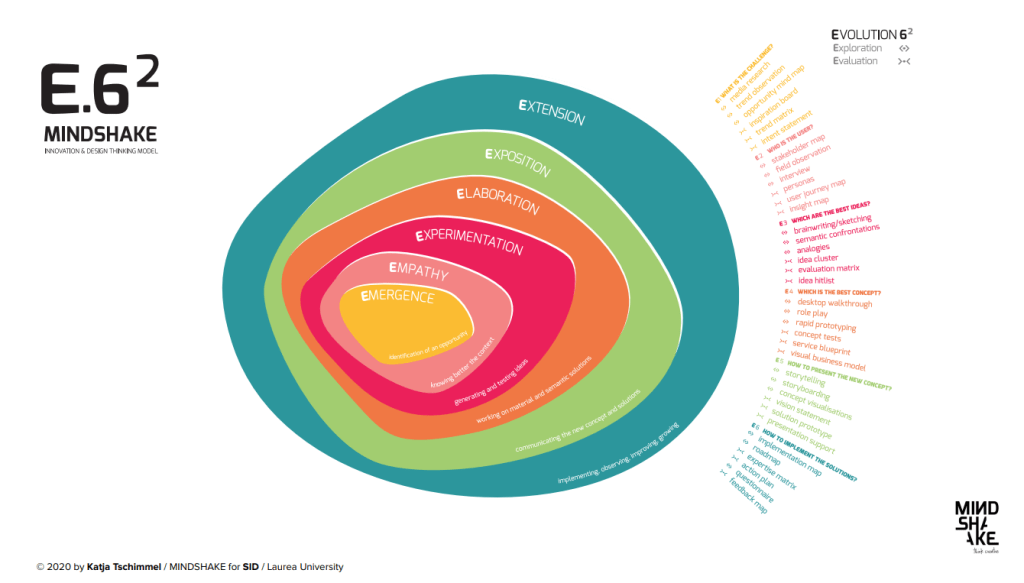
As part of the workshop, we walked through each of the steps and applied the methodology for solving a suggested problem. At first I was skeptical about the value of “another ideation tool”, but once applied in practice, the value has become more apparent. This design process enables the imagination to flourish and brings new perspectives by utilizing a fusion of techniques and approaches.

Motivated by inspiring discussions, I next approached one of the recommended books called “Change by design”. Tim Brown’s seminal paper on Design Thinking describes approaches that made a firm IDEO one of the leaders in design consulting. Tim emphasizes the human-centered aspect of design thinking arguing that empathy is the fundamental tool to grasp problems and perspectives the end users are dealing with. I ended up giving the book 3 on the scale between 1 to 5 on Goodreads due to heavy marketing implications of the included stories, however the paper definitely brought my understanding of the design thinking fundamentals to a new level and stirred up my interest in the topic further.
Coming from a professional services field where structural problem-solving is the key enabler, design thinking at first seems like a discipline full of “fluff” with unnecessary “poetic” or even esoteric implications. Luckily, I enjoy these genres. Like the “not-necessarily 100% scientifically-backed” works of Carlos Castaneda or Marshall Rosenberg at some point in my life gave me new momentums to start something new, I have high hopes for Design Thinking to expand the professional boundaries I’ve been locked into in the recent years.
Resources:
Tschimmel, Katja (2020). Design Thinking course lectures, September 4–5 2020. Laurea University of Applied Sciences. Espoo, Finland.
Brown, Tim 2009. Change by design: how design thinking can transform organizations and inspire innovation. New York: HarperCollins Publishers.
Tschimmel, Katja (2020 forthcoming). Creativity, Design and Design Thinking – a human-centred ménage à trois
Pereira, J.C.; Russo, R. (2018). Design Thinking Integrated in Agile Software Development: A Systematic Literature Review.


Leave a comment