
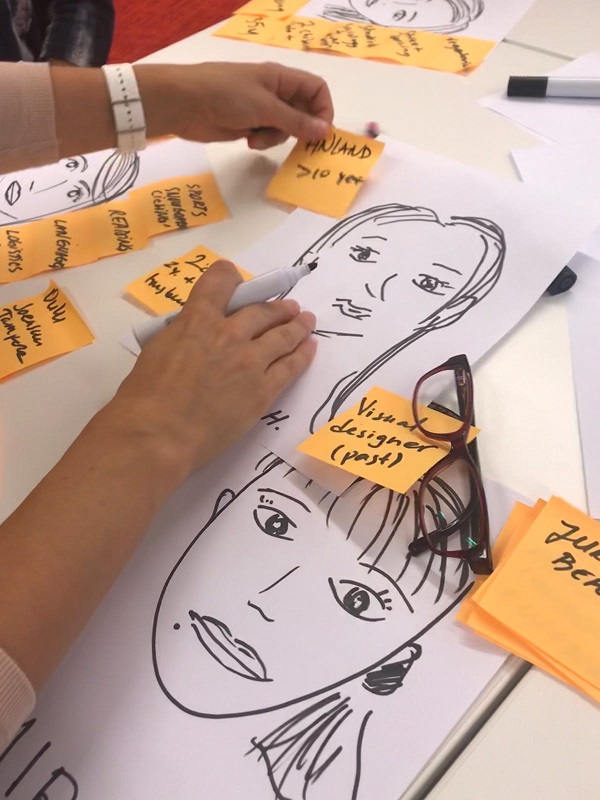
We started our journey as SID students in early September 2020 with a two-day workshop that introduced the concept and process of Design Thinking. It was hosted by Katja Tschimmel and our tutoring teacher Päivi Pöyry-Lassila. Katja is the founder of design agency Mindshake and the model Evolution 6² or E6² (2018), Päivi is a Principal Lecturer at Laurea.
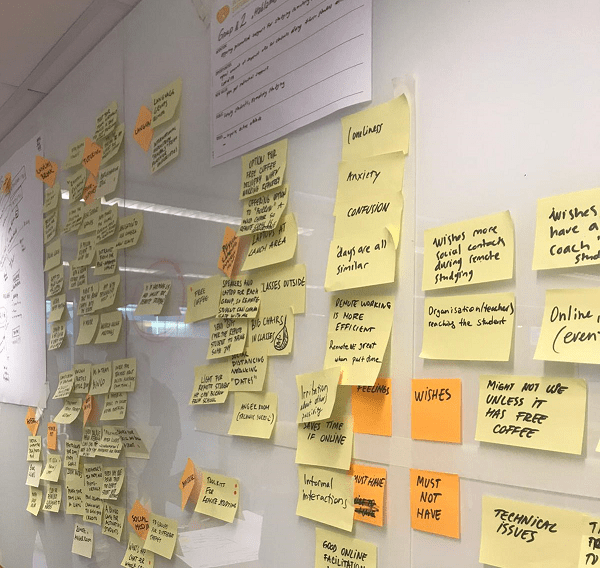
In the limited timeframe, Katja walked us through the design process with Mindshake’s Evolution 6² model to support the creative thinking process. This helped us form an understanding of what the design process can be like.
We are all designers
Historically designers were typically arts-based design professionals. It is now known that successful designers do not differentiate themselves only through their specialised knowledge, but by their ability to think creatively. (Tschimmel, K. (2020).
According to Kamil Michlewski (Design Attitude, 2016) we all possess some form of design skills. Even though some are inherently better at designing than others, there are a set of steps anyone can follow on the road to innovation.

Design Thinking
Design for Innovation always implies the creation of something new, it is always based on creative thinking or design thinking. Design Thinking is not only a cognitive process or a mindset, it has today become an effective method with a toolkit for any innovation process, connecting the creative design approach to traditional business thinking.
Design is also no longer viewed as just a creative or rational problem-solving process, but rather as an opportunity and knowledge generating activity that helps to deal with intricate problems.
It’s important to remember however that, as concluded in Design Thinking comes of age, “Design doesn’t solve all problems”, it offers unique opportunities for humanising technology and developing emotionally resonant services and products.
Today design is making significant economic contribution to businesses, organisations and economies and designers are the closest group between the company and its internal and external consumers, they are change agents who are transforming organisational cultures.
Courage to take risks, empathy for understanding
An underlying theme from our research is courage and the ability to embrace risk and ambiguity. For creativity to flourish, the culture needs to be one that allows not getting things right the first time, gives room for quick prototypes and iteration.
So, to “boldly go where no man has gone before” we need creativity, design thinking and a design attitude. We need to have courage to experiment, a toolbox to choose tools from for divergence and convergence for designing and to create new meaning from complexity. When we are able to solve problems, we are at best creating meaningful value for the society and our planet.
Blog text written by Elena Howlader and Anna Sahinoja, SID2020 students
References:
Kimbell, Lucy (2012). Rethinking Design Thinking: Part II. Design and Culture, Volume 4, Issue 2, July 2012, 129-148.
Kolko, Jon (2015). Design thinking comes of age (https://hbr.org/2015/09/design-thinking-comes-of-age). Harvard Business Review September 2015, 66-71.
Michlewski, Kamil (2015). Design Attitude. Gower Publishing Limited. England.
Tschimmel, Katja (2020). Design Thinking course lectures, September 4–5 2020. Laurea University of Applied Sciences. Espoo, Finland.
Tschimmel, Katja (2018). Evolution 6² Toolkit: An E-handbook for Practical Design Thinking for Innovation. Mindshake.


Leave a comment