
Can you kill with a pencil? Yes, and not just literally as pen(cil) truly is mightier than a sword. A mind shaking two-day crash course to design thinking by Katja Tschimmel and Sanna Marttila began with an exercise on creativity and a lesson on the importance of luck. One should strive to be creative – and can train for it – but the uniqueness of your idea often is a matter of pure chance. Suggesting a new use for pencil as an eyeliner calls for creative thinking. But from the group of some 60 eager students attending the same course, others had also come up with the same idea. Being creative is a must, but being lucky can make the difference between success and failure.

Tim Brown suggests that thoroughly understanding what people want and need in their lives is the very core of design thinking[1]. To someone coming from a background of international development that sounds oddly familiar. We learned that people tend to use what’s familiar to them to boost creativity and make sense of the unknow. As a complete rookie to design thinking, that is exactly what I did.
The “people first” approach of design thinkers is called “ownership” in the world of development. Through trial and error aid workers (=people from developed countries, with a sense of humor, cooperating with people from developing countries) have realized that local people (= often referred as “intended beneficiaries” or “partners” in development jargon) are the real experts on improving their lives. To achieve sustainable results one must design activities that respond to the needs of the end-users. It sounds so simple and almost self-evident, doesn’t it? However, just as the world of business has over time learned to use design thinking to create value and build customer experiences around user’s needs[2], it has taken time for the world of international development to come to the same realization.
Brown also argues that including designers into the process should not be about making an already existing idea more attractive, nor should it be done as an add-on afterthought. Similarly planning together with your partners should always be an integral part of any development cooperation project. Whether you are building schools in Africa or lobbying for a more just world in Finland, walking in the shoes of your target group should be among the first things you do. After all, collaboration – a core characteristic of design thinking – is very much part of international development. Experimentation – learning from mistakes and failures for something new to emerge – is also a must.
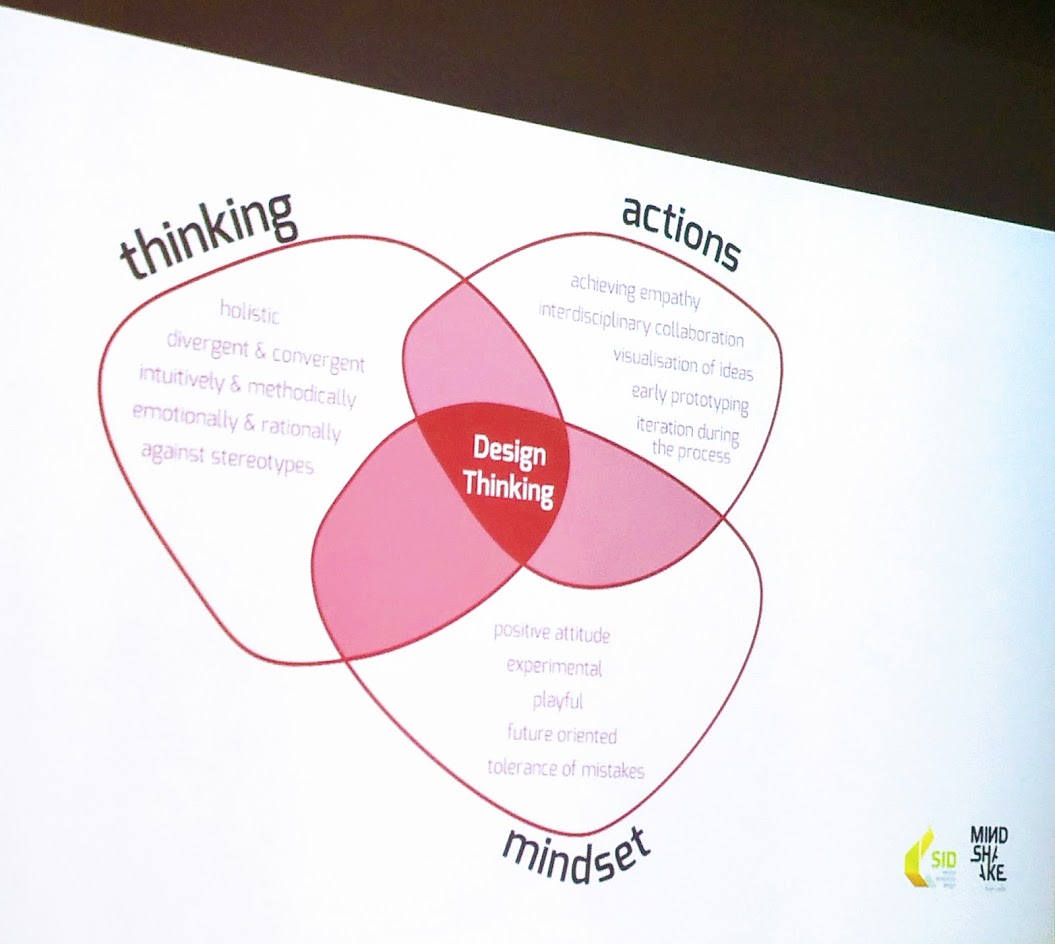
For someone with a degree in anthropology, mapping out needs, perceptions and beliefs of your target group comes naturally. Using different methods of ethnography could also prove useful in the search for “new nuances”, which according to Katja Tschimmel should be the core of design education. Instead of sketching, visualization and prototyping aid workers tend to rely on stakeholder workshops and interviews. I was glad to learn that these could also be used as participatory methods of co-creation.[3]
As IDEO´s work on social innovations among the impoverished communities demonstrates, linkages between the international development and design thinking are not just imagination of a wanna-be-service-designer like myself. From IDEO’s 3 I and HCD models to double-diamond model of the British Council[4] and Mindshake’s Evolution 6²model[5], the tools of design thinking can create value in any field. This includes solving development challenges encountered by the poorest people of this globe. In fact some companies, such as M4ID, are already successfully combining design thinking and development.

Just as global development, we learned that design thinking is never a linear process. One can’t plan too far ahead and at times the whole process can feel chaotic. But armed with the mighty pencil (as nothing else works when you´re sitting underneath a mango tree facilitating a workshop in +37-degree weather), working together with enthusiastic (Mozambican small-scale farmer) co-creators one might just be lucky enough to come up with something that satisfies both the needs of the beneficiaries and the desires of the funders. In international development that is very close to a perfect design.

References
[1] Brown, Tim 2008: Design Thinking. Harward Business Review. June. 84-95. http://www.ideo.com/images/uploads/thoughts/IDEO_HBR_Design_Thinking.pdf
[2] Kolko, Jon 2015. Design Thinking Comes of Age. The approach, once used primarily in product design, is now infusing corporate culture. Harvard Business Review. September 2015.
[3] Tschimmel, Katja 2012: Design Thinking as an effective Toolkit for Innovation. In: Proceedings of the XXIII ISPIM Conference: Action for Innovation: Innovating from Experience. Barcelona. http://www.academia.edu/1906407/Design_Thinking_as_an_effective_Toolkit_for_Innovation
[4] Tschimmel, Katja 2012: Design Thinking as an effective Toolkit for Innovation. In: Proceedings of the XXIII ISPIM Conference: Action for Innovation: Innovating from Experience. Barcelona. http://www.academia.edu/1906407/Design_Thinking_as_an_effective_Toolkit_for_Innovation
[5] Tschimmel, Katja 2017: E. 6² Mindshake Innovation & Design Thinking Model. Toolkit for Master Class Practical Design Thinking. Helsinki. September. Laurea University.


Leave a reply to mihalinageorgieva Cancel reply