
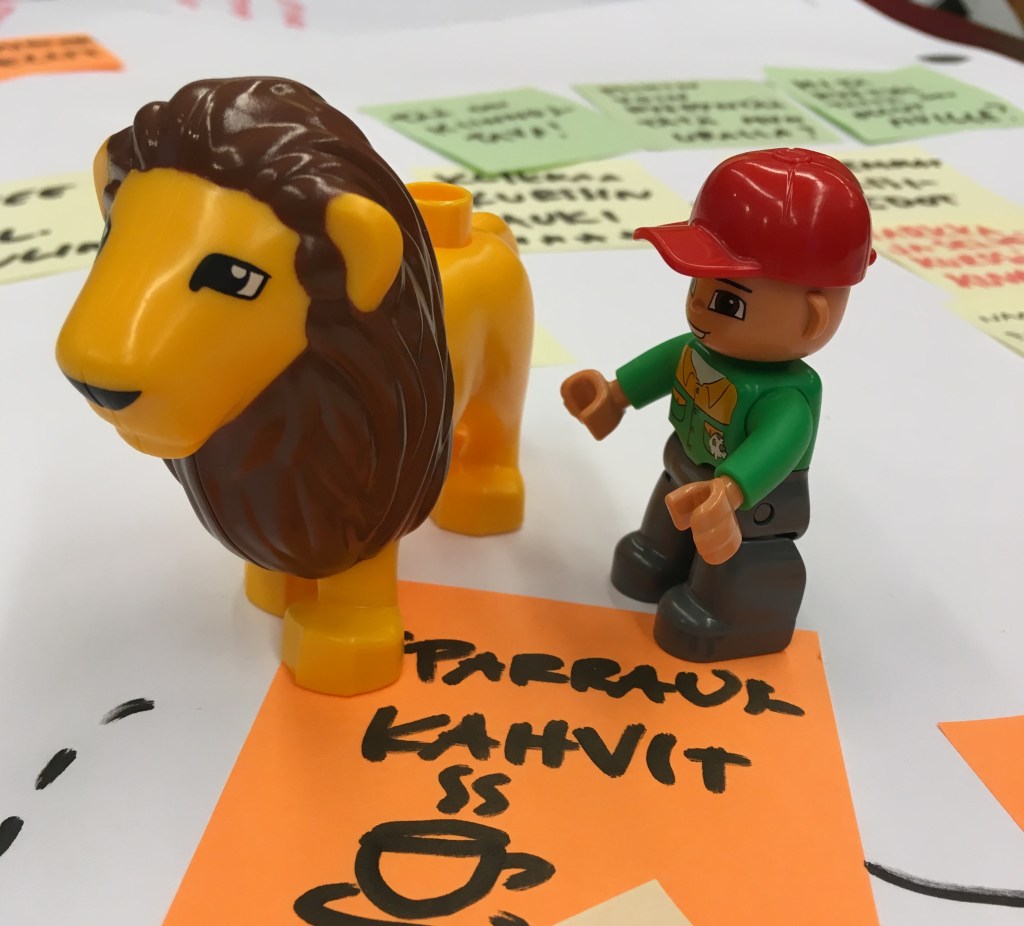
 Let’s start with a thought experiment. You have been working in the same job for years and now you are tasked with creating a new service for your customers. Where do you start?
Probably where you already are. Your first ideas are what have always been done and how to improve them, but only slightly.
To innovate, you need an open mind. To facilitate the innovation process you can use Design Thinking. Katja Tschimmel writes in her article Design Thinking as an effective Toolkit for Innovation[1] that Design Thinking offers new models of processes and toolkits for every creative process. It can be used in any business or organization. When you open your mind, and let the crazy ideas out, you can find something new.
The Service Design students at Laurea got a crash course on Design Thinking with Dr Tschimmel in the beginning of September. The students were tasked to create a new service around the theme Studying at Laurea. Every group could do whatever they thought might be useful, but in the end most new service ideas focused on solving everyday problems with quite traditional approaches. Why was it so difficult for us to let our imaginations fly and go for something completely different?
My suspicion is that it is the Inner Critic who is to blame. Often innovation processes suffer from the innovators’ fear of failure. In companies, upper management controls the time and resources available for trial and error. In universities, the students’ grade depends on the teachers’ understanding of their brave new idea.
Novices can out-innovate experts
Philipp Skogstad and Larry Leifer write in their contribution to the book Design Thinking: understand – improve – apply[2] about how reviewers and experts often discourage experimentation at cost of innovation. They demonstrate their thinking with their observation of student groups. One group was given a task to build a bike out of paper and use it to race against other groups. The day before the race they were given feedback that suggested that their unorthodox design would not last the race. The students later commented that if they had gotten the same feedback earlier, they might have changed their design into a more traditional one. Their ground-breaking new cardboard design would not have seen the light of day.
Another group was tasked to create a better wind deflector for a convertible car. Wind deflectors reduce turbulence in the car, but are bulky and hinder conversations with people who sit in the backseat of the car.
The group decided that it is best to eliminate the wind deflector altogether and to lessen turbulence by cutting a hole into the car’s windshield. At first, they did not even get permission to simulate the hole-in-the-windshield scenario with the participating car manufacturer’s computer. Other experts discouraged them from trying to cut the hole in the glass. The students persevered and tried it out. In doing so they demonstrated J. Wiley’s theory that in novel situations novices can outperform experts.
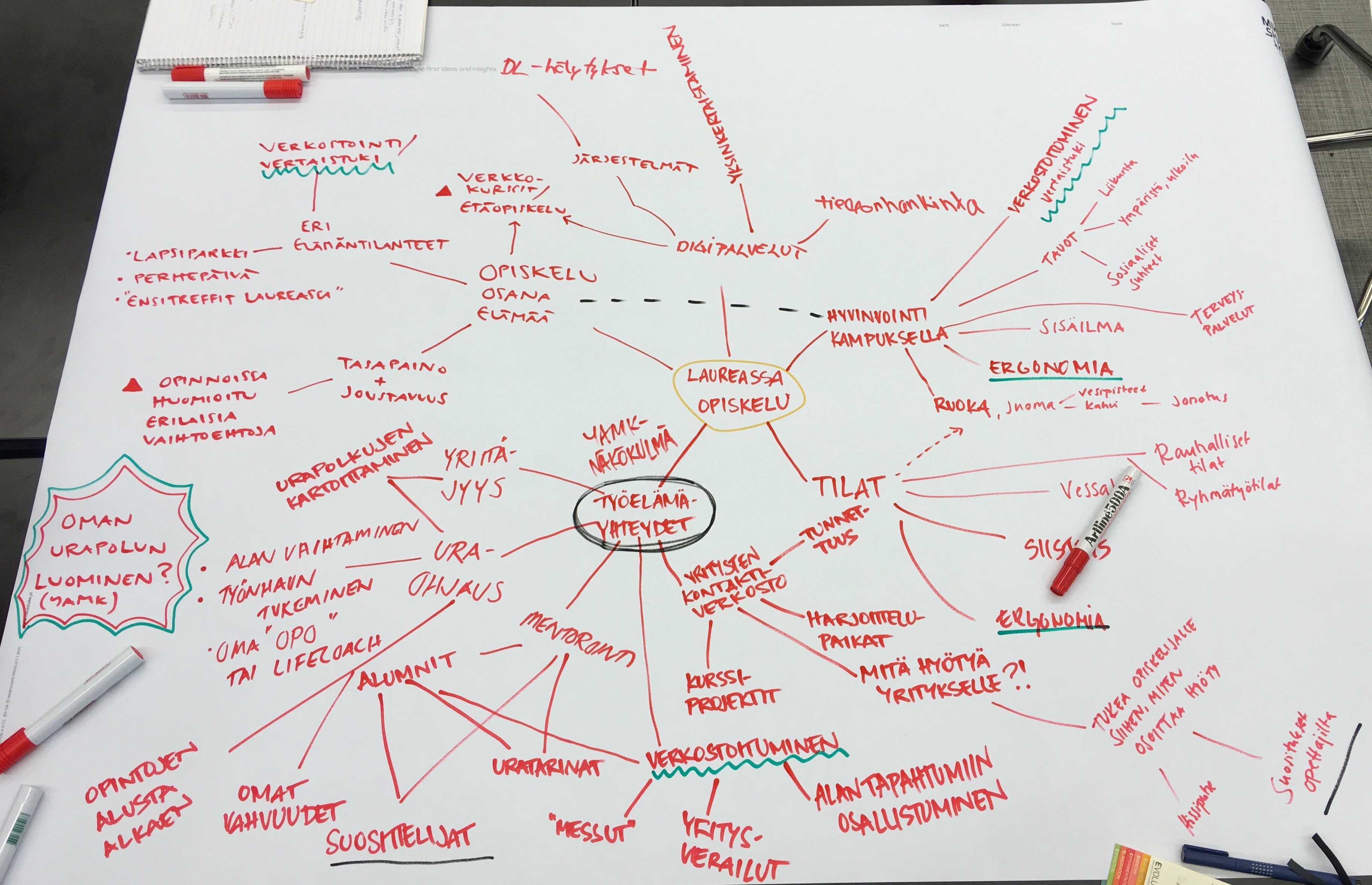
How did this manifest in our own Design Thinking project? All of us had been students before and therefore we were experts in the field of Studying at Laurea. Our first rough ideas on the Opportunity Mind Map in the Emergence phase[3] were all in areas that already exist, such as student well being, career counselling, work–life balance and campus infrastructure.
In the Experimentation phase we used Brainwriting and came up with existing solutions such as mentoring, tutoring, hackathons, career fairs, etc.
How to innovate without getting stuck in existing frameworks? In my opinion, a successful Design Thinking process needs a strong facilitator and preferably participants from different disciplines and walks of life. Radically different ways of thinking and looking at a certain problem will create differing ideas that facilitate semantic confrontations, which can lead to products and services that were not even fathomable before.
Maybe even the Inner Critic will finally shut up.
The author Noora Penttinen is a journalist and a recent Service Design student who believes in creative chaos and thinks that best ideas appear at four in the morning.
[1] Tschimmel, Katja 2012. Design Thinking as an effective Toolkit for Innovation. In:
Proceedings of the XXIII ISPIM Conference: Action for Innovation: Innovating from Experience. Barcelona.
[2] Meinel, Christoph 2011. Design Thinking: understand – improve – apply. Dordrecht: Springer.
[3] We used the MINDSHAKE Evolution 62 model.


Leave a comment