
“Design is all about action, and business too often gets stuck at the talking stage. Uncertainty comes with the territory when business objective is growth. But that doesn’t mean that you are powerless to do anything about it. You can’t make it go away, but you can manage it rather than allow it to manage you.”
Ogilvie, Tim, and Liedtka, Jeanne. Designing for Growth: A Design Thinking Tool Kit for Managers
According to Dr. Katja Tschimmel Design Thinking has, in fact, become an effective toolkit for any innovation process, connecting the creative design approach to traditional business thinking. It is just what business managers need when looking for new opportunities to take their businesses to the next level.
Becoming a Design Thinker
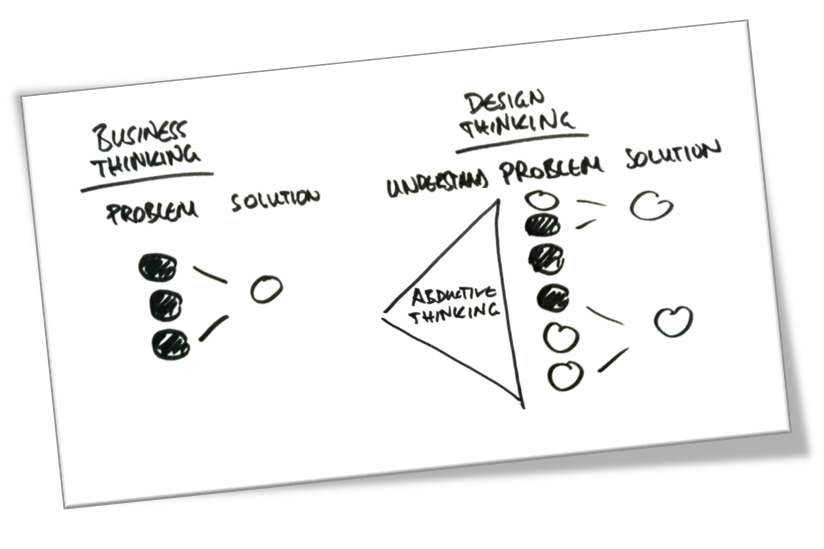
Ogilvy and Liedtka assimilate TQM & quality with Design Thinking & organic growth and innovation. Surely the transformation from a structured and rational fact-based business manager into an ambiguous and empathy-focused Design Thinker calls for true desire to learn a new way of thinking. It also means challenging and rethinking some of the most common business tools and development practices.
6 helpful tips on how to apply Design Thinking:
- Choose a method or process model and follow it – there are plenty to choose from
- Throw away the facts, figures and trends you already have and focus on what you do not know
- Be empathetic: take a deep-dive into your customers’ lives to understand their TRUE needs
- Embrace trial and error – it will not make you look stupid, it will make you stronger
- Test your innovation and be prepared to iterate – it will not be ready the first time around
- Include as many people as possible and share the ownership in your internal (and external) Network
Falling in love with ideas
 Class of 2014 SID studies were kicked off in a spirit of “learning by doing” during an innovation expedition guided by Design Professor Katja Tschimmel and the Innovation Expert Gijs van Wulfen. The two-day Design Thinking Master Class, following the FORTH framework and applying different Design Thinking tools, concentrated in working on an actual business assignment innovating a new service concept for better learning at Laurea.
The Master Class culminated into team presentations of the service concepts and business models. Even with this exercise it became evident that transferring the team’s vision and excitement to an audience outside the innovation process was, in fact, rather challenging. In order for others to buy into your idea they have to love it like it was their own!


The key insight for me was to recognize the make-or-break value of the concept transfer process presented in the FORTH model.
During the concept transfer process the designer passes on the newly innovated concept to E.g. production or marketing. No matter how great the idea, the design, the value proposition or the business potential of the new concept is, it will never provide the expected outcome unless it is first successfully launched. In order to do this, others must adopt the ownership, too.
In case Design Thinking is applied to improve business outcome, nailing the concept transfer phase is an absolute must!
References
Ogilvie, Tim, and Liedtka, Jeanne. Designing for Growth: A Design Thinking Tool Kit for Managers. New York, NY, USA: Columbia University Press, 2011. ProQuest ebrary. Web. 14 October 2014.
Tschimmel, K. 2012. Design Thinking as an effective Toolkit for Innovation. In Proceedings of the XXIII ISPIM Conference: Action for Innovation: Innovating from Experience. Barcelona, Spain.
Brown, T. 2008. Design Thinking. Harvard Business Review.
Katja von Alfthan, SID 2014 student


Leave a comment