my image

THINK, ACT AND GENERATE: Steps Ahead in Design Thinking at LAUREA

written by :- Partiva Madai and Praveen Thapa
Class started with participation. We started working in team, forming different groups. Simple works were assigned to each group. We started thinking, making notes and picturising friends while introducing and equal participation was followed. This was a beginning of shaping mindset to think, visualise and sticky notes were made. We learnt Team work -where we started understanding concepts of design thinking. Design thinking is a collective process-We participate, we carry as many questions, create as many ideas through visualisation, sharing with group members and carrying as many researches. Our group discussion made us understand how design thinking mindset work on. All members were focused in finding as many innovative ideas and we were taught -work in pairs, write as many ideas, collaborate similar ideas as well as distinguish different ways of thinking which can ultimately be real innovative ideas.
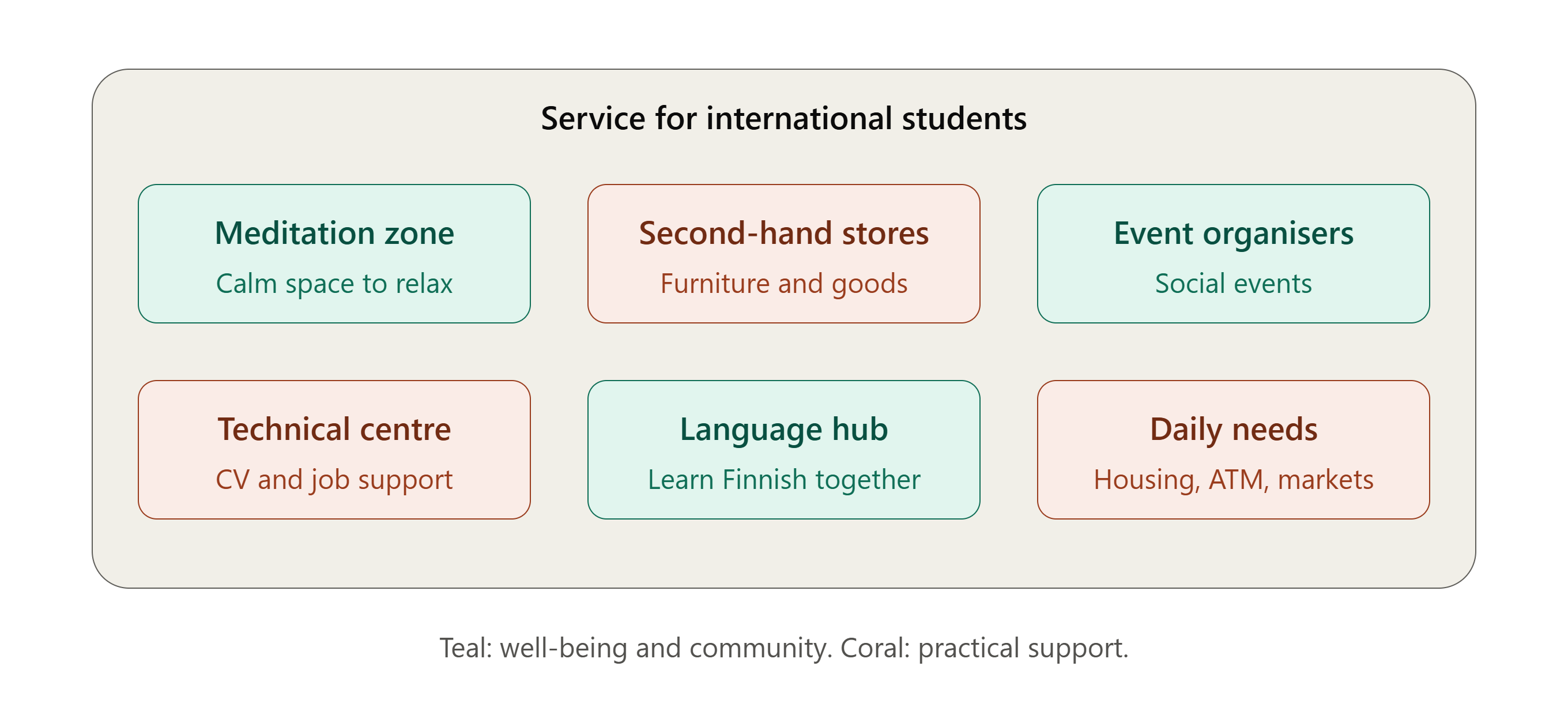
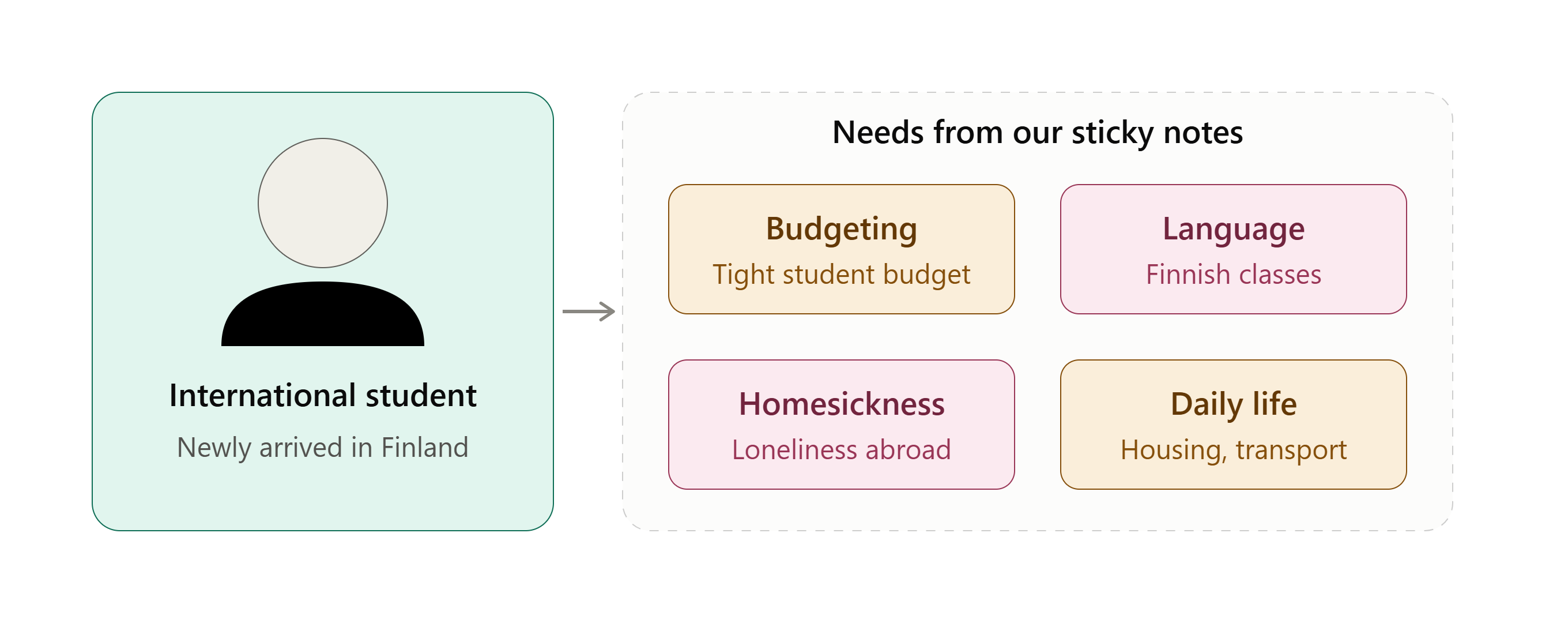
We took one example to understand concepts of design thinking , with real problems faced by international students as on or after their arrival in Finland .Finally we prepared persona of International student and team members in group started to work . We started to think, How might be………. ? , sketch , ideas clustering began , and finally we came with different aspects of innovation-Legos were used to show final ideas of service orientation to facilitate international students .This group work really taught us-work in collaboration to come up with different experiments and prototype and to think out of the box and generate as many innovative ideas -which are human cantered, empathetic .Products and services should be based on users’ perspective, which as a whole, can be said we learnt through ourselves, exercised with simple team work but were preparing ourselves to understand how design thinking evolved-our whole contact day 1 and 2 was arranged in such designs that we did various activities and we were following Desing Thinking Process model  (discover, define , develop and deliver service ).
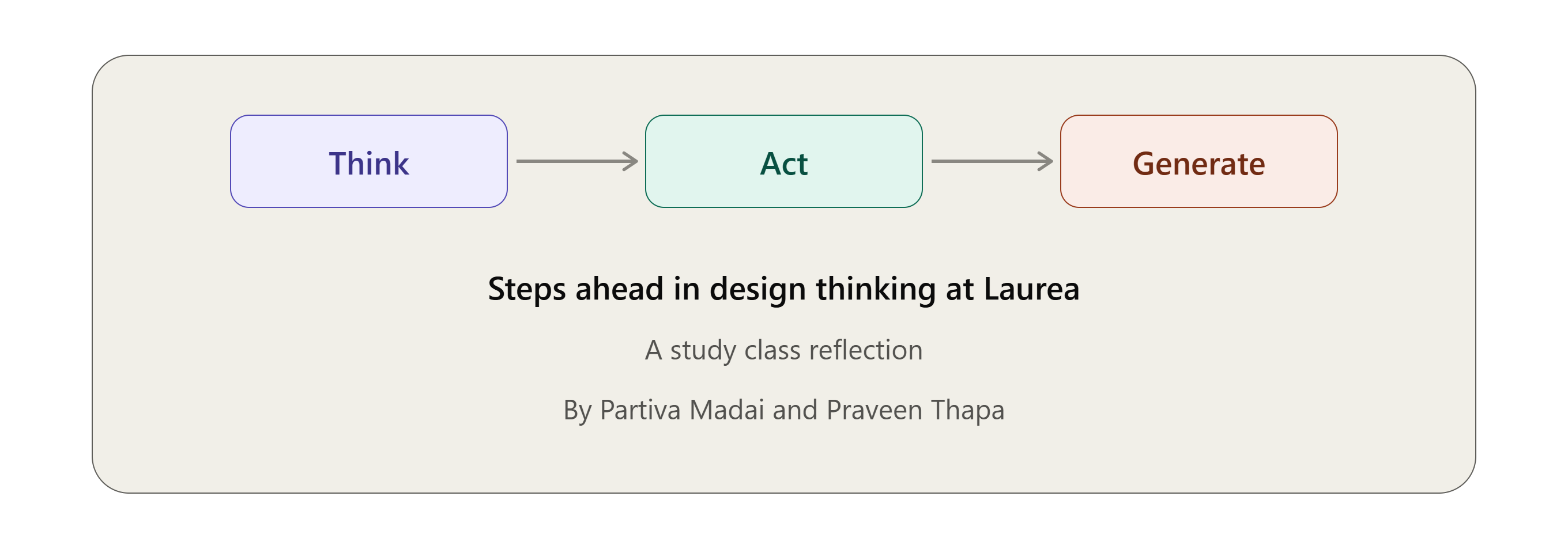
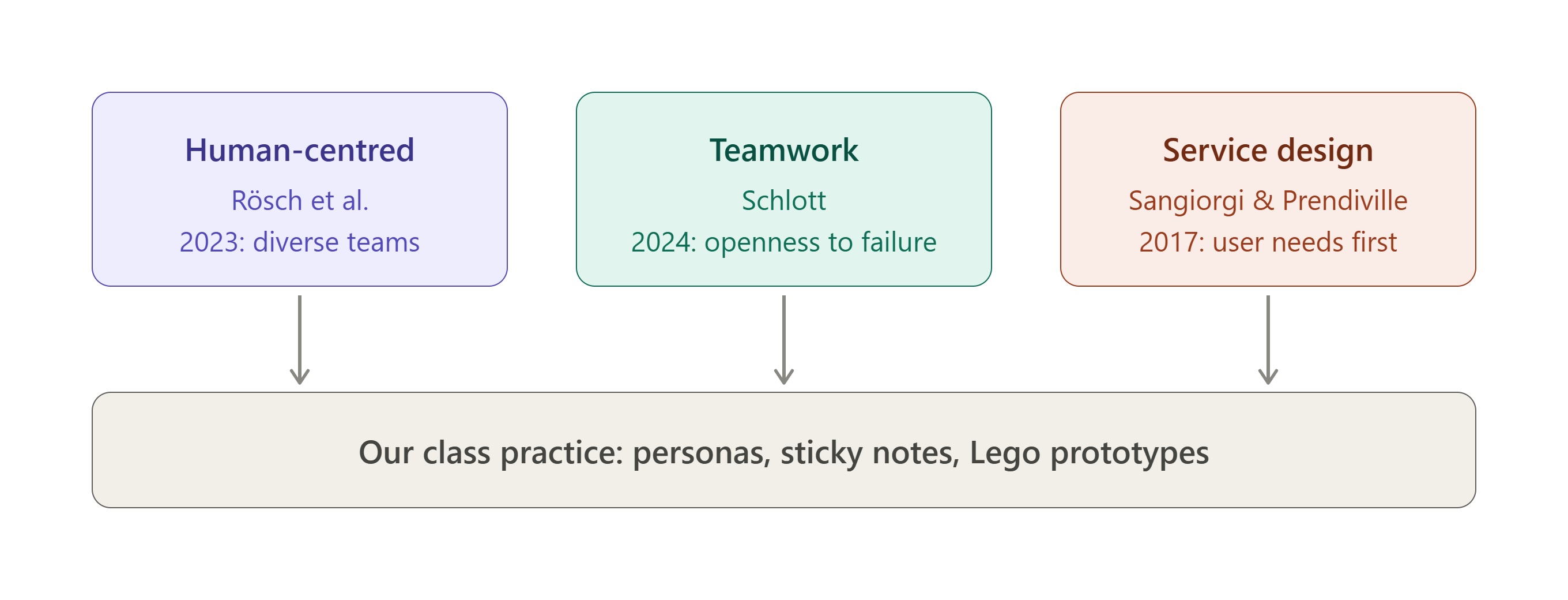
Major highlights from article Rosch,N.,Tiberius, V.,&Kraus ,S.(2023) are like Design thinking is human cantered problem approach. Team work emphasized for possible experimentation and collaboration in any organizations can come up with diverse viewpoints that can support to generate various innovation outcomes which can really be solutions that are linked with understanding user needs. However, still there has been ongoing researches as many as, to improve innovations.

Major highlights from article Schlott,C.K.(2024) are like working in team like brainstorming, idea generating, prototyping come up with various mindset and encourage openness to generate new ideas, build up attitude towards understanding failure and willingness to innovate against various failures.

Major highlights from book, Designing for Service; -key issues and new directions. are like service design is a systematic approach, human centered and require broader perspective to understand that users’ needs and perspective value much to shape various innovation which also adapt technology change, new business models and collaborative ways of organising services.
References

Rösch, N., Tiberius, V., & Kraus, S. (2023). Design thinking for innovation: Context factors, process, and outcomes. European Journal of Innovation Management, 26(7), 160-176. https://doi.org/10.1108/EJIM-03-2022-0164

Sangiorgi, D., & Prendiville, A. (2017). Designing for service: Key issues and new directions. Bloomsbury.

Schlott, C. K. (2024). Design thinking and teamwork—Measuring impact: A systematic literature review. Journal of Organization Design, 13, 163-196. https://doi.org/10.1007/s41469-024-00177-x

Note:-All the images are generated with the help of Claude AI(Anthropic) with full human intervention.


Posted

in

by

Tags:

Comments

6 responses to “THINK, ACT AND GENERATE: Steps Ahead in Design Thinking at LAUREA”

  1. abhishekgupta40df99e848 Avatar
    abhishekgupta40df99e848

    Thanks for sharing this. I liked how you applied a real scenario when introducing international students to Finland. This made the stages of design thinking clear to follow. Plus your use of Lego to create a service map was a creative idea. As an international student, I wondered if the persona could go into more detail. The practical needs of finding accommodation, setting up a bank account and finding a job are very different from the emotional needs of feeling lonely and uncertain. Wicked problems do not have one solution (Buchanan, 1992), and this felt like a wicked problem as every student had a different background.

    How did your group decide which need to focus on in your prototype? Did you test your prototype with other international students?

  2. rajeshshahfb79d7074e Avatar
    rajeshshahfb79d7074e

    Hello Partiva and Praveen

    Thank you for this clear post. I liked how you described the whole flow, from sticky notes and the persona to the Lego prototype for international students in Finland. It shows that design thinking is something you learn by doing, not only by reading.

    One idea I would like to add comes from my background in my civil engineering and interior design. On site, we often use a simple mock up or a quick sketch before the final work starts, because a mistake found early costs very little, while the same mistake found after construction costs a lot. Your Lego prototype works in the same way. It lets the team test the service idea cheaply and see problems early. This connects well with the point from Schlott (2024) about learning from failure, because a small failure in a prototype is a safe way to learn.

    One suggestion: it would be interesting to know how real international students reacted to the Lego prototype? In construction, feedback from the actual user is what makes a design useful, so that step could make your example even stronger.

    Thanks again for sharing your learning. Great reflection and teamwork!

  3. sharmilahamal Avatar
    sharmilahamal

    Thanks for sharing this blog with us, Partiva and Praveen! I enjoyed your approach on design thinking by working in groups, creating a persona as an international student in Finland, posing a question like “How might we can…?” and presenting the idea using LEGO at the end. More interesting is the process of practically learning and very human-centric, using a real problem for international students.
    The most prominent part about failure in Schlott (2024) impressed me a lot. Creating a culture of embracing failure is a great point since people usually avoid this kind of thing in every perspectives. I would like to suggest one additional perspective – psychological safety, as people can be hesitant to say “the wrong thing” when they have the fear of criticism. Sharing your own failed experiment as a leader of the team can change all the situation.
    Also, I believe, that the persona could be better when adding some actual research, like conducting a brief interview with an international student in order to test the idea of the user.
    So, I would be interested in your feedback: which stage of discovery is more important(discover, define, develop, deliver) was the most difficult for your team and why?

  4. deepeshkhadka Avatar
    deepeshkhadka

    Hi Partiva and Praveen

    Thank you for sharing your reflection. I really like how you described the contact days as learning by doing. The use of sticky notes, how might we questions and the Lego prototype help to demonstrate how working in a team can bring design thinking to life. I also liked how you chose your challenge around the issues international students face when arriving in Finland. 

    Rösch et al. (2023) emphasise the importance of considering context factors when using design thinking. How did the context of international students in Finland affect your persona or ideas? Schlott (2024) explains the importance of being okay with failure. Did your group have any ideas that you altered or abandoned in the Lego prototype?

    In my experience of pharmaceutical sales I know that the user’s context isn’t always what you think it will be. By having a prototype early on with actual users such as newly arrived student, you could further develop your ideas for the service. Thank you for an inspiring post!

  5. santoshlamichhanec7a0f72e60 Avatar
    santoshlamichhanec7a0f72e60

    Hi Partiva and Praveen,

    Your blog post is very impressive. The title is very relevant and eye-catching. Your way of describing the group work is really enjoying. The sticky notes as well as the persona activity are also my favorite parts of this blog.

    You have added three sources and linked them to teamwork. You also described the human-centered thinking. Schlott’s point about accepting failure was interesting because making mistake is a way of learning and leading to new innovations. Just like that your group might have faced a failed idea during the Lego prototype. Adding short example would make that statement stronger.

    I have one small suggestion. The paragraphs are quite long and shorter paragraphs are easier to read. I also noticed few small spellings slips, like “Desing” and “cantered”. You guys have mentioned the discover, define, develop and deliver model in the blog. I think it would help to show where your persona actually fits in. Overall, a good reflection. Well done!

  6. umadhakalgautam Avatar
    umadhakalgautam

    Hello Prativa and Praveen,

    Sharing about your journey from Nepal to Laurea UAS, Finland in this blog post was wonderful. I enjoyed when you have shown step by step acpects of journey. How you thought, worked, and applied from the beginning to the classroom participation. When I read, I found the terms like team works, shaping mind set of thinking, sticky notes which were also new for me too. This blog post helps other new students to know about the real problems and how can be solved in real life. In my previous learning those were only could see in a particular trainings. I love the way you talking about questions raised in the class and tried to solve in groups.

    The good part of this blog was about concepts of design thinking. Which can be connected to the international students faced real problems before or after their arrival in Finland. One of the interesting things was persona for international students. Major highlights from article Rosch,N.,Tiberius, V.,&Kraus ,S.(2023) are like Design thinking is human cantered problem approach was nice. Different aspects of innovation-Legos were used to show ideas of service orientation to facilitate international students.

    At last, I want to thanks to you both for showing a clear concept for new students’ problems and solving. So that, upcoming students can prepare themselves likewise. I would like to say other students that problem arises because of lack of preparation so before arrive as a new student research is needed.

    Thank you.

Leave a Reply