

By Aditya Rai
I walked into Prof. Katja Tschimmel’s masterclass on 4 September not knowing what to expect. Design thinking was a phrase I’d heard, not something I understood. I left with something worth it, and something I needed.
Walking in Blind
The session got practical fast. Paired with random classmates, we interviewed each other anonymously to find real pain points. Because nobody was named, people spoke openly. I learned that empathy is a skill you practise, not just a value you agree with.
Strangers and Collaboration
Turning separate stories into one picture was harder. Studying with such experienced professionals for the first time was eye-opening, because everyone had something to contribute and each background read the same pain points differently. Liedtka (2020) calls design thinking a social technology that overcomes social and psychological barriers, such as cognitive biases, and aligns stakeholders. Tschimmel (2025) ties it to democratic values like participation and plurality. Our table felt like both.
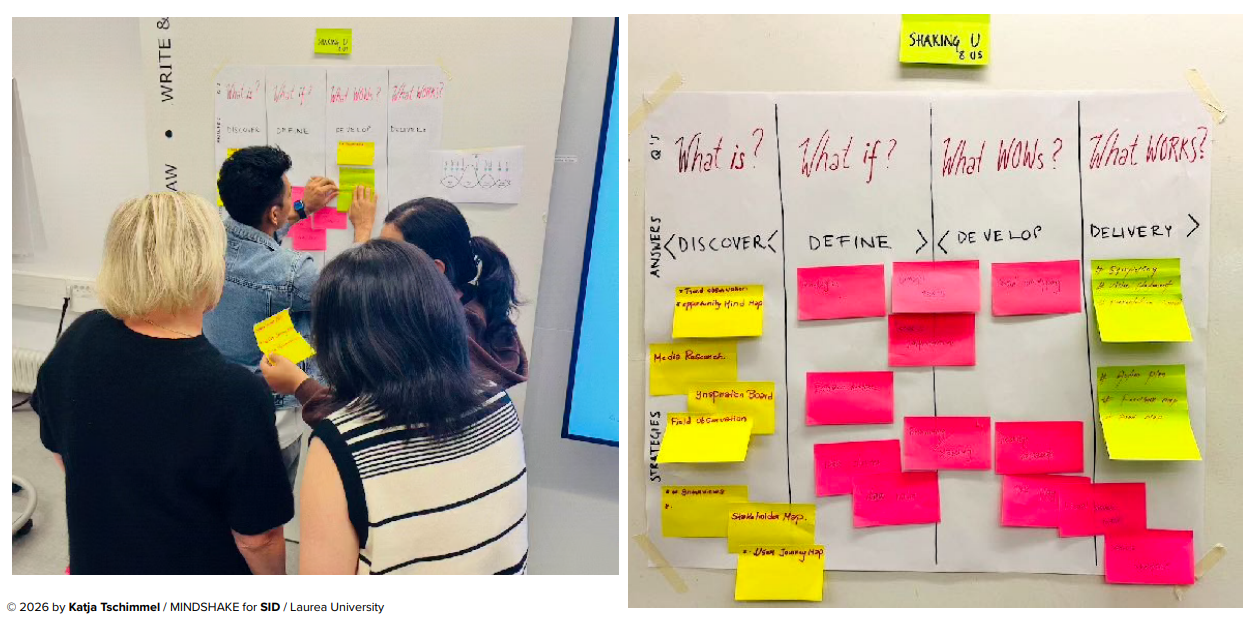
Building process
Instead of following one model, we combined several design thinking processes into one that fit our task. Nakata and Hwang (2020) tested six components of design thinking and their impact on new product and service performance in firms, which suggests that the method is made of parts that can be chosen and combined with purpose.
From insights to Experimentation.
One lesson stayed with me: good ideas depend on getting the order. Good ideas begin by listening to people grouping the information into insights and turning each insight into a question that starts with “How Might We…?”. After that do good ideas appear, through brainwriting, word battles and analogies and you must sort the good ideas before building anything. Even the first prototype is meant to be rough made from paper role play or LEGO so the prototype can be tested and changed. This lesson taught me to hold back: diverge then converge and treat the prototype as a learning tool, not a final answer.
Noticing the small things (Human-centredness)
The biggest lesson for me was how much a small change can alter what we see: how we frame a question, or whose story we stop listening to. Norman (2013) makes a similar point in The Design of Everyday Things: when people struggle with an ordinary object, the fault lies in the design, not the person. A badly framed problem works the same way, because it blames the wrong cause. But good ideas also need the right setting. Augsten and Marzavan (2017) studied design thinking in the German automotive industry and found that it can clash with traditional, planning-driven organisations. A method alone isn’t enough.
Conclusion
I came in oblivious and left knowing that design thinking starts with listening, not solving. Before the masterclass, I saw it as a set of tools. Now I see it as a habit of attention: the anonymous interviews showed me that people speak openly when they feel heard, and that real pain points only appear when we stop rushing toward answers.
Working with classmates from different backgrounds taught me that one problem looks different from every seat at the table, and that a method is a starting point to adapt, not a script to follow. What I needed was to slow down, hear people out and frame the problem before reaching for answers. I will take that into my studies and my future work, and practise it as a skill, not just agree with it as a value.
References
Augsten, A. and Marzavan, D. (2017) ‘Achieving sustainable innovation for organisations through the practice of design thinking’, Proceedings of the 28th ISPIM Innovation Conference, Vienna, Austria.
Liedtka, J. (2020) ‘Putting technology in its place: design thinking’s social technology at work’, California Management Review, 62(2), pp. 53–83.
Nakata, C. and Hwang, J. (2020) ‘Design thinking for innovation: composition, consequence, and contingency’, Journal of Business Research, 118, pp. 117–128.
Norman, D.A. (2013) The design of everyday things. Rev. and expanded edn. New York: Basic Books.
Tschimmel, K. (2025) ‘Design thinking: a catalyst for democratic collaboration and transdisciplinarity’, in Duarte, E. and Ferreira, J.B. (eds.) Design and democracy: essays towards democratic imagination. Lisbon: IADE Press, pp. 215–221.


Leave a Reply