
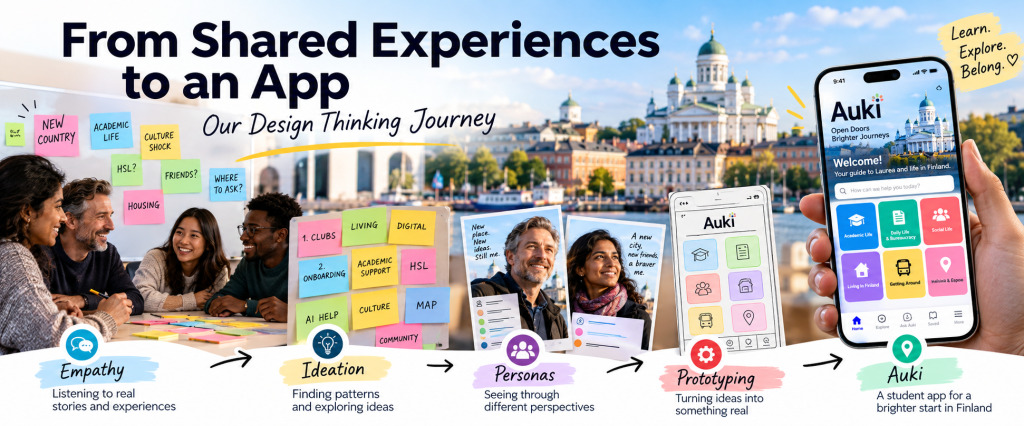
By Michael Sylvia and Laxmi Khatri Shrestha
It began with storytelling and listening
(Empathy)
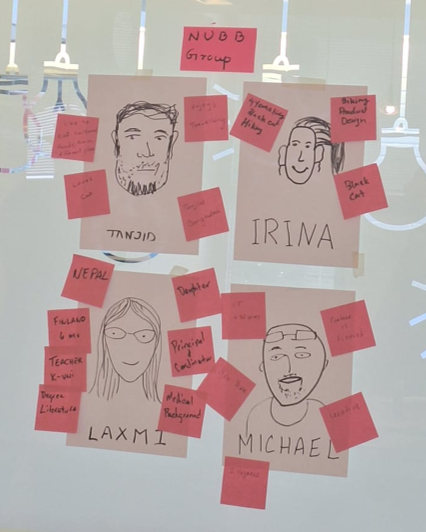
In our first group exercise, Katja Tschimmel showed us how universal questions created common ground among diverse people from all over the world. We learned about each other and where we started on our paths that led to Espoo. Each question told a little story about who we were starting a Design Thinking journey that would lead to developing an app for international students in Finland.
From shared stories to a shared problem
(Collaboration)
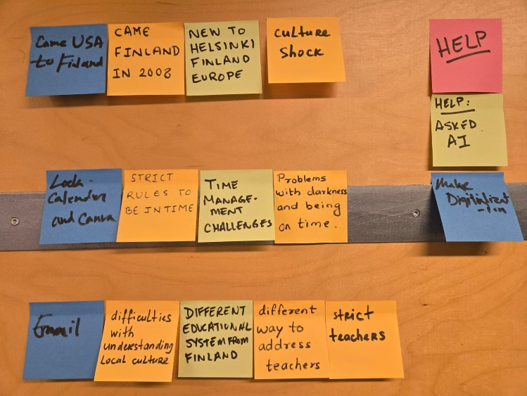
From our stories, we identified different challenges. Through ideation exercises and a lot of Post-It notes moving around the wall, patterns emerged: unfamiliar academic expectations, information scattered across systems, culture shock, time management, and finding the right sources. We saw the uncertainty and complexity of the problems we were faced and identified the wicked problem we shared – adjusting to academic life in Finland.
How might we? (Experimentation)
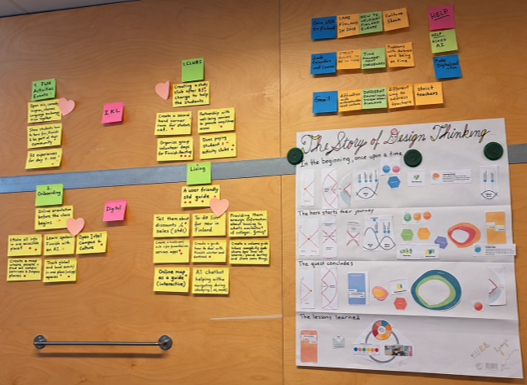
We all struggled with myriad sources of information and talked about existing resources, like the New Student Guide pages on Laurea’s website. We found that it met Kolko’s (2015) description of a technically efficient service that was frustrating and stressful. We had moved from findings to insights by collecting data, jointly documenting our findings while staying aware of our biases, and creating problems statements (Marzavan, 2022, 46).
Through this process, Auki began to take shape.
Who are we designing for? (Visualization)
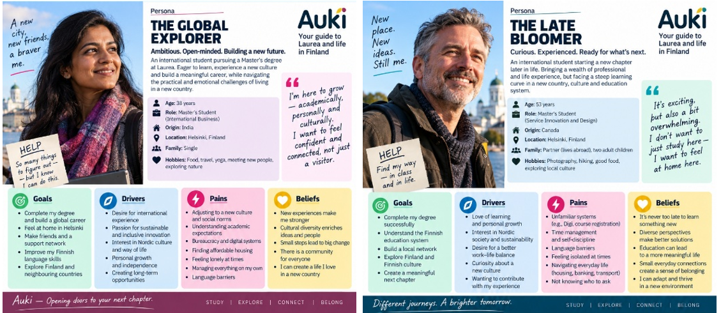
Focusing on emotional experiences was important to us because users do not judge a service only by whether it technically works. They also judge whether it feels clear, safe, respectful, and easy to use. Creating personas let us take a step back from our personal experiences (and biases) and look at the problem externally to imagine a single, friendly source, weaving together the threads of our wicked problems through human-centered design.
From Post-Its to Auki (Prototyping)
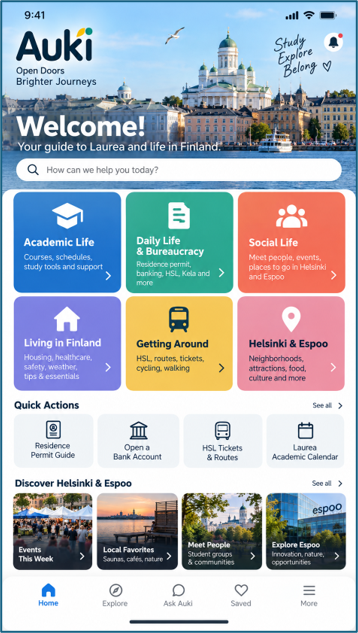
Post-Its were an imperfect medium for envisioning an app, so we turned to Claude AI to generate possible solutions. We discussed and iterated our prompts to present test cases to other teams for feedback. All our readings have stressed the importance of prototyping and failing fast, yet there were reservations about how this would work in real life. Our stories contained examples where a lack of leadership buy-in to the process affected not only outcomes, but team morale and careers.
Bringing it all together (Holistic Approach)
Auki wasn’t the most important outcome – it was gaining knowledge of how Design Thinking works by actually doing it. Like Marshall McLuhan’s famous quote “The mediums is the message,” the path to solving a wicked problem is a destination of itself, as Buchanan emphasized, because it was complex, involved different perspectives, and could not be solved through one simple solution.
In the end, we shard our stories (human centered approach), put our challenges on the wall (collaboration), brainstormed solutions (experimentation), created and tested a prototype (visualization), presented our solution to the class and instructors, and wrote this post about our experience (holistic conclusion) (Tschimmel et al, p. 29).
Sources
Buchanan, R. (1992). Wicked Problems in Design Thinking. Design Issues, 8(2), pp.5–21. Cambridge, MA: The MIT Press.
Kolko, J. (2015) Design thinking comes of age. The approach, once used primarily in product design, is now infusing corporate culture. Harvard Business Review September 2015, 66-71.
Mootee, Idris. (2013) Design Thinking for Strategic Innovation : What They Can’t Teach You at Business or Design School, John Wiley & Sons, Incorporated.
Marzavan, D. 2022. Findings ≠ Insights. In K. Tschimmel (ed.), Creativity and Innovation Affairs: Are They or Are They Not? Porto: Mindshake, 46-47.
Tschimmel K. (2022). Creativity, Design and Design Thinking—A Human-Centred ménage à trois for Innovation. In: Raposo D., Neves J., Silva J. (eds.). Perspectives on Design II. Springer Series in Design and Innovation, vol 16. Springer, Cham. https://doi.org/10.1007/978-3-030-79879-6_1
Tschimmel, K. 2026. Design thinking masterclass at SID. [lecture]. Held on 4–5 September. Laurea University of Applied Sciences.


Leave a Reply