
Reflections by Tuukka Savinainen & Showmen Rudra
The themes of the days became noticeably clear during the teaching, and the understanding of why something grew during the teaching also increased. We went through the entire design thinking process in service design and experienced the power of activating thinking through various exercises.
Design Thinking is a creative and human-centered approach that emphasizes empathy and innovation. It involves various exercises aimed at discovering new ideas and gathering feedback. Key principles include the idea of “Yes, and” instead of “Yes, but” which fosters a positive atmosphere in business and culture. This method combines practical innovation with a touch of artistry.

Reminder of The six steps of Desing thinking were available two days at class room
The first day brought a lot of theoretical knowledge, which was utilized through practical exercises as part of the learning. The day was topped off with a challenge where we had to, as part of the process, go through an interview as part of designing the perfect wallet for a client. The most memorable lesson of the day was the technique of empathy. Practicing empathy does not mean sympathizing with the answers, but rather careful listening where guidance was provided through additional questions. Practicing this side will surely bring relief and even hilarious situations to everyday life if this ability was misused. Imagine now, for example, a salesperson just listening and wriggling when he cannot complete and guide all the other person’s answers himself. Understand, observe, point of view, ideate, prototype, was the marching order in studying the topics.
The framework is designed to help designers incorporate empathy into their work. It is based on psychological principles and offers a structure for empathic design. This framework can guide the use of existing empathy techniques, help develop new tools and encourage further discussion about the role of empathy in design. We hope this framework sparks more conversation and development of empathy-driven design methods. (Kouprie & Visser 2009.)
The second day brought with it some amazing challenges, referred to as Wicked Problems. Our group, like the others, consisted of four people. In practice the first task within the group was to divide the tasks according to the pre-assigned titles. The role allocation in this section is such that everyone has an equally strong responsibility for guiding the process as a whole and a responsibility to participate equally. Collaboration is essential, as group work thrives in this environment. Together, we embark on a journey to explore the transformative potential of Design Thinking in addressing social challenges and enriching customer culture.
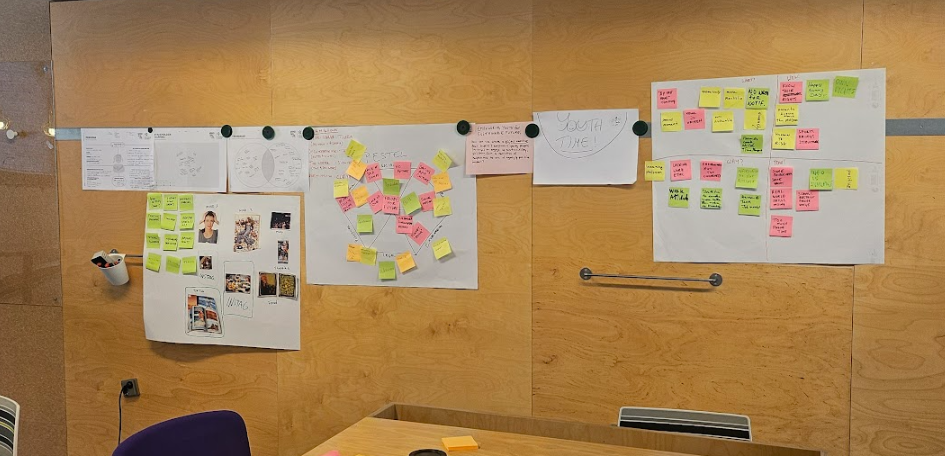
Great productivity from the group and process was going forward
Design Thinking is a natural part of how we all think and explore the world. It complements our existing skills and knowledge by focusing on the forms, relationships, behaviors, and human interactions that drive our world. It is important to remember that Design Thinking is not the opposite of data-driven thinking. It is its own way of analyzing information, one that emphasizes human experience and emotions. (Mootee 2013, 39.)
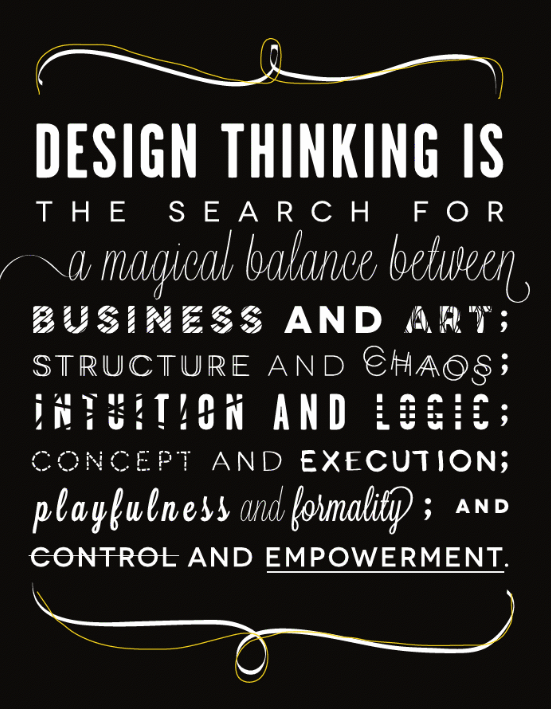
Desing thinking expained (Mootee 2015, 33).
Through diverse understandings we as a group managed to push through a PESTEL analysis, create a trend map, and begin stakeholder mapping. From there the group headed into the field to conduct research in interviews. As a summary of the interviews, we gained important data indicating that the most crucial aspect of our customers’ problem was not what we had anticipated. Different customer types altogether were coming to our minds. However, it can be concluded that fieldwork and data collection through interviews are extremely valuable. The deeper one can delve into collecting data from various perspectives, the more significantly the understanding improves during the problem-solving phase.
In a design-focused company, employees like to understand what people want and must by noticing their behavior. Since it’s hard to explain these insights with numbers, they use emotional words (such desires and experiences) to describe products and how they make users feel. While a traditional value proposition tells what is going to get from a product, an emotional value proposition promises how it will make us feel. Therefore, companies, emotional language is valued and considered key to good user experience, as well as its leads to business success. (Kolko 2015.)
The lessons learned over these two days were immense, but as part of the design thinking process, it is crucial to understand the importance of not jumping to solutions too early and to trust the process and its unfolding. Creative, innovative thinking and generating ideas with the help of tools is a treasure that should be cherished and practiced individually, in pairs, and as a group. Courage and generating ideas, even if they do not always lead to concrete progress, enriches the next idea. Be bold, dare to be yourself and bring that to the forefront, because there are undoubtedly great ideas within all of us.
References
Kouprie, M. & Visser, F. S. 2009. A framework for empathy in design: Stepping into and out of the user’s life. Journal of engineering design, 437-448. Accessed 28 September 2024. https://web-p-ebscohost-com.nelli.laurea.fi/ehost/pdfviewer/pdfviewer?vid=0&sid=e1b04fb3-73a7-4e74-8f80-33af4e5bdcdb%40redis
Kolko, J. 2015. Design thinking comes of age: The approach, once used primarily in product design, is now infusing corporate culture. Harvard Business Review, September, 66-71. Accessed 15 September 2024. https://hbr.org/2015/09/design-thinking-comes-of-age
Mootee, I. 2013. Design Thinking for Strategic Innovation: What They Can’t Teach You at Business or Design School. Hoboken: John Wiley & Sons, Incorporated.


Leave a comment