
The quote in the title was spoken out by our lecturer, Daniela Marzavan, on our first day of the Design Thinking-course (DT) in Laurea. Here, we learned how one could adopt the mind of a 5 year-old by asking numerous Why`s and deciding that a tape roll can be an airplane if it’s said to be an airplane, the outcome often covers the means in a creative process. It was groundbreaking to realize how our biases or expertise might block our way to understand our users and approach their world with empathy.
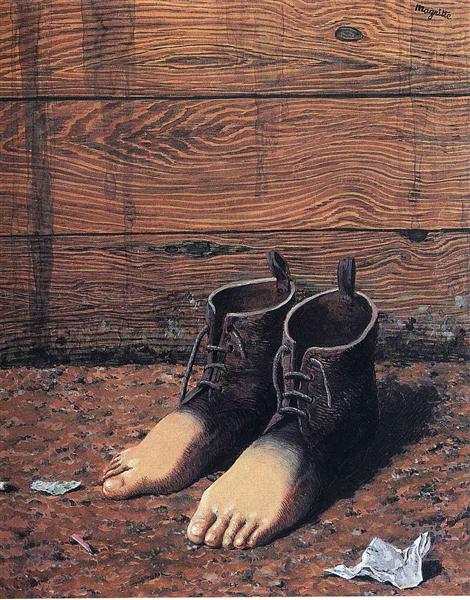
“The Red Model, 1935 – Rene Magritte.”
The power of empathy
Kelley & Kelley (2013, 13-18) describes the role of empathy in DT in their example of Doug Dietz, who turned the “scary MRI-machines” into space shuttles or pirate ships so kids wouldn’t be so terrified taking MRI-scans that sometimes they even had to be sedated or appointments postponed.. By making only external changes to the environment, he was able to change the experience to match the children’s world, making it more pleasant for them as children were excited by the adventurous themes of not only the MRI-machine, but the whole patient room. The example illustrates the power of DT and empathic, human-centered approach to design. Empathizing with users’ feelings and inner world has paramount influence in solving problems and it may not even require huge financial investments. You can watch the full story of Dietz`s experiment in the video below.
Transforming healthcare for children and their families: Doug Dietz at TEDxSanJoseCA 2012.
During our lecture days we had the opportunity to test an empathic design process through a “Wallet challenge” proposed by Daniela. We paired with an objective to create a wallet that is designed based on the conscious and unconscious needs of our partner. To reveal these needs, we challenged ourselves to listen, ask questions and observe our users in order to recognise their feelings, emotions and also behavioural acts. For these insights, we were able to start prototyping the wallet matching our users needs. As discovered by our example, using empathy in a design process requires the use of various tools, as Kouprie & Sleeswijk (2009, 439) suggest: The designers should not only research but also to communicate and ideate together with their users.
The emphatic process
Empathizing with users can be challenging, but there are various tools available to help in the empathic design process.
Kouprie and Sleeswijk Visser (2009) have proposed a four-phase framework which emphasizes the designer’s ability to understand the user’s perspective by walking in their shoes and then stepping back with a deeper understanding.

Graphic by Raquel Alonso and Jenni Jäppinen based on Kouprie and Sleeswijk Visser (2009) frame-work.
The first phase focuses on curiosity and exploration, while the second phase involves collecting data and diving into the user’s life. The third phase focuses on establishing an emotional connection with the user to gain understanding and the last phase concludes with disconnecting from the user’s world to reflect and find perspective.
Empathy also plays an important role inside an organization. “In design-centric organizations, emotionally charged language isn’t denigrated as thin, silly, or biased” (Kolko, 2015, p. 68). But the importance of empathy and Design Thinking methods apply in a wider context too. Tschimmel (2021, 4) highlights the role of empathy in today’s volatile world: We experience hardships here and there, but with empathy and an ability to listen and co-create with each other, we are able to counteract unpleasant forces or phenomenons around us. Design Thinking builds on creating together, listening, and being curious to our surrounding world. With empathy we are able to use these tools to solve various types of problems all around us, whether it is within an organization, inside a community or related to physical goods.
Let’s put our knowledge of empathy into action now that we understand its power!
Written by Service Innovation and Design students Raquel Alonso and Jenni Jäppinen.
References
- Kelley, T., & Kelley, D. (2013). “Creative confidence: Unleashing the creative potential within us all”. Crown Business. (https://www.creativeconfidence.com/)
- Kolko, J. (2015) “Design thinking comes of age. The approach, once used primarily in product design, is now infusing corporate culture”, Harvard Business Review, September 2015, 66-71.
- Kouprie, M & Sleeswijk Visser, F. (2009) “A framework for empathy in design: stepping into and out of the user’s life”, Journal of Engineering Design Vol. 20, No. 5, October 2009, 437–448
- Tschimmel, K. (2021). “Creativity, Design and Design Thinking – A Human-Centred ménage à trois for Innovation”, Perspectives on Design II. Ed. Springer “Serie in Design and Innovation”. DOI: 10.1007/978-3-030-79879-6.
- Magritte, Rene. “The Red Model, 1935 – Rene Magritte.” Www.Wikiart.Org, www.wikiart.org/en/rene-magritte/the-red-model-1935. Accessed 18 Sept. 2023.
- TedX Talks (2012). “Transforming healthcare for children and their families: Doug Dietz at TEDx SanJose CA 2012” (Video). YouTube. Available at: (https://www.youtube.com/watch?v=jajduxPD6H4)


Leave a comment