

During the master class we felt ourselves and saw our fellow participants get ignited with a feeling of creativity and gaining a new appreciation of what is considered as creative. Many of us believed to not be creative, but when faced with the right questions and frameworks, most of us realized we indeed are.
We were left curious about how to use Design Thinking in an organization in practice. Why should organizations care about unleashing the creative potential of their members in the first place? What are the blockers in organizations?
Get rid of blockers on all levels
Most of us have lost our creative confidence while growing up. As children, we tended to think creatively, outside the box and without fear of judgment. Kelley and Kelley suggest for individuals to face their phobias around fear of judgment. Also a key element for creativity according to Kelley and Kelley is empathy with your clients or users of the end result. People should believe in themselves again, because they were born creative. (DTALE Design Studio. 2017.) It was evident in our masterclass that many of us had lost confidence in our creativity.
In our own experience, in organizations creativity is killed on a daily basis and the habit of doing so can go quite unnoticed. Often the difficult, disruptive questions are not appreciated, which effectively blocks any new thoughts on the raised subject. Also blunt answers like “we have tried that 10 years ago and it did not go that well” to any new ideas do not nurture a creative culture whatsoever. Which of these idea killers have you heard before?
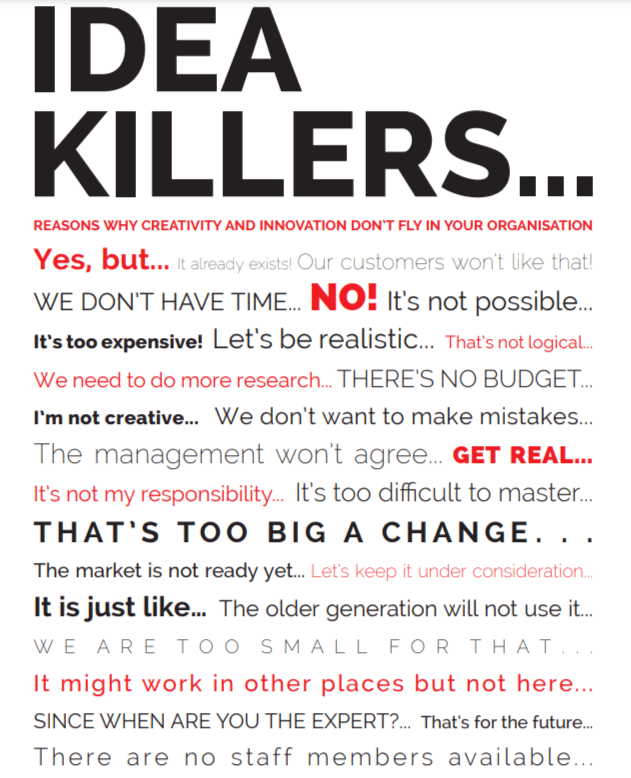
According to Kelley and Kelley (2015) the key focus areas for organizations for getting rid of the blockers of creativity are: nurturing a creative culture, avoiding “the talking phase”, where management is on board and talking positively about creativity, but nothing actually happens in the organization. They suggest creating a team of design catalysts with members who are excited about design thinking from all over the organization to build creativity as a grassroot action with quick wins. Organizations should also lift their focus from short sight to a multi-year horizon. Innovation culture is made out of humor, getting infected with each other’s energy, minimizing hierarchy, increasing team trust and camaraderie and lessening judgment. (Kelley & Kelley 2015, 175-179, 184)
For us this recipe sounds like a place where people can truly thrive and give their all and more towards the goals of the organization. How could we get more organizations on board?
Getting the managers on board
Organizations are made of people with a certain training. Roger Martin, long time Dean of Rotman Business School in Toronto has recognized that business education and the management practice are quite conservative. He advocates for a change in management education: to start teaching students how designers think (design thinking) and design shops work (project based). Working in the design shop way, he argues, management would be more creative in solving problems and would embrace constraints as an exciting challenge instead of obstacles. (Dunne 2006)

What does it look like when an organization puts design thinking to use?
From reading research it becomes clear that both the definition of design thinking and its implementations can be remarkably varied. Carlgren (2016) shows examples of conceptualizing a fixed multi-step innovation process based on design thinking. At the other extreme the entire innovation work of a company can be given only three principles based on Design thinking and the rest is up to the project to define as it sees fit. With such a multitude of approaches it becomes hard to talk about the concept let alone research and compare organizations. To facilitate discussion and research Carlgren proposes a framework of five main themes: User focus, Problem framing, Visualization, Experimentation and Diversity. (Carlgren 2016)
Interestingly the word creativity is not included in the framework, even though creativity and ideation are foundational in the initial descriptions of Design thinking by Tim Brown and IDEO. Creativity is needed in many if not all the phases of the design process making it a pervasive attitude as a part of cycles of divergent and convergent thinking. As the researched companies are already using design thinking it might be less of an issue to foster a creative environment.
We are left hopeful since Katja Tschimmel’s Master class taught us that creative thinking is a skill you can learn and develop. We can therefore also learn how to ignite people around us. We now possess some knowledge about design thinking and can either help to implement it in our organizations or nudge them to improve in that area.

Written by Tuuva Tiainen and Janne Karjalainen
Sources:
Carlgren, L., Rauth, I. & Elmquist., M. 2016. Framing Design Thinking: The Concept in Idea and Enactment. Creativity and Innovation Management, Vol. 25, Nr. 1. 38-57.
Dunne, D. & Martin, R. 2006. Design Thinking and How It Will Change Management Education: An Interview and Discussion. Academy of Management Learning & Education, Vol. 5, No. 4, 512–52.
Kelley, D. & Kelley, T. Creative Confidence. 2015. Unleashing the creative potential within us all. Edition 2015/25. London: William Collins.
DTALE Design Studio. 2017. How to build your creative confidence. Medium.com. Accessed 27 September 2022. https://medium.com/productivity-revolution/learnings-from-david-kelleys-how-to-build-your-creative-confidence-8b9a594612f0
Tschimmel, K. 2021. Creativity, Design and Design Thinking – A Human-Centred ménage à trois for Innovation. In Perspectives on Design II. Ed. Springer “Serie in Design and Innovation”. DOI: 10.1007/978-3-030-79879-6.


Leave a reply to danmosid Cancel reply