
The modern business world is fast-paced and highly competitive. Companies must stay innovative to answer the complex demands of the ever-changing market and business needs. Design thinking has found its’ way to larger organizations as an answer to simplifying the challenges of both modern business and technology. (Kolko 2015.)
For business success, an empathic approach of design thinking is fundamental, as highlighted by Kolko (2015). It cannot be something extra – it is a core competence. But what is empathy, exactly, and how do you enable empathy as a competence? And how does it link to design thinking?
Design thinking is a mindset consisting of processes, methods and tools for innovation that can be used in any organization by multidisciplinary teams, not only designers (Tschimmel 2022). While reading industry literature and articles we noted that empathic design and empathy are some of the key elements in design thinking, and included in all of the tools in one form or another.

”Empathy is our superpower” – Teija Hakaoja, Head of Business, Design at Gofore Lead
Empathy is intuitive and a way to relate to the user’s circumstances and experiences. It is a natural skill that everyone has – and like any skill, it can be practiced.
Understanding empathy as a concept is critical for a designer and it would take a deep dive to psychological research and literature to get to the core of it, but for businesses and their multidisciplinary teams applying design thinking, it can be enough if they instead use some common tools and frameworks to help them train their skills in empathy and to be more empathic in their work.
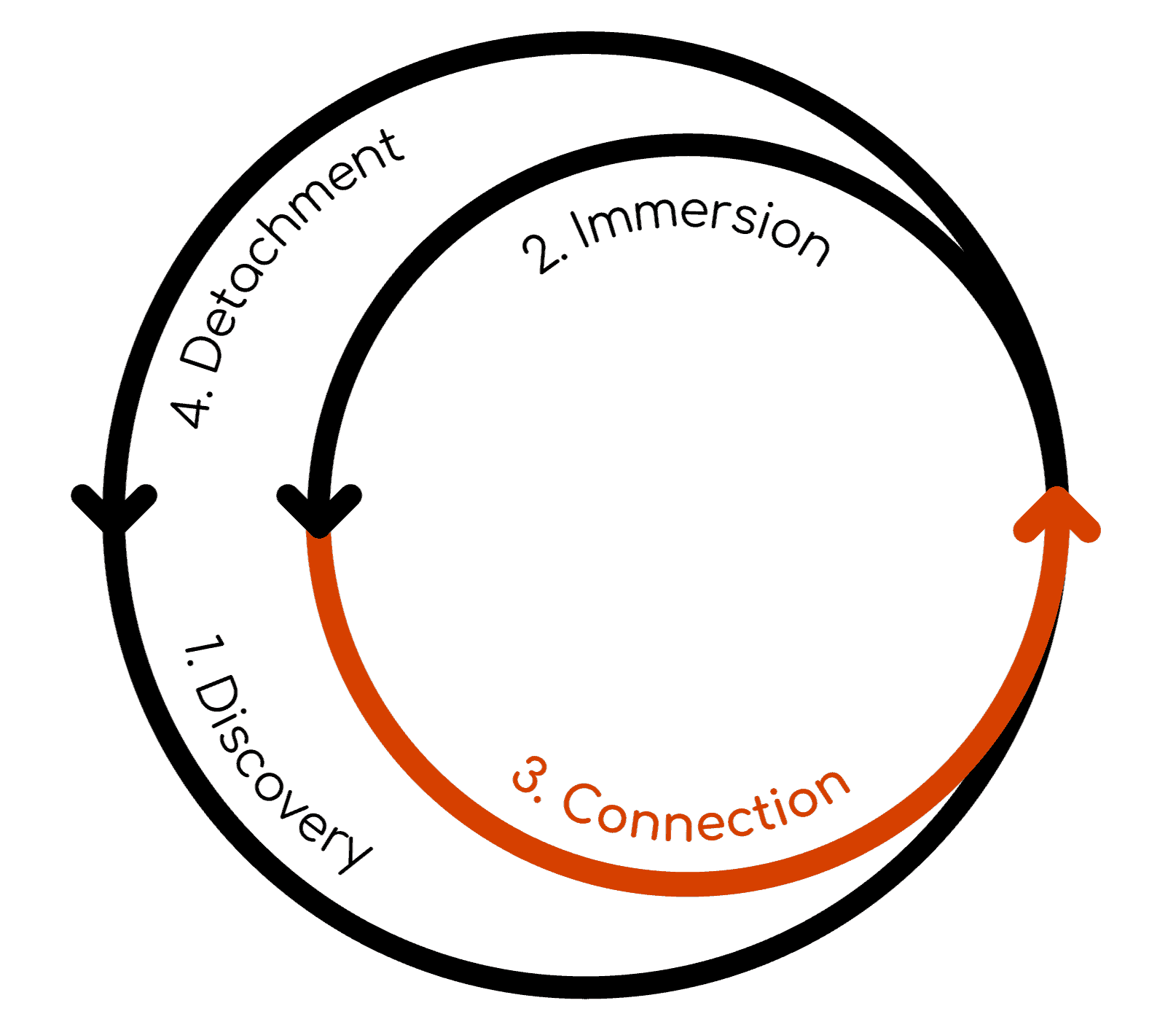
One example of this could be the framework by Kouprie and Sleeswjik Visser (2009), that makes it easier to use empathic techniques in design. The framework consists of four concrete phases of empathy:
1) Discovery,
2) Immersion,
3) Connection and
4) Detachment.
A practical approach like this helps stepping into – and out of – the user’s shoes and builds the skill of empathy.
During the first two days of our Design Thinking course for #sidlaurea 2022, we approached empathy from various angles by trying out some of the commonly used tools and techniques in design thinking, mainly based on the Evolution 6² model by Mindshake. We, for example, empathized with different student personas and created study plans best suited for each of them.
At the end of the day, we feel that empathy means recognizing and responding to basic human needs in a simple yet effective way. This is a skill that can be developed by using well thought-out tools as described above. Even though empathy is already widely recognized in business, we believe there is still more to uncover – winning innovation comes through radically knowing the users and their needs.
Written by Sari Lindberg & Riitta Räsänen
Sources:
Hakaoja, T. 2022. Expectations for service designers’ competence. [lecture]. Held on 1 September. Laurea University of Applied Sciences.
Kolko, J. 2015. Design thinking comes of age. Harvard Business Review September 2015, 66-71.
Kouprie, M. & Sleeswijk Visser, F. 2009. A framework for empathy in design: stepping into and out of the user’s life. Journal of Engineering Design Vol. 20, No. 5, October 2009, 437-448.
Liedtka, J. & Ogilvie, T. 2011. Designing for growth: a design thinking toolkit for managers. New York: Columbia University Press.
Tschimmel, K. 2022. Creativity, Design and Design Thinking – A Human-Centred ménage à trois for Innovation. In: Raposo, D., Neves, J., Silva, J. (eds) Perspectives on Design II. Springer Series in Design and Innovation , vol 16. Springer, Cham. https://doi.org/10.1007/978-3-030-79879-6_1


Leave a comment