
As budding Service Designers, coming together with this diverse group for three days of collaboration and problem solving was an incredible way to kick off our studies. After a few days of reading and reflecting, two of us sat down to discuss the experience and share our thoughts…
Anmol: What an amazing and intensive master class!
Sheena: Agreed, I’m looking forward to discussing this with you! Let’s start broad – What was your biggest “lightbulb moment” from our Design Thinking contact sessions? Did anything inspire or surprise you?
Anmol: It really surprised me how much human psychology plays a role in not only designing something aimed at end-users but also in the amount of psychological aspects that are important when designing a team and considering the personality dynamics among team members.
Sheena: Absolutely. I thought it was really interesting how certain activities and models are designed to help limit any hierarchy or otherwise change the dynamics to encourage contributions from everyone. For example, the Idea Hitlist activity really fostered empathy and compromise within our group.
Anmol: Indeed! All the group work helped us get to know each other and work as a team.
Sheena: The workshop put us into groups and had us work together to identify a problem, conduct some research on campus, and begin prototyping our solution, leveraging the Mindshake Evolution 62 model. What did you learn most from our group and how can you see this informing your future approaches to Service Innovation and Design?
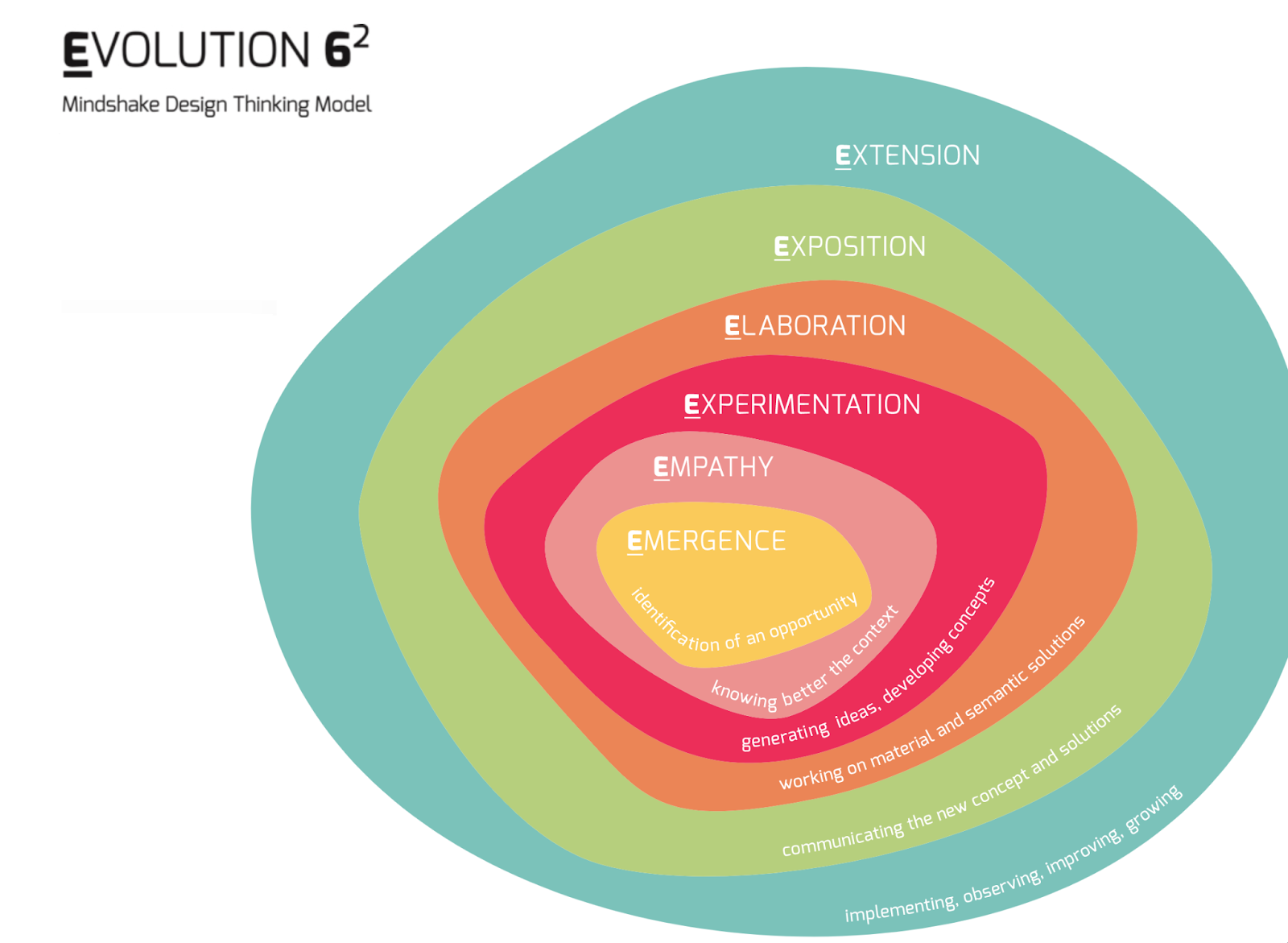
Anmol: This was a great way to put knowledge into practice. It was quite fascinating to go through each step of the service design processes. With so little time, we came up with great ideas as well as rapid prototypes. I would definitely implement these steps in my future projects.
How would you suggest that service design be integrated in current business models?
Sheena: Oh good question. I really do believe that Design Thinking is steadily becoming the most effective driver of business innovation and that the best way to integrate Service Design is by embracing the mindset. A lot of what has been taught in business schools hasn’t changed in over 30 years and is really rooted in a distorted concept of value.
One of the books in Laurea’s ebook Library, Design Thinking for Strategic Innovation by Idris Mootee discusses this really clearly. Montee posits that “more than 80 percent of our management tools, systems, and techniques are for value-capture efforts, not for value creation” (Mootee, 2013, 59). What I think he means here is that we’ve been totally preoccupied with consistency and predictability and in doing so we’ve dampened our ability to innovate.
Anmol: One of the best ways to move past the obvious is to conduct interviews. I will be going to focus more on collecting field data from end-users to further polish my prototyping. As rightly conceptualized, “Service designing is a constantly evolving process” (Brown, 2008) and end-users input is a key factor in improving design.

Sheena: I really appreciated how eager you were to talk to people on campus. I can be a bit shy, but it’s important to talk to your users – they might surprise you! Montee says that “innovation is about maximizing the chance of lucky surprises” (Mootee, 2013, 52), and so I’ve been thinking about that a lot lately. I think that one of the most valuable ways to integrate Design Thinking into current business models is to really focus on fostering a mindset that aims to push past the obvious and find something surprising, even if the unpredictability requires you to give up a bit of that control.
Anmol: That takes a lot of creativity.
Sheena: It really does. I like how Katja Tschimmel posits that Innovation arises at the intersection of Creativity, Design, and Design Thinking and that Service Designers must form a nuanced understanding of the definitions of and relationship between these three concepts (“Creativity, Design and Design Thinking—A Human-Centred Ménage à Trois for Innovation,” 2021)
Throughout the Design Thinking contact sessions, where else did you see Creativity and Design come into play? Did you come out of the workshop with a deeper understanding of these distinct concepts?
Anmol: I certainly came out with a deeper understanding of these distinct yet essentially interconnected concepts. Creativity leads to better design and a better design fuels further creativity. In my opinion, this interlink is not so linear, but rather a more circular process in the design thinking process.
Sheena: That’s really interesting. I look forward to our next sessions and furthering my learning with you and the rest of the class!
Written by SID 2022 students Sheena OhUiginn and Anmol Kumar
References
Brown, T. (2008, June). Design Thinking. Harvard Business Review.
Creativity, Design and Design Thinking—A Human-Centred ménage à trois for Innovation. (2021). In J. Neves, J. Silva, & D. Raposo (Eds.), Perspectives on Design II: Research, Education and Practice. Springer International Publishing.
Midshake. (n.d.). Design Thinking. Mindshake. Retrieved September 25, 2022, from https://www.mindshake.pt/design-thinking/
Mootee, I. (2013). Design Thinking for Strategic Innovation: What They Can’t Teach You at Business Or Design School. Wiley.


Leave a reply to danmosid Cancel reply