
What is this mumbojambo?
The word that is repeated most often when describing Design Thinking is process. Design Thinking is not a job task you can start in the morning and be done with by lunch-time. Instead, Design Thinking requires much more planning, preparation and normal work than most people that participate in just the workshops realize. But the work that you put into the process will pay itself off in the end.
So what’s in it for me?
All of the mentioned things are true and Design Thinking is a powerful tool, there’s no denying it. But at the same time, why isn’t Design Thinking the main way for companies to develop their business? Because as well as being a process, Design Thinking is more than one-shot development workshops or methods. It’s a change in thinking for the whole business unit in which it is used. And also in the core of the methodology is the idea that there will be failures and the company needs to learn from those failures. How many companies do you know that think “if we fail, at least we’ll learn from those failures”? This rationale is not easy to accept at first, but once you can you have a bigger possibility of achieving the goal you have set for yourself in the beginning of the process.
Sweet. Let’s make it work fast and cheap! You can do that, right?
For Design Thinking to work for the company, the company needs to integrate it and Service-dominant logic into its very DNA to get everyone onboard. In Gijs Van Wulfen’s book The Innovation Expedition the author makes the notion over and over again of involving the management in the innovation process. I feel that this is both crucial for the process and only truly possible if Design Thinking has been adopted in more ways than only for few innovation projects and the aforementioned Service-dominant Logic is somewhat familiar to the management.
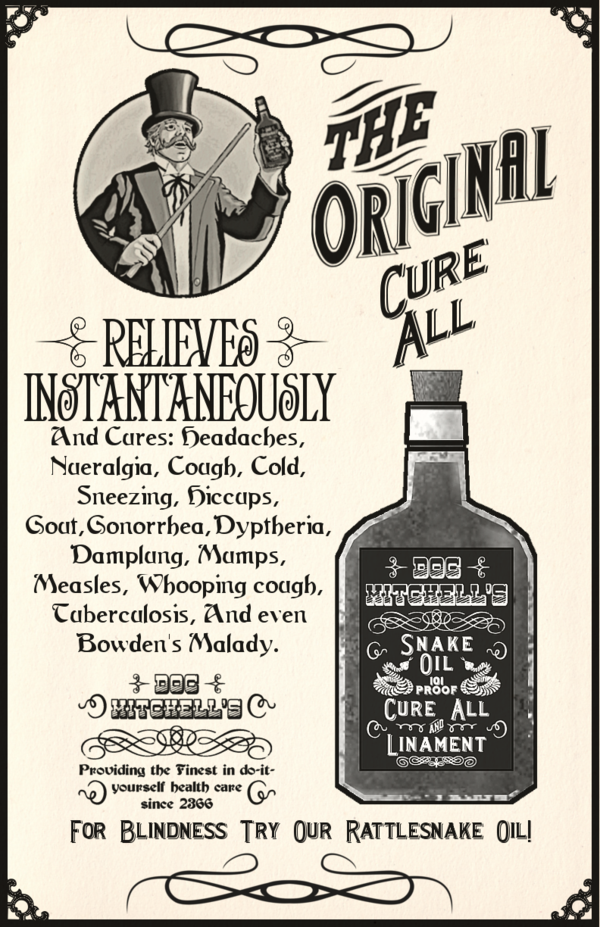
As the Finnish companies need innovation more than ever amidst the worst fiscal downturn in memory, Design Thinking and it’s derivative Service Design can provide this. I truly believe Finnish companies can harness the benefits of design thinking but only and ONLY if they can fight the temptation of going for the easy way of just getting quick fixes. There will be companies helping you pluck those low hanging apples. If the companies don’t make a more profound implementation of the logic, methodology and process, Design Thinkings powerfull tools will be nothing more than snake oil of today for those companies that choose the easy route of the innovation expedition.
Written by Jukka Kaartinen, a first year SID Laurea student
REFERENCES:
Tschimmel, Katja. 2012. Design Thinking as an effective Toolkit for Innovation. In Proceedings of the XXIII ISPIM Conference: Action for Innovation: Innovating from Experience. Barcelona, Spain.
Gijs Van Wulfen, G. 2013.The Innovation Expedition, A Visual Toolkit to Start Innovation. Amsterdam, Netherlands: BIS Publishers.
Lüftenegger et al. 2012, The Service Dominant Strategy Canvas: Defining and Visualizing a Service Dominant Strategy through the Traditional Strategic Lens, Beta Working Paper series 383, Research School for Operations, Management, and Logistics, University of Eindhoven, The Netherlands. http://cms.ieis.tue.nl/Beta/Files/WorkingPapers/wp_383.pdf
Fast Company Staff, 20.3.2006. Design Thinking…What is it? http://www.fastcompany.com/919258/design-thinking-what
Ballé, Freddy & Ballé, Michael. 2005. Lean Development. http://bsr.london.edu/lbs-article/312/index.html
Mueller, Roland & Thoring, Katja, 2012. Design Thinking vs. Lean Startup: A comparison of two user-driven innovation strategies
http://www.researchgate.net/profile/Katja_Thoring/publication/234066097_DESIGN_THINKING_VS._LEAN_STARTUP_A_COMPARISON_OF_TWO_USER-DRIVEN_INNOVATION_STRATEGIES/links/0912f50ecc0814696a000000.


Leave a reply to Lavanya Prakash Cancel reply