
Creativity is a fundamental element for design processes and innovation. However, many people think that they are not creative, that they are more practical types. David Kelley states that we all have huge potential within us. People are naturally wildly creative, and we just need to take the blocks away from keeping us from being creative. So, how to think out of the box? By following a series of steps, you will solve problems more creatively, make better decisions and attack challenges in the way a designer would do.
Today, a creative person is seen as someone who has an innate potential to think creatively and who can improve creative thoughts by certain techniques and methods. We collected some ideas inspired by Kelley and Tschimmel, how to tackle the empty page problem in idea generation and start thinking more creatively.
Creative Thinking
According to Satiro and Tschimmel (2020) creative thinking can be classified into four groups (Tschimmel, K. 2022). Keep in mind that these following skills are all interconnected, and designers apply all these forms and thinking abilities in their creative processes.

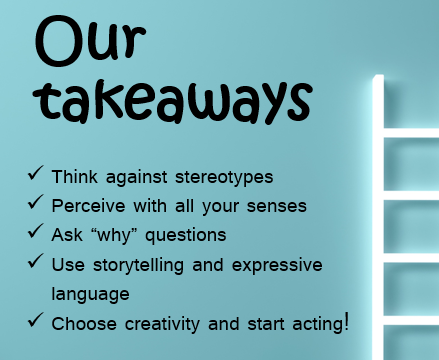
Perception with all senses is an essential form of creative thinking. If you intentionally use all your senses, you can enrich your perceptual experience and produce new and unusual combinations of ideas. Also, a key for creative thinking is the ability to take time to work with unfinished perceptions to not reach conclusions too fast. So, to be able to generate new ideas, you need to avoid stereotyping.
Asking questions can be a driver of innovation. Provocative questions such as “what makes you respond the way you do?” confront the truths and realities people tend to accept without critical reflection. Imaginative questions such as “what would happen if?” help break the ordinary reality. By asking questions, you can open a variety of answers.
Comparison is the ability to assess ideas in the context of other ideas, where you can make uncommon associations and new combinations of ideas. For example, thinking in analogies helps you to think of one thing as if it was another. By thinking in analogies, you can create novel ideas.
Language is a form of creative thinking where through using narrative thinking and expressive language you can give meaning to people’s lives and to the world. In innovation, using narrative thinking such as storytelling helps make the message of the service or product you designed more accessible to people. Use storytelling and expressive language to set a clear voice to your design.
Improve Your Creative Thinking Skills
#1 Choose creativity
Creative people have one thing in common: they decided to be creative (Sternberg). Deciding for creativity does not guarantee that creativity will emerge, but without the decision, it certainly will not. So, make the decision to be creative, try to find your own way, and look for ideas that are both novel and useful in some way.
#2 Expose yourself to new ideas
“If you want a good idea, start with a lot of ideas“, said Linus Pauling. Try to have an open mind for different ideas and apply beginner’s mind to something you do every day. Never fall in love with the first ideas since the first ones are never original ones. Search actively out for inspiration. Try to stay inspired and turn creativity into a habit. Keep in mind that quantity matters!
#3 Understand the needs of end-users
Creativity and innovation need empathy, the ability to see an experience through another person’s eyes and to recognize why people do what they do. Try to observe the persons you are creating for. Do observations in the field to gain more information about how people really act and what are their non-obvious, latent needs. And when you spot a contradiction between what you see and what you expect, it’s a sign that you should dig deeper.
#4 Ask “Why” and “How” questions
Learn more and go deeper by asking questions like “why” or “what if”. As stated earlier, questions can be drivers of innovation and get you to the heart of the matter. Always try to ask five “why” questions. Ask questions from different people and different age groups. In addition, questions may help you to reframe your challenges. Asking “How might we….” may lead you to find the right question that needs to be answered.
#5 Collaborate your ideas with others
Many of the best ideas result from collaborating with other people. You don’t have to generate all the ideas on your own. Figure out how you can have your own advisory board – it might be a temporary one for a single project or a more permanent one. Build your own creative support network.
Written by Riikamaria Vartiainen and Marika Malmström
Credits
Tschimmel, K. (2022) “Creativity, Design and Design Thinking – a ménage à trois”. Perspectives in Design II: Research, Education and Practice II “Series in Design and Innovation” Springer International Publishing (in print).
Tschimmel, K. (2022) “Design vs. Design Thinking”. In Creativity and Innovation Affairs (in process).
Tschimmel K, Design Thinking Master Class 3.- 4.9.2021 materials. Laurea University of Applied Sciences.
Kelley, D. & Kelley, T. (2013) Creative Confidence: Unleashing the Creative Potential Within Us All. Crown Business.
David Kelley (2012): How to build your creative confidence. TED Talk


Leave a comment