

Service design is now sexy. Pretty much any enterprise or organisation flirts with hot words as “service thinking” or “service design”. As a skill on one’s CV it can employ a person. However, rare people really know what the discipline is really about. I came across service design by accident while puzzling how to help generalist graduates to employ better (haavi.info) and ended to be amazed by the versatility of the discipline.

During the lectures of design thinking on 8-9th September it became evident that, as a hot discipline, it is also a great business for consultants creating their own methodology and tools of service thinking and service design. There are multiple, more or less “easy-to-implement”, design process tools that are sold to enterprises and organisations wanting to “trim” their activities. However, the prices of mainly short, intensive courses are sky high and normally paid by companies for their current employees. Other, much arduous, option is to do a university degree connected to service design – something our class is after.
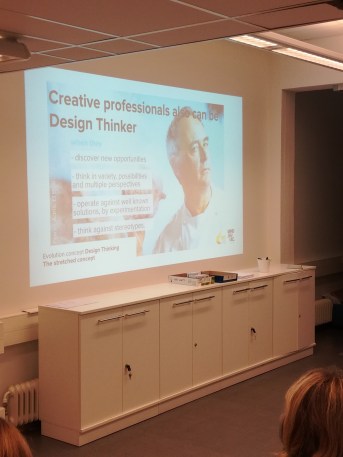
The composition of backgrounds of our service design class offers a fruitful background for student projects. Humanities, political science, economics, philology, natural sciences, information technology and pedagogy – the academic degrees vary a lot. Same applies to career histories and age difference (however, not to gender balance!). By Tschimmel (Tschimmel 2012), this heterogeneity provides different views and brings together multiple expertise guaranteeing novel solutions for problems.
Naturally, as a generalist it is to identify how humanities, pedagogy and political science offer a sound background for service design. They are highly multidisciplinary and the critical thinking provides good insights to questions in hand. On the other hand, I believe it is the conceptualising, prototyping and visualising (that Tschimmel also calls for) that are valuable new skills for academic generalists.
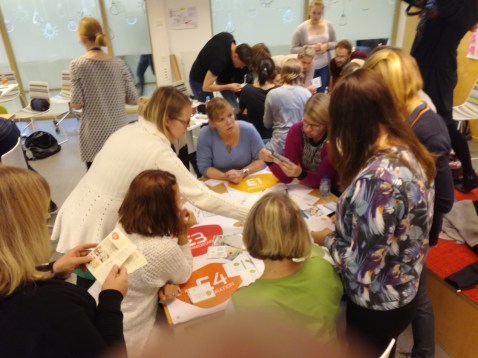
Although, it is easy to recognise what your own discipline has to offer, the other disciplines like economics and natural sciences are just as important. I like how Mootee describes the requirements of novel design thinking: “Design thinking is the search for a magical balance between business and art, structure and chaos, intuition and logic, concept and execution, playfulness and formality, and control and empowerment.” (Mootee 2013).
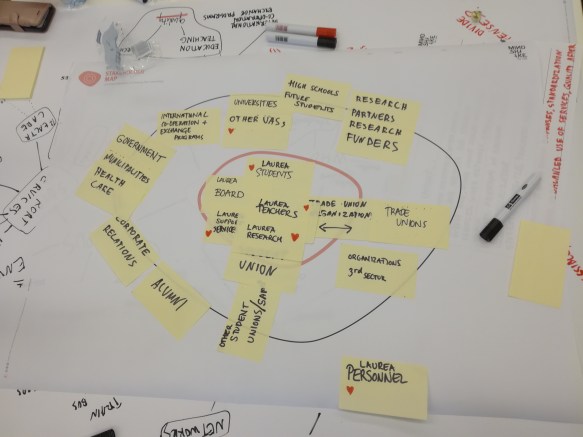
Mootee stresses the importance of design in business life. However, there were quite a few students with a professional background in public services, organisations or government. It should be pointed out that the same customer based creative mind-set can, and also should, be applied to public sphere. If one thinks of Mootee’s characteristics of design thinking oriented organisations (Human-centric, Speed and agility, Adaptable and flexible, Inspired, Disruptive, Passionate, Purposeful, Creative and innovative, Connected and flat, Fun and playful, Committed, High-energy and Risk-taking, Mootee 2013), the general opinion would not include many institutions of public sector to carry them.
Service thinking is a mixture of art and science. Novel ideas and future oriented solutions are co-created in conceptualising, prototyping and experimenting. The design process benefits from richness of backgrounds and open dialogues. Let them flourish!
Sources:
Design Thinking course 8.-9.9.2017, Laurea University of Applied Sciences, Espoo.
Mootee, Idris, Design Thinking for Strategic Innovation: What They Can’t Teach You at Business or Design School, John Wiley & Sons, 2013.
Tschimmel, Katja, Design Thinking as an effective Toolkit for Innovation in Proceedings of the XXIII ISPIM Conference: Action for Innovation: Innovating from Experience, Barcelona, 2012.


Leave a comment