
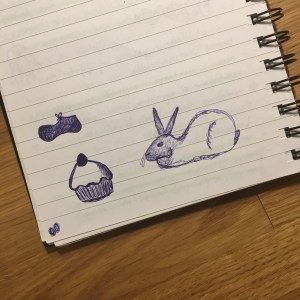
For me creativity has quite a long time meant being good at drawing, painting or writing poems. My confidence in my own creativity has not been too strong.
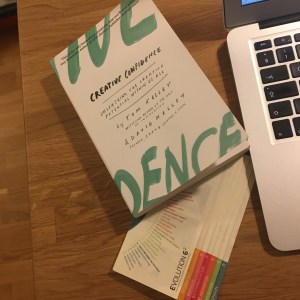
I started my studies a few weeks ago in SID programme. After the first workshop, I pondered my choice to apply to Laurea and the process that led me to it. After reading the book Creative Confidence (Kelley D. & Kelley T., 2013), I learned that creativity is not about being artistic but more about “the ability to come up with new ideas and the courage to try them out”. At the end of the day, I realized that my decision to apply to Laurea was actually a creative one and it was an outcome of stages that are similar to design thinking.
There are different models describing the stages of design thinking oriented processes. In the course ’Design Thinking’ Katja Tschimmel described Mindshake’s Evolution 6² model that consists of six stages. In these stages there are different kinds of tools described also in Research Report D-Think (Tschimmel et al. 2015). Here I’ve applied that model and some of the tools to the process I went through.
Who are you and what do you want?
The first stage in the model is Emergence which consists of identification of an opportunity. In 2016 I took part in a mentoring program. The process started by identification of the themes and opportunities to be handled with my mentor: to find an inspirational course for my career. As a part of the process I wrote a letter to my future self. This letter served as an intent statement describing my goals, opportunities and the value I was hoping to perceive during the process.
As the process started with my mentor, we discussed about my skills, hidden talents, needs and fears. Based on the discussions I used SWOT analysis based matrix to visualize the key internal strengths & weaknesses and external opportunities & threats related to my overall goal. This analysis served as a kind of an insight/empathy map. This second stage is Empathy i.e. knowing what is the context.

Got any ideas?
Generating ideas is the next stage called Experimentation. Based on the previous stages I started to list different opportunities ranging from moving to Thailand to teach scuba diving to copywriting and new studies. I used brainwriting as a tool to collect all my opportunities and ideas on paper and to categorize them.
Stage four, Elaboration, is about working on materials and semantic solutions, and hence I interviewed people of different careers about my ideas. After that I was able to do what you could call a role play: I imagined myself in different situations and positions based on my ideas and found out what would be the the pros and cons compared to my needs and persona.
Based on the previous steps I was able to identify the best concept: i.e. studying service design. The fifth stage, Exposition, communicates and visualizes the new concept. For me the visualization was a concept visualisation or ‘a treasure map’ portraying my current situation, motivations, skills and the desired outcomes i.e. the journey I wanted to take.
What next?
Now I am on the sixth stage of the Evolution 6² model called Extension that is implementing the solution. Kelley D. & Kelley T. (2013) state that “when you open your mind to the possibility that your capabilities are unlimited and unknown, you already have your running shoes on”. I feel that even after the first SID workshop my mind is more open than before. I am truly excited what opportunities and new inspirations are going to arise on my way. My personal study plan serves as a roadmap. The journey to finding my creative confidence has begun.
References
Kelley, David and Kelley, Tom (2013) Creative Confidence: Unleashing the Creative Potential Within Us All. Crown Business.
Tschimmel, Katja; Santos, Joana; Loyens, Dirk; Jacinto, Alexandre; Monteiro, Rute & Valenca, Mariana 2015. Research Report D-Think.


Leave a comment